


Understanding how medications affect the body requires more than just memorizing drug names; it requires an understanding of where those drugs act. The Autonomic Nervous System (ANS) regulates involuntary functions like heart rate, breathing, and digestion through two primary divisions: the sympathetic and parasympathetic systems. Because these systems use specific receptors to communicate with organs, the location of a receptor determines the physiological response when a medication binds to it.
The Autonomic Nervous System Framework
The ANS operates through a balance of "fight or flight" (sympathetic) and "rest and digest" (parasympathetic) activities.
- Sympathetic Activity: Generally prepares the body for action. It increases heart rate and contractility, dilates the airways (bronchodilation), and promotes pupil dilation.
- Parasympathetic Activity: Generally promotes conservation and restoration. It slows the heart rate, constricts airways, increases gastrointestinal motility, and promotes bladder emptying.
A critical clinical distinction is that a medication's effect depends entirely on the specific receptor it hits and the organ where that receptor is located. For example, a drug might affect the heart and the lungs simultaneously, but the specific "feeling" or physiological change will differ based on the receptor subtype present in those tissues.

Autonomic Receptors: The Targets of Pharmacology
Receptors are the "locks" that medications (the "keys") turn to produce an effect. In the autonomic system, we focus on several major types:
Adrenergic Receptors (Sympathetic)
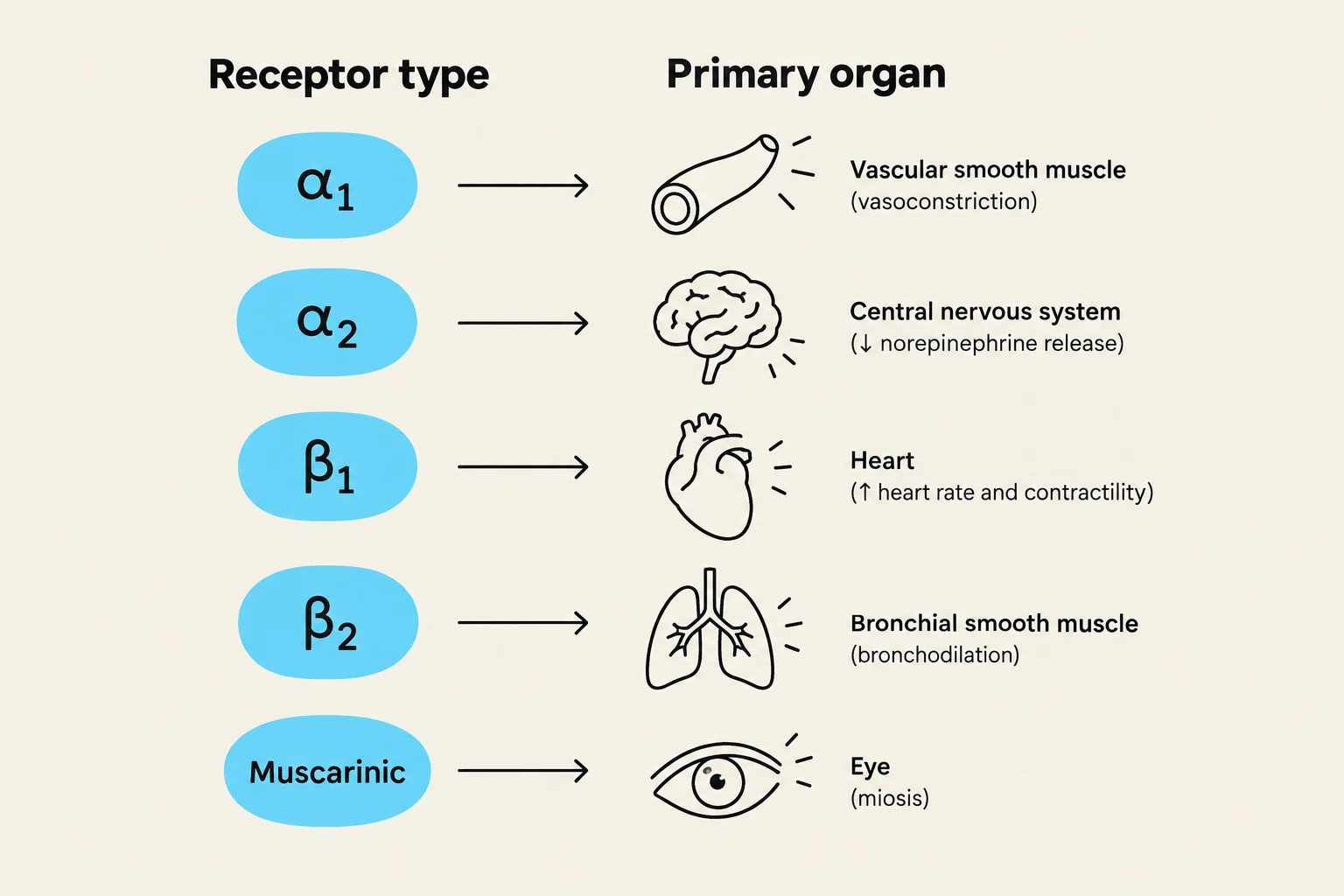
- Alpha-1 (): Located on vascular smooth muscle. Activation causes vasoconstriction.
- Alpha-2 (): Located centrally in the brain. Activation actually reduces sympathetic outflow, which can lower blood pressure.
- Beta-1 (): Located primarily in the heart. Activation increases heart rate and contractility.
- Beta-2 (): Located in the bronchial smooth muscle. Activation promotes bronchodilation (opening the airways).
Keep reading for free.
Create an account to finish this reading and make it part of your study routine.
Continue reading freeAlready have an account? Log in
Updated