An examination of the social, religious, and financial reforms implemented by Augustus to stabilize the Roman Empire after decades of civil war, focusing on the ideology of mos maiorum, moral legislation, religious restoration, and administrative restructuring.
Following decades of violent civil wars and the collapse of the Roman Republic, the transition to the Roman Empire required more than just military victory; it required a fundamental restructuring of Roman society. When Octavian emerged as the sole leader following the Battle of Actium in 31 BCE, he faced a civilization that was politically fractured and morally exhausted. To stabilize his rule, he adopted the persona of a restorer rather than a conqueror, implementing a sweeping program of social, religious, and financial reforms designed to return Rome to its perceived former glory.
The Ideology of Mos Maiorum
At the heart of Augustus’s entire reform agenda was the concept of mos maiorum, or "the way of the ancestors". This was not merely a nostalgic sentiment; it was a political tool used to justify his unprecedented concentration of power. By framing his actions as a return to traditional Roman values, Augustus could claim he was "restoring the Republic" even as he was effectively ending it.
This ideology emphasized discipline, piety, and strict social hierarchies. Augustus believed that the chaos of the late Republic had been caused by a departure from these ancestral customs. Therefore, to ensure the stability of the empire, he felt compelled to legislate morality and revive the spiritual life of the state.
Moral Legislation and Social Control
To address what he perceived as the moral decay of the Roman elite and the general population, Augustus introduced specific legislation aimed at regulating private behavior and strengthening the family unit.
Regulation of Adultery
One of the most controversial aspects of his social program was the crackdown on infidelity. Augustus sought to criminalize adultery, placing a disproportionate burden on women. Under these laws, husbands were legally required to report and punish their wives for infidelity. This created a significant social double standard: while women were strictly policed, men were permitted to engage in extramarital affairs, provided they did not involve other married women.
Pro-natalist Policies and Birth Rates
Augustus was also deeply concerned with the declining birth rates among the Roman upper classes, which he viewed as a threat to the future of the state. To combat this, he implemented pro-natalist incentives to encourage larger families.
Example: The Incentive for Large Families
To encourage childbearing, Augustus introduced rules where free-born women who bore more than three children could escape certain legal requirements, such as the need to have custodians.
Religious Restoration and Public Image
Augustus understood that a stable empire required a stable relationship with the gods. The civil wars had left many of Rome's sacred spaces in a state of neglect. As part of his religious restoration, Augustus undertook a massive program to repair numerous temples and religious sites that had fallen into disrepair.
This rejuvenation served two purposes:
Spiritual Foundation: It strengthened the cultural and spiritual ties that bound Romans to their traditions.
Political Propaganda: By associating himself with the gods and the restoration of sacred spaces, Augustus elevated his own status. He used coinage to promote his image as the "son of a god" (Divi Filius), leveraging the deification of Julius Caesar to cement his own divine legitimacy.
Financial and Administrative Restructuring
While moral and religious reforms addressed the "soul" of Rome, Augustus knew that the "body" of the empire required efficient management to prevent further collapse. He implemented significant financial system reforms to ensure long-term stability.
Taxation and the End of Corruption
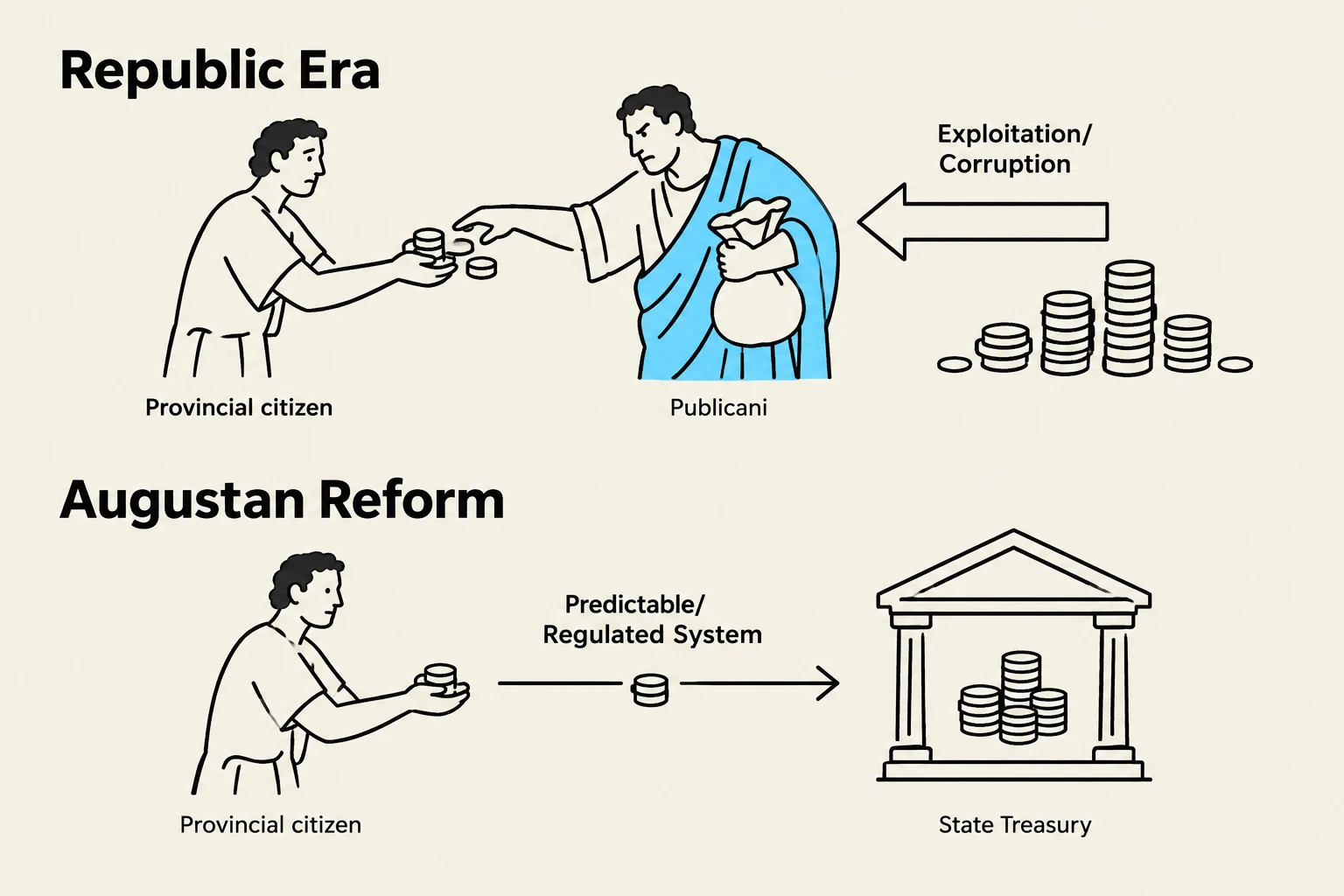
This illustration contrasts the Republic Era, where provincial citizens paid taxes to Publicani leading to exploitation and corruption, with the Augustan Reform, which established a predictable and regulated system for tax collection into the State Treasury.
One of the most effective changes was the reform of the taxation system. During the Republic, tax collection was often outsourced to publicani—private tax collectors who were notorious for exploiting provincial populations to maximize their own profits. This corruption had caused immense friction between Rome and its provinces. Augustus worked to curb this exploitation, creating a more predictable and less predatory system that helped stabilize the relationship between the central government and its territories.
Administrative Efficiency
To facilitate better governance, Augustus also focused on administrative restructuring within the city of Rome itself:
Urban Division: He redivided Rome into new neighborhoods to improve organization.
Census Reform: He improved the census process, which was essential for accurate population counts and efficient tax collection throughout the empire.
💡 Study Tip: The "Two Sides" of Augustus
When analyzing Augustus for an exam, remember his dual approach. He used soft power (religious restoration, mos maiorum, and moral legislation) to win cultural legitimacy, and hard power (taxation reform, administrative restructuring, and military control) to ensure the practical functioning of the state.
Through these multifaceted reforms, Augustus successfully transitioned Rome from a period of violent, unpredictable instability into a structured, disciplined, and administratively sound empire.
Keep reading for free.
Create an account to finish this reading and make it part of your study routine.