Explains the fundamental structure of atoms, including subatomic particles (protons, neutrons, electrons), atomic number, mass number, and the concept of isotopes. It also covers valence electrons and their role in chemical behavior and bonding.
Everything in the physical universe, from the air you breathe to the cells in your body, is composed of matter. At the most fundamental level of this matter lies the atom. An atom is the smallest particle of an element that retains the unique properties of that element. While atoms are incredibly small, understanding their internal architecture is the key to unlocking the mysteries of chemistry and biology.
The Architecture of the Atom
An atom is not a solid, indivisible sphere; rather, it is composed of much smaller subatomic particles organized into two distinct regions: a dense central core and an expansive outer region.
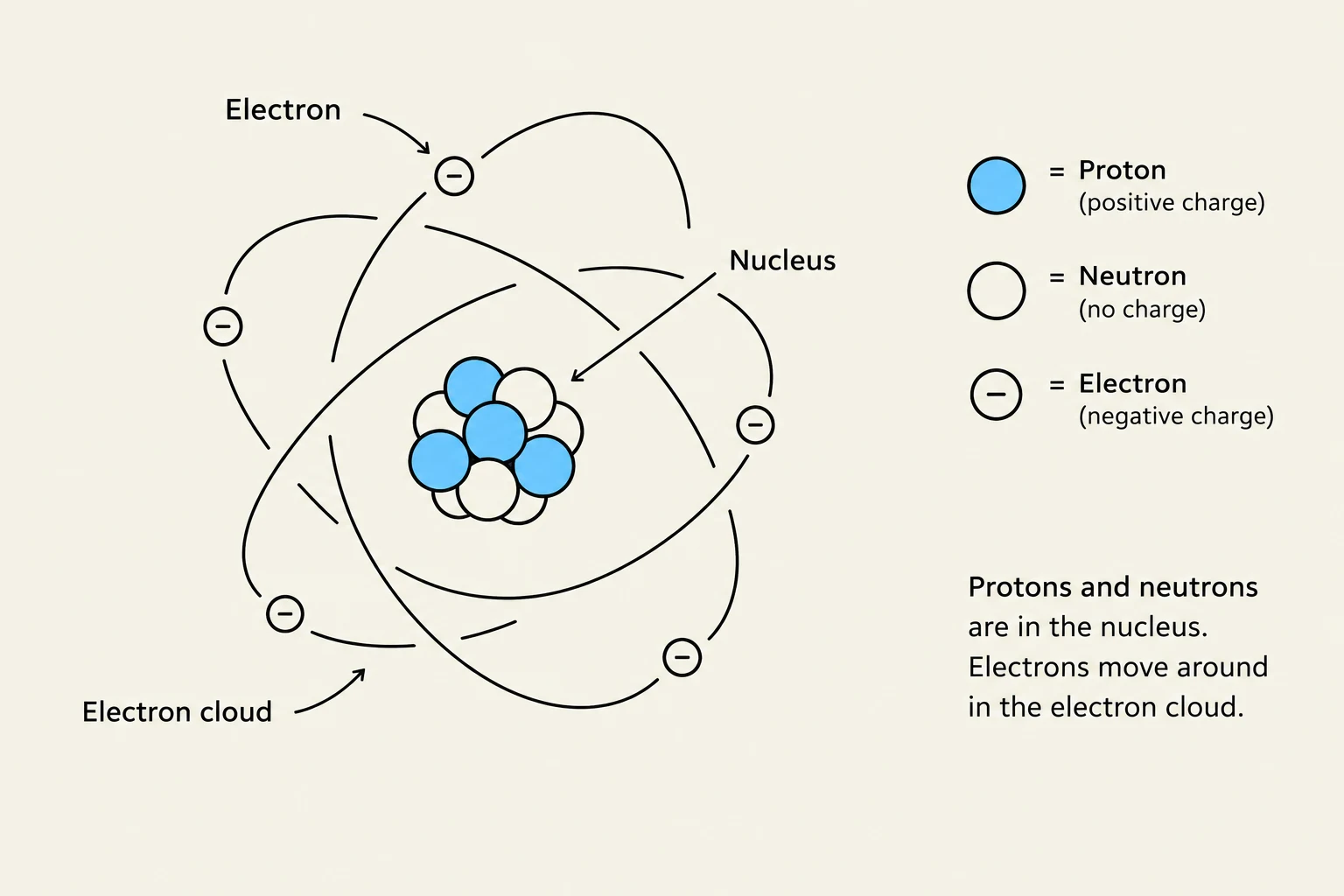
The center of the atom is the nucleus. Despite its tiny size relative to the whole atom, the nucleus contains almost all of the atom's mass. Surrounding this nucleus is the electron cloud, a region where electrons reside in specific energy levels. To visualize this scale, imagine an atom was expanded to the size of an orange; the nucleus would be no larger than a marble sitting in the center, while the rest of the volume would be mostly empty space.
This diagram illustrates the basic structure of an atom, showing a nucleus containing protons and neutrons, surrounded by an electron cloud of orbiting electrons.
Subatomic Particles
The behavior and identity of an atom are determined by three primary subatomic particles:
Protons (p+): Located in the nucleus, protons carry a +1 charge and have a mass of 1 AMU (atomic mass unit).
Neutrons (n0): Also located in the nucleus, neutrons carry no charge (neutral) and also have a mass of 1 AMU.
Electrons (e−): Located in the electron cloud, electrons carry a −1 charge. Their mass is considered negligible (0 AMU) compared to protons and neutrons.
Exam Tip: In a neutral atom, the number of positively charged protons must exactly equal the number of negatively charged electrons.
Defining the Element: Atomic Number and Mass
How do we distinguish one element from another? The answer lies in the number of protons.
Atomic Number
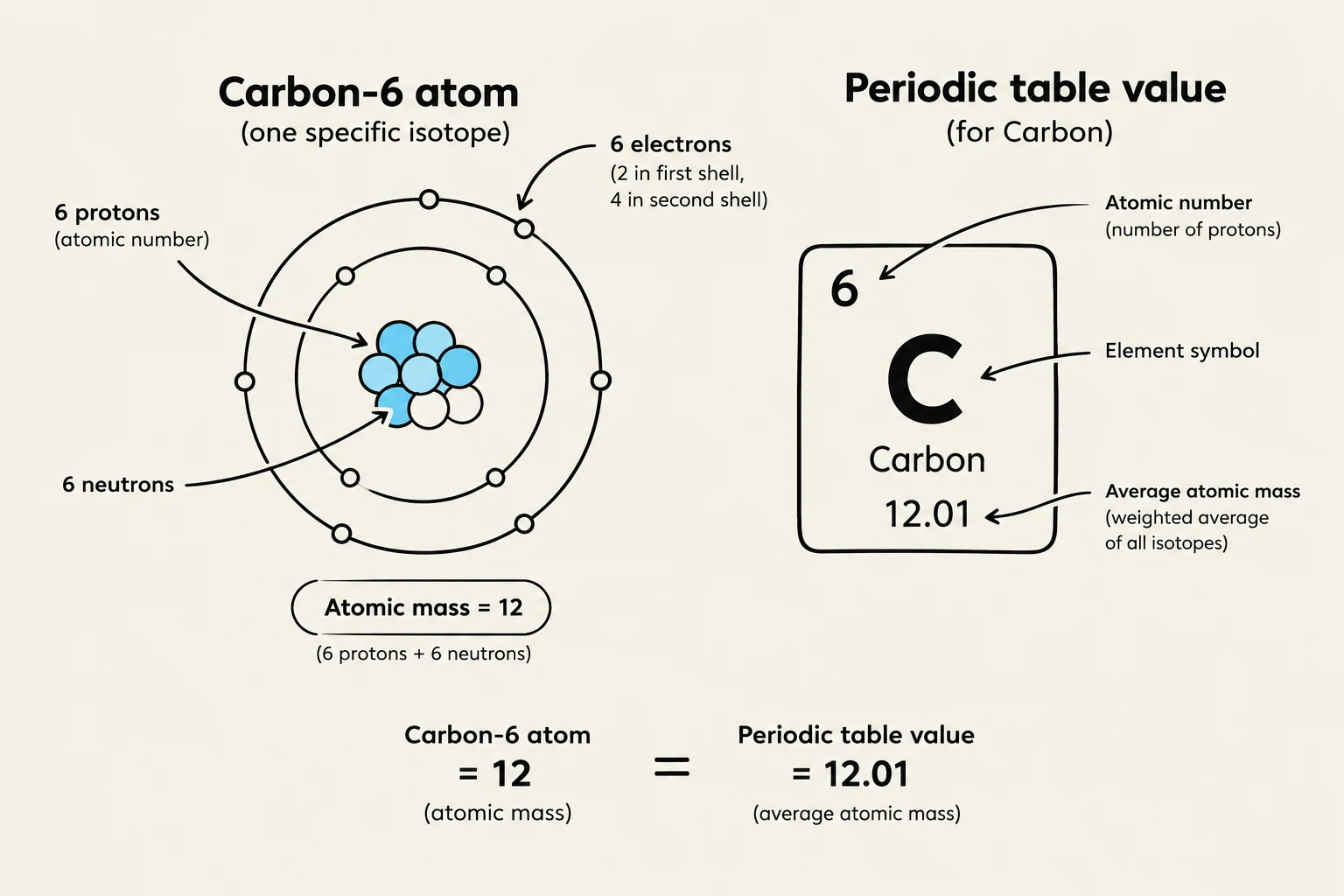
The atomic number is the number of protons in the nucleus. This number is unique to each element; no two elements share the same atomic number. For example, every hydrogen atom has an atomic number of 1 because it contains exactly one proton. Because the atom is neutral, the atomic number also tells us the number of electrons present.
Mass Number and Atomic Mass
While the atomic number is constant for an element, the mass of individual atoms can vary.
Mass Number: This is the sum of the protons and neutrons in a single atom's nucleus. You can calculate the number of neutrons using this formula:
mass number−atomic number=number of neutrons
Atomic Mass: This is the specific sum of protons and neutrons for one specific atom.
Atomic Weight: Because elements exist in nature as a mixture of different versions, the atomic weight listed on the periodic table is the weighted average of the atomic masses of all naturally occurring isotopes of that element.
This illustration explains the atomic structure of a Carbon-6 atom, detailing its protons, neutrons, and electrons, and contrasts it with the information presented for Carbon on the periodic table, including atomic number, element symbol, and average atomic mass.
Isotopes: Variations on a Theme
Isotopes are atoms of the same element that possess the same atomic number (the same number of protons) but different mass numbers because they contain different numbers of neutrons.
Because they have the same number of protons and electrons, isotopes of an element share the same chemical identity. However, their physical properties, such as density, may differ. Isotopes can be identified by adding a hyphen after the element name (e.g., carbon-14) or by using a nuclear symbol.
Radioactive Isotopes and Practical Applications
Some isotopes are unstable, a property known as being radioactive. These isotopes are incredibly useful in science and medicine:
Carbon Dating: Using the isotope carbon-14 to determine the age of organic materials.
Medicine: Used in specialized treatments, such as cancer therapy.
Biological Tracers: Used to track the movement of substances within living organisms.
Food Preservation: Used to kill bacteria that cause food to spoil.
Chemical Behavior and Valence Electrons
While the nucleus defines the element, the electrons define how that element interacts with others. Specifically, the most important electrons are the valence electrons. These are the electrons located in the outermost energy level (the valence shell) of the atom.
Valence electrons are the primary drivers of chemical behavior; they are the electrons available to form chemical bonds between atoms. Whether an atom forms an ionic bond by transferring electrons or a covalent bond by sharing them depends entirely on its valence electron configuration.
Worked Example: Calculating Subatomic ParticlesProblem: An atom of copper has an atomic number of 29 and a mass number of 64. How many protons, electrons, and neutrons does it have?
Solution:
Protons: The atomic number is the number of protons. Therefore, there are 29 protons.
Electrons: In a neutral atom, electrons = protons. Therefore, there are 29 electrons.
Neutrons: Use the formula mass number−atomic number=neutrons.
64−29=35
There are 35 neutrons.
Keep reading for free.
Create an account to finish this reading and make it part of your study routine.