Atomic Structure and Isotopes: The Building Blocks of Matter
Explore the fundamental components of atoms: protons, neutrons, and electrons. Understand how atomic number defines an element and how mass number relates to isotopes, with examples like hydrogen and carbon.
Everything in the universe, from the screen you are reading this on to the air you breathe, is composed of matter. At the most fundamental level, matter is organized into tiny, discrete units called atoms. While an atom is incredibly small, its internal architecture determines the identity, stability, and behavior of every element in the periodic table. Understanding how these particles interact is the first step in mastering chemistry.
The Anatomy of an Atom
Diagram illustrating the internal structure of a neutral atom, showing the nucleus composed of protons and neutrons, surrounded by an electron cloud of electrons.
An atom is not a solid, indivisible sphere; rather, it is a complex system composed of three primary subatomic particles: protons, neutrons, and electrons. These particles are organized into two distinct regions: a dense central nucleus and a vast, surrounding electron cloud.
The Nucleus: Protons and Neutrons
At the very center of the atom lies the nucleus. Despite containing most of the atom's mass, the nucleus occupies only a tiny fraction of the atom's total volume. It is composed of two types of particles known as nucleons:
Protons: These particles carry a positive electrical charge (+1). The number of protons in the nucleus is the most critical value in chemistry because it defines the identity of the element. For example, any atom with exactly 6 protons is Carbon, regardless of its other properties.
Neutrons: These particles are electrically neutral, meaning they carry no charge. They act as a sort of "nuclear glue," helping to stabilize the nucleus by buffering the repulsive forces between positively charged protons.
The Electron Cloud: Electrons
Surrounding the nucleus is a region of space inhabited by electrons. Electrons carry a negative electrical charge (−1) and are significantly lighter than protons and neutrons—so light, in fact, that their mass is often considered negligible when calculating the total mass of an atom.
In a neutral atom, the number of electrons is exactly equal to the number of protons. This balance ensures that the total positive charge of the nucleus is canceled out by the total negative charge of the electrons, resulting in a net charge of zero.
Exam Tip: If a question asks you to identify an element, look only at the number of protons (the atomic number). The number of electrons or neutrons can change, but the proton count is the element's unique "fingerprint."
Defining Elements: Atomic Number and Mass Number
This diagram illustrates the atomic nucleus, showing protons and neutrons. It defines Atomic Number (Z) as the number of protons and Mass Number (A) as the sum of protons and neutrons, using an example of an atom with 6 protons and 7 neutrons.
To navigate the periodic table and solve chemical problems, we use two fundamental values derived from the subatomic particles: the Atomic Number and the Mass Number.
The Atomic Number (Z)
The atomic number represents the number of protons in the nucleus of an atom. It is the fundamental organizing principle of the periodic table.
The Mass Number (A)
While the atomic number tells us which element we are looking at, the mass number tells us how heavy that specific atom is. The mass number is the sum of the protons and neutrons in the nucleus.
We can express this relationship with a simple formula:
A=Z+N
Where:
A is the Mass Number
Z is the Atomic Number (protons)
N is the number of neutrons
Worked Example: Calculating Subatomic Particles
Suppose you are given an atom of Phosphorus with an atomic number of 15 and a mass number of 31. How many protons, neutrons, and electrons does it have?
Protons: The atomic number is 15, so there are 15 protons.
Electrons: Since the atom is neutral, the number of electrons equals the number of protons. Therefore, there are 15 electrons.
Neutrons: Use the mass number formula:
N=A−ZN=31−15=16
There are 16 neutrons.
Isotopes: Variations in the Nucleus
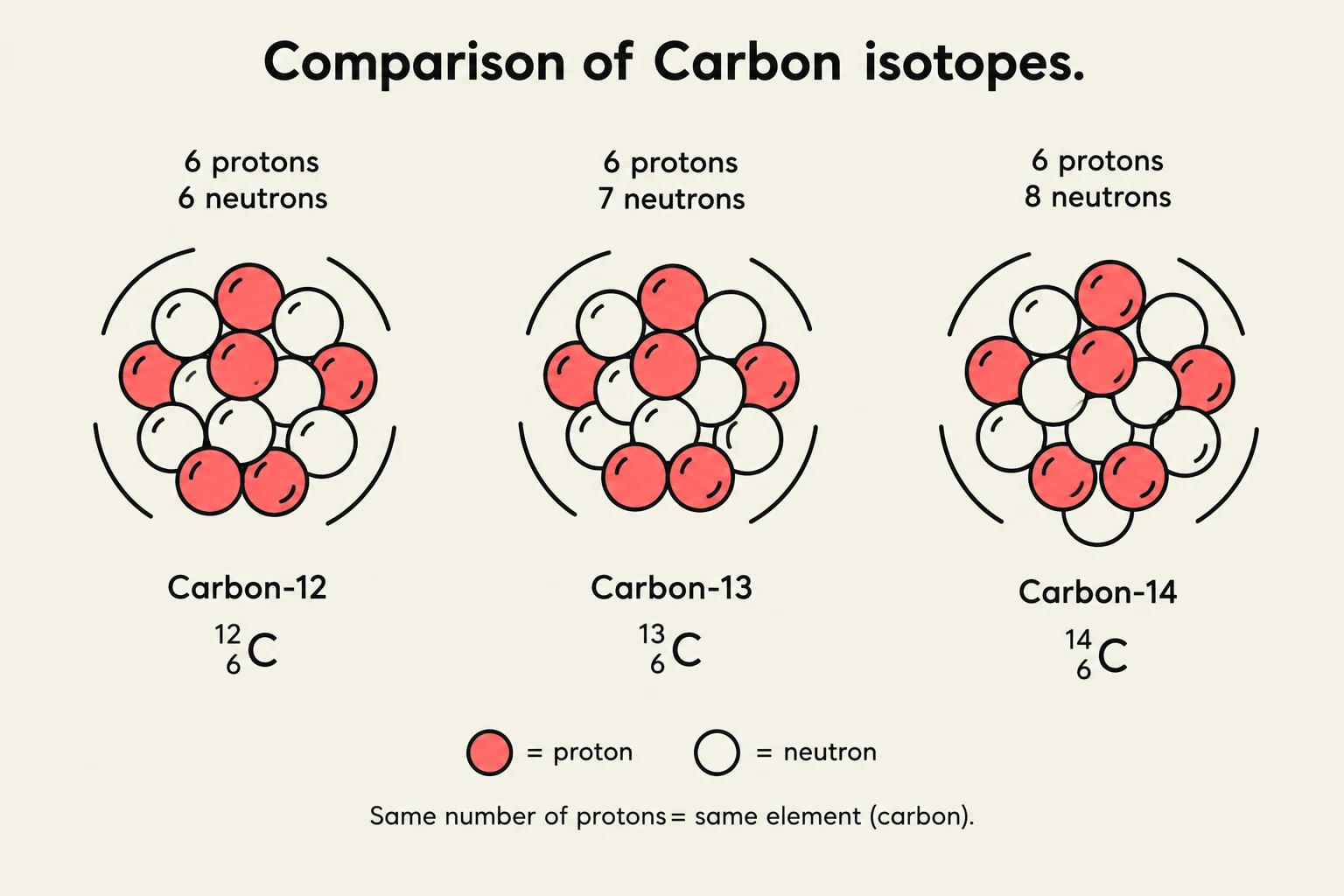
This diagram illustrates the atomic structure of three carbon isotopes: Carbon-12, Carbon-13, and Carbon-14. Each isotope has 6 protons, but they differ in the number of neutrons (6, 7, and 8, respectively). The diagram also shows that having the same number of protons defines an element as carbon.
You may have noticed that the "atomic mass" listed on the periodic table is often a decimal (like Carbon being 12.011) rather than a whole number. This is because of isotopes.
Isotopes are atoms of the same element that have the same number of protons but a different number of neutrons. Because they have the same number of protons, isotopes of an element behave almost identically in chemical reactions. However, because they have different numbers of neutrons, they have different physical masses.
Common Examples of Isotopes
Hydrogen: Hydrogen is unique because its isotopes are often given special names.
Protium: 1 proton, 0 neutrons (the most common form).
Deuterium: 1 proton, 1 neutron (often used in specialized research).
Tritium: 1 proton, 2 neutrons (radioactive).
Carbon:
Carbon-12: 6 protons, 6 neutrons (stable and most abundant).
Carbon-14: 6 protons, 8 neutrons (radioactive, used in radiocarbon dating).
Summary Table: Comparing Isotopes of Carbon
Isotope
Protons (Z)
Neutrons (N)
Mass Number (A)
Carbon-12
6
6
12
Carbon-13
6
7
13
Carbon-14
6
8
14
Conclusion
The structure of the atom is a delicate balance of forces. The protons and neutrons provide the mass and stability within the nucleus, while the electrons dictate how the atom interacts with its neighbors. By understanding the relationship between these particles—and recognizing how variations in neutron count create isotopes—you gain the ability to predict the identity and properties of the matter that makes up our world.
Keep reading for free.
Create an account to finish this reading and make it part of your study routine.