Explains atmospheric stability, the physics of rising air, adiabatic lapse rates (dry and saturated), and how environmental lapse rates determine atmospheric states (absolute instability, conditional instability, absolute stability). Discusses mechanisms generating instability like surface warming and upper-level cooli
In meteorology, understanding why air moves vertically is fundamental to predicting weather, from gentle cloud formation to violent thunderstorms. At the heart of this movement is the concept of atmospheric stability—a measure of how an air parcel responds to being moved from its original position. If a displaced parcel of air tends to return to its original level, the atmosphere is considered stable; if it continues to rise or sink further away from its starting point, the atmosphere is unstable.
The Physics of Rising Air
To understand stability, we must first understand why air cools as it rises. As an air parcel ascends, the surrounding atmospheric pressure decreases. This lower pressure allows the air molecules within the parcel to push outward, causing the parcel to expand. Because this expansion requires energy, the internal kinetic energy of the molecules decreases, which manifests as a drop in temperature.
The rate at which this cooling occurs depends on whether the air is dry or saturated:
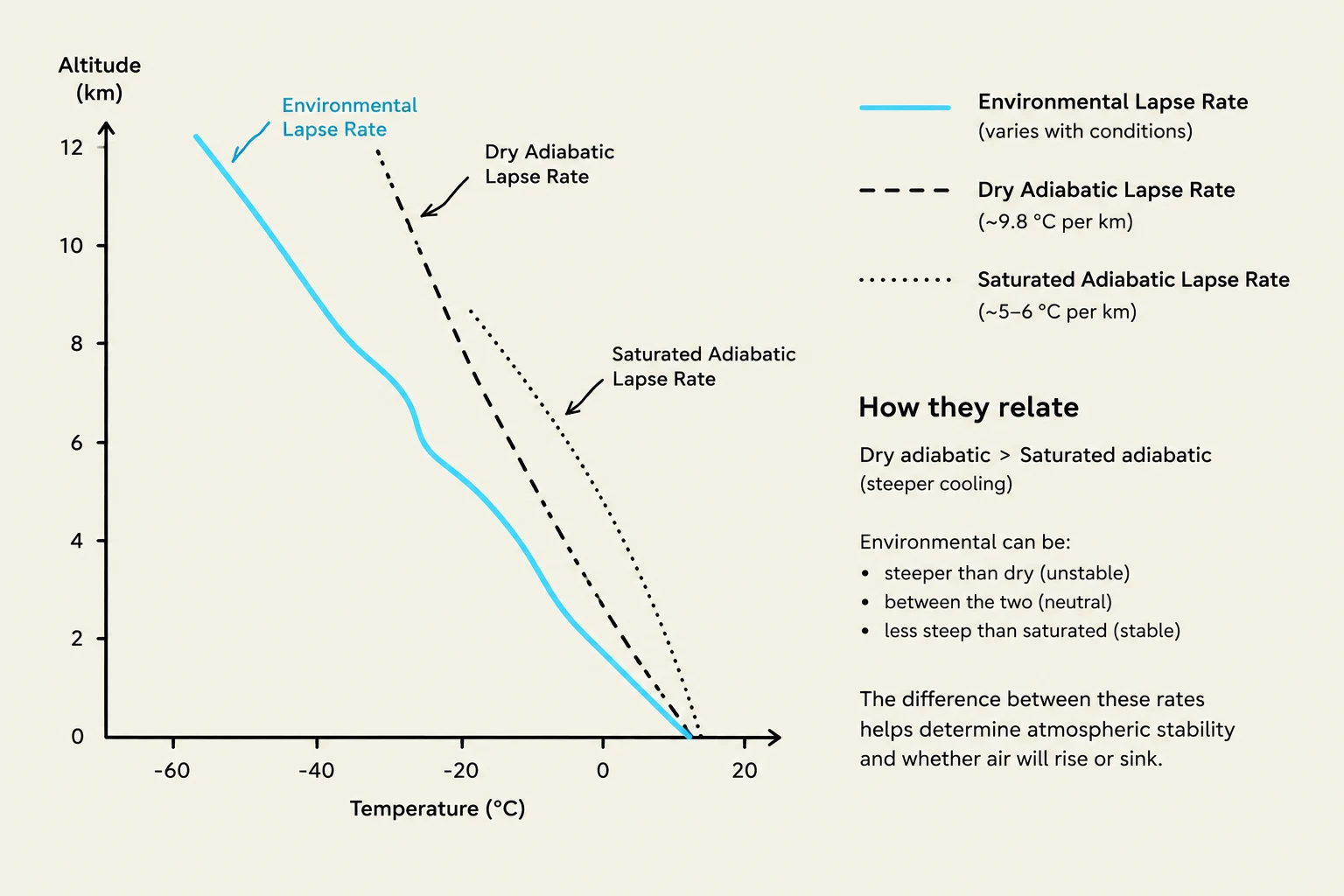
Dry Adiabatic Lapse Rate (DALR): An unsaturated dry parcel cools at a rate of approximately 9.8∘C/km.
Saturated Adiabatic Lapse Rate (SALR): Once a parcel reaches its dew point and becomes saturated air, condensation begins. This process releases latent heat into the parcel, which partially offsets the cooling caused by expansion. Consequently, saturated parcels cool more slowly, typically at a rate of 4–7∘C/km.
Exam Tip: Always distinguish between the "parcel lapse rate" (how the air inside the bubble cools) and the "environmental lapse rate" (how the actual atmosphere cools with height). Stability is determined by comparing these two values.
This diagram illustrates the concept of a rising air parcel and the dry adiabatic lapse rate. As an air parcel ascends, it expands and cools due to decreasing atmospheric pressure, a process known as adiabatic cooling. The graph shows how the temperature of a rising parcel decreases with altitude compared to the environmental lapse rate.
Categorizing Stability
The stability of the atmosphere is determined by the environmental lapse rate (ELR)—the actual temperature change of the surrounding air with height. We categorize the atmosphere into three main states based on how the ELR compares to the dry and saturated rates:
1. Absolute Instability
Absolute instability occurs when the environmental lapse rate is very steep—specifically, when the ELR is greater than the dry adiabatic lapse rate (e.g., ≈11∘C/km). In this scenario, whether a parcel is dry or saturated, it will always be warmer (and thus less dense) than its surroundings after being lifted. This creates positive buoyancy, causing the air to rise spontaneously.
2. Conditional Instability
This is perhaps the most common state for significant weather development. In a conditionally unstable environment, the ELR falls between the saturated and dry rates (e.g., 6∘C/km<ELR<10∘C/km).
A dry parcel lifted in this environment will initially be cooler than its surroundings and will resist upward movement.
However, if the parcel is forced upward (by a mountain or a front) until it reaches saturation, the slower cooling rate of the saturated air may eventually make the parcel warmer than the environment.
Once this happens, the parcel enters a state of free convection, where it rises on its own without further external forcing.
3. Absolute Stability
If the environmental lapse rate is very shallow (e.g., 4∘C/km), both dry and saturated parcels will become cooler and denser than their surroundings as they rise. In this state, any vertical displacement is met with a restoring force that pushes the air back to its original level.
This graph illustrates the relationship between atmospheric temperature and altitude, depicting the Environmental Lapse Rate, Dry Adiabatic Lapse Rate, and Saturated Adiabatic Lapse Rate. It explains how these rates influence atmospheric stability and air movement.
Mechanisms of Instability Generation
Instability is not a static condition; it can be generated or enhanced by changing the temperature or moisture profiles of the atmosphere.
Surface Warming
Heating the bottom layer of the atmosphere steepens the lapse rate. This can be caused by intense solar radiation on a clear day or even by extreme events like forest fires. For instance, a large fire can heat the air so intensely that it creates pyrocumulus clouds—massive clouds formed by rapidly rising, heated air and smoke.
Upper-Level Cooling
Cooling the air aloft also increases the temperature gradient between the surface and higher altitudes. A common example is cold air advection, where a cold front moves in and brings much colder air into the upper levels of the atmosphere, making the environment more unstable.
Increased Moisture Content
While moisture does not directly change the environmental lapse rate, increasing the moisture content of the air makes it easier for parcels to reach saturation. By lowering the altitude at which a parcel becomes saturated, moisture helps a parcel transition from a stable dry state to a buoyant saturated state, facilitating free convection.
Real-World Examples and Mixing
The interaction of these mechanisms creates diverse weather phenomena. In the Florida peninsula, the combination of intense daytime surface heating and high humidity creates a perfect environment for daily convective thunderstorms. Conversely, lake-effect snow bands occur when cold air flows over relatively warm water; the water heats the bottom layer of air while the air is cooled from above, generating the instability necessary for heavy snow.
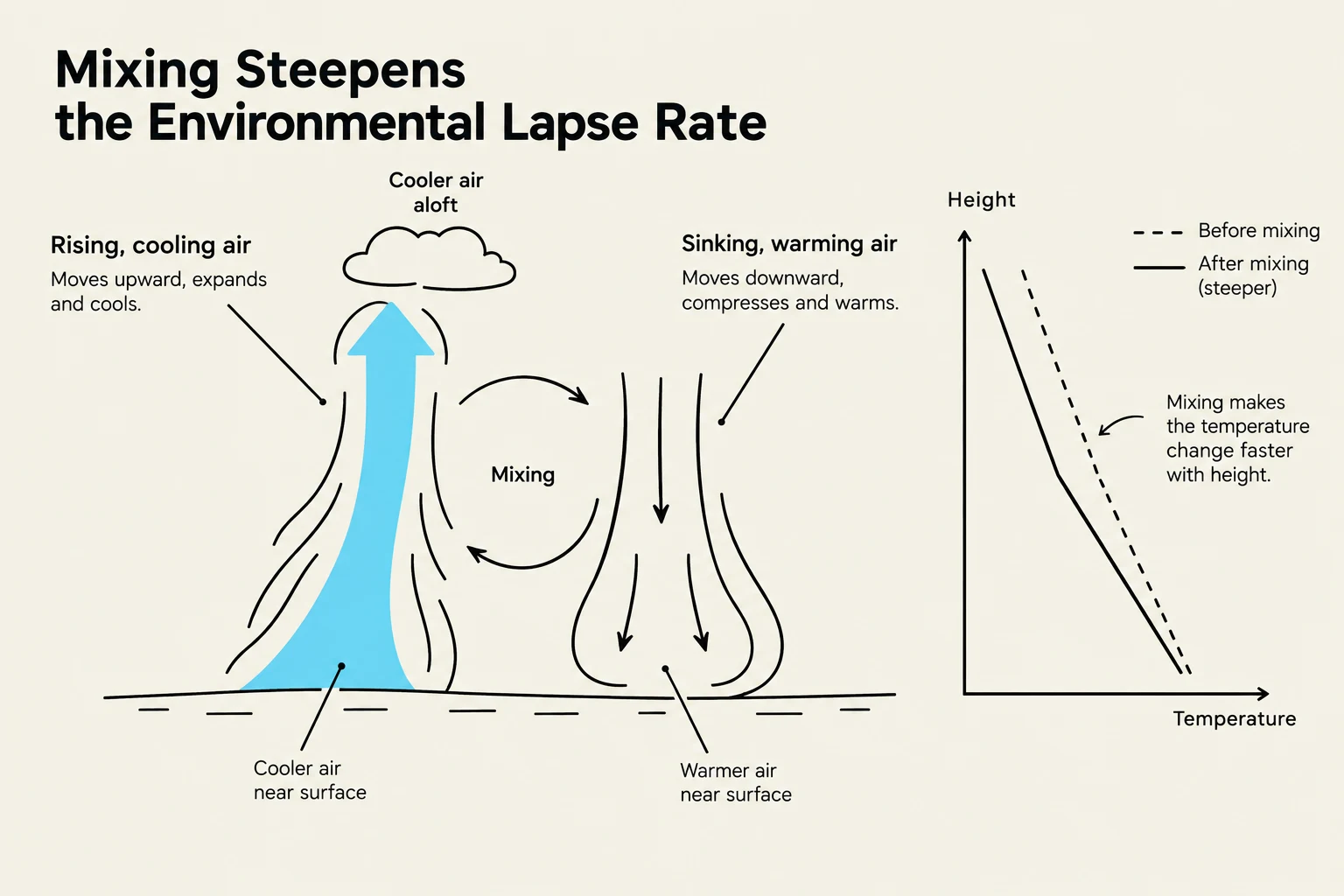
Finally, we must consider mixing. As air rises and cools, and air sinks and warms, the temperature gradient between the two layers can change. This mixing process tends to steepen the lapse rate, further influencing the stability of the local environment.
This diagram illustrates how atmospheric mixing affects the environmental lapse rate, showing rising and sinking air parcels and their corresponding temperature changes with height.
Keep reading for free.
Create an account to finish this reading and make it part of your study routine.