Explains atmospheric stability, adiabatic cooling rates, buoyancy, and the three states of stability (absolute stability, absolute instability, conditional instability) that influence cloud formation and vertical air motion.
Have you ever wondered why some days the sky remains a clear, empty blue, while on other days, massive, towering clouds erupt from the horizon? The answer lies in the invisible physics of the atmosphere—specifically, how air responds when it is moved vertically. This concept is known as atmospheric stability. By understanding the relationship between a rising air parcel and its surrounding environment, we can predict whether the atmosphere will remain calm or trigger the violent vertical motions that lead to cloud growth and storms.
The Physics of a Rising Air Parcel
To understand stability, we must first look at what happens to a single "parcel" of air when it is lifted. As a parcel rises, it moves into regions of lower atmospheric pressure. Because the pressure outside the parcel is decreasing, the air molecules inside push outward, causing the parcel to expand.
This expansion is not "free." To push against the surrounding atmosphere, the molecules within the parcel must use some of their own internal kinetic energy. Since temperature is essentially a measure of the average kinetic energy of molecules, this loss of energy results in a drop in temperature.
Adiabatic Cooling Rates
The rate at which an air parcel cools depends on whether it is saturated with water vapor or not.
Dry Adiabatic Lapse Rate: When an air parcel is unsaturated (meaning it hasn't reached its dew point), it cools at a predictable rate of approximately 9.8 °C/km.
Moist Adiabatic Lapse Rate: Once the parcel reaches its dew point, condensation begins. This phase change from gas to liquid releases latent heat into the parcel. This extra heat acts as a buffer, slowing down the cooling process. Consequently, a saturated parcel cools more slowly, typically at a rate of 4–7 °C/km in the lower troposphere.
This diagram illustrates the difference in cooling rates between unsaturated and saturated air parcels as they ascend. Unsaturated parcels cool at the dry adiabatic rate (9.8 °C/km), while saturated parcels cool more slowly at the moist adiabatic rate (~5-6 °C/km) due to latent heat release from condensation.
Buoyancy: The Driver of Motion
The movement of an air parcel is governed by buoyancy. Buoyancy is determined by comparing the density of the rising parcel to the density of the surrounding environment at the same altitude. Because density is temperature-dependent (warmer air is less dense than cooler air at the same pressure), the temperature difference is the deciding factor.
Positive Buoyancy: If the parcel is warmer than its surroundings, it is less dense and will continue to rise.
Negative Buoyancy: If the parcel is cooler than its surroundings, it is denser and will sink back toward its original level.
Exam Tip: Always compare the parcel's temperature to the environmental temperature at the exact same height. Do not confuse the parcel's cooling rate with the environmental lapse rate!
The Three States of Stability
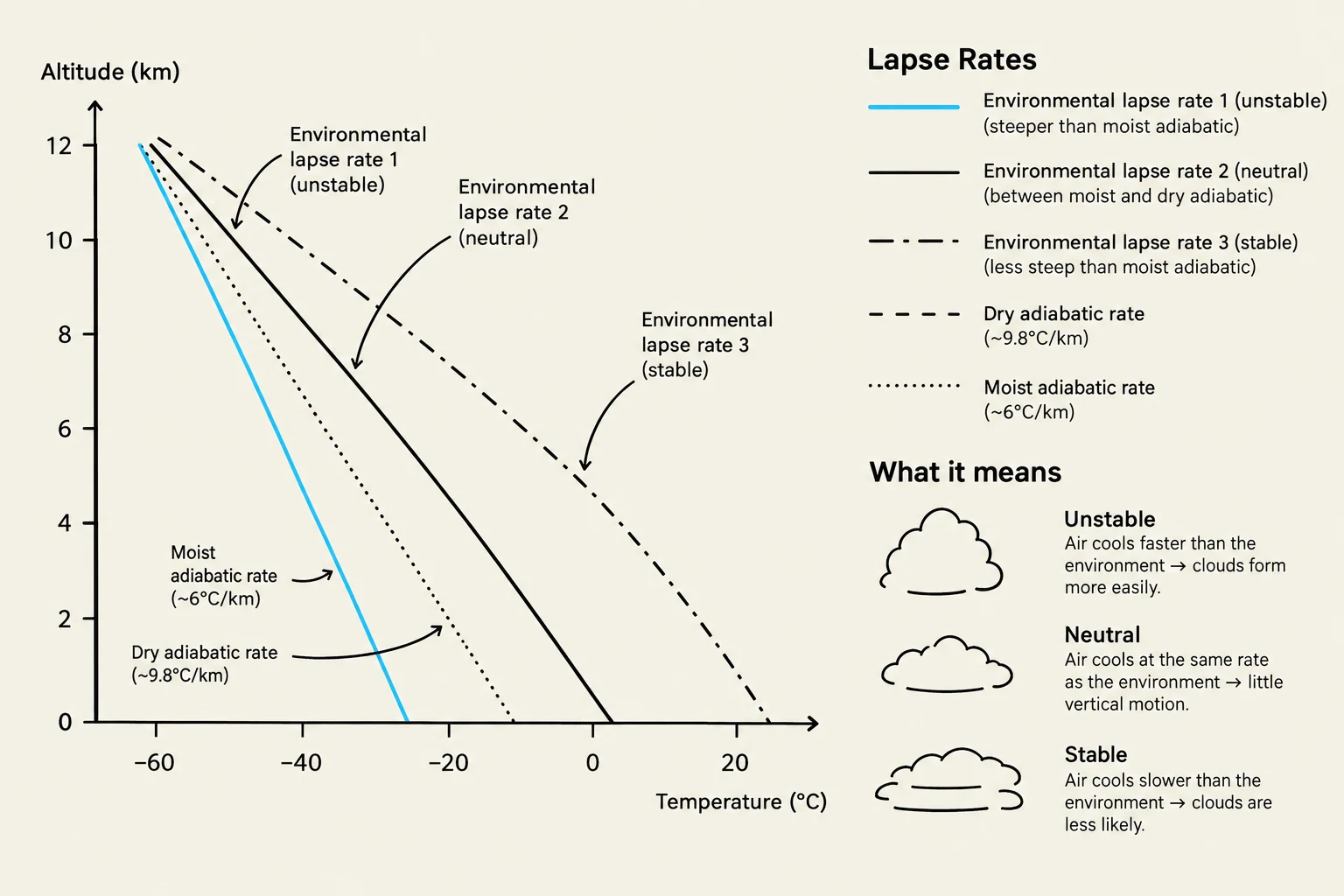
Atmospheric stability is a "competition" between the rate at which the rising parcel cools and the rate at which the surrounding environment cools with height (the environmental lapse rate).
1. Absolute Stability (Stable Equilibrium)
In a state of absolute stability, the environment cools very slowly with height. If you lift a parcel, even if it becomes saturated, it will still be cooler and denser than the surrounding air. This creates a restoring force—much like a boulder nudged in a valley that rolls back to the bottom. The parcel is negatively buoyant and sinks.
2. Absolute Instability (Unstable Equilibrium)
Absolute instability occurs when the environmental lapse rate is very steep—meaning the surrounding air gets cold very quickly as you go up. In this scenario, any lifted parcel (whether dry or saturated) will remain warmer than its environment. This creates a displacement that grows, much like a boulder nudged from a hilltop that accelerates away from its starting point. The parcel is positively buoyant and continues to rise.
3. Conditional Instability
This is the most common state in the atmosphere. The atmosphere is "conditionally" unstable because its behavior depends on whether the air is saturated.
If the parcel is unsaturated, it cools quickly (dry rate) and remains cooler than the environment (stable).
If the parcel is saturated, it cools more slowly (moist rate). If the environment is cooling at a moderate rate, the saturated parcel may become warmer than its surroundings and begin to rise freely.
This graph illustrates atmospheric lapse rates, showing how temperature changes with altitude and its effect on atmospheric stability, cloud formation, and vertical motion.
How Instability Generates Clouds
Instability is the engine of cloud formation. When the atmosphere is unstable, it facilitates the vertical movement necessary for clouds to grow. There are three primary ways to increase instability and encourage convection:
Warming the bottom: Heating the surface (e.g., intense sunlight on a summer day) steepens the environmental lapse rate.
Cooling the top: Introducing cold air at higher altitudes (e.g., cold air advection behind a front) also steepens the lapse rate.
Increasing Moisture: Adding moisture to the lower levels lowers the cloud base and makes it easier for a parcel to reach saturation and trigger conditional instability.
Real-World Examples
Forest Fires: Heat from a fire can warm the air near the surface, causing smoke and warm air to bubble upward, forming "pyrocumulus" clouds.
Lake-Effect Snow: Cold air flowing over relatively warm water creates intense instability near the surface.
Florida Convection: The combination of intense land heating and high humidity is a classic recipe for daytime convective cloud growth.
Keep reading for free.
Create an account to finish this reading and make it part of your study routine.