An overview of Earth's atmosphere, detailing its distinct layers (troposphere, stratosphere, mesosphere, thermosphere, exosphere) and the physical properties like temperature and pressure that define them. Explains the role of each layer in weather, radiation protection, and space transition.
The Earth is wrapped in a complex, multi-layered blanket of gases known as the atmosphere. This gaseous envelope does more than just provide the air we breathe; it protects us from harmful solar radiation, regulates our temperature, and facilitates the weather patterns that sustain life. To understand how the atmosphere functions, we must look at it not as a single uniform mass, but as a series of distinct layers defined by specific physical properties, most notably changes in temperature and pressure with altitude.
The Fundamental Drivers: Pressure and Temperature
Before diving into the specific layers, it is essential to understand the two physical variables that dictate atmospheric structure: pressure and temperature.
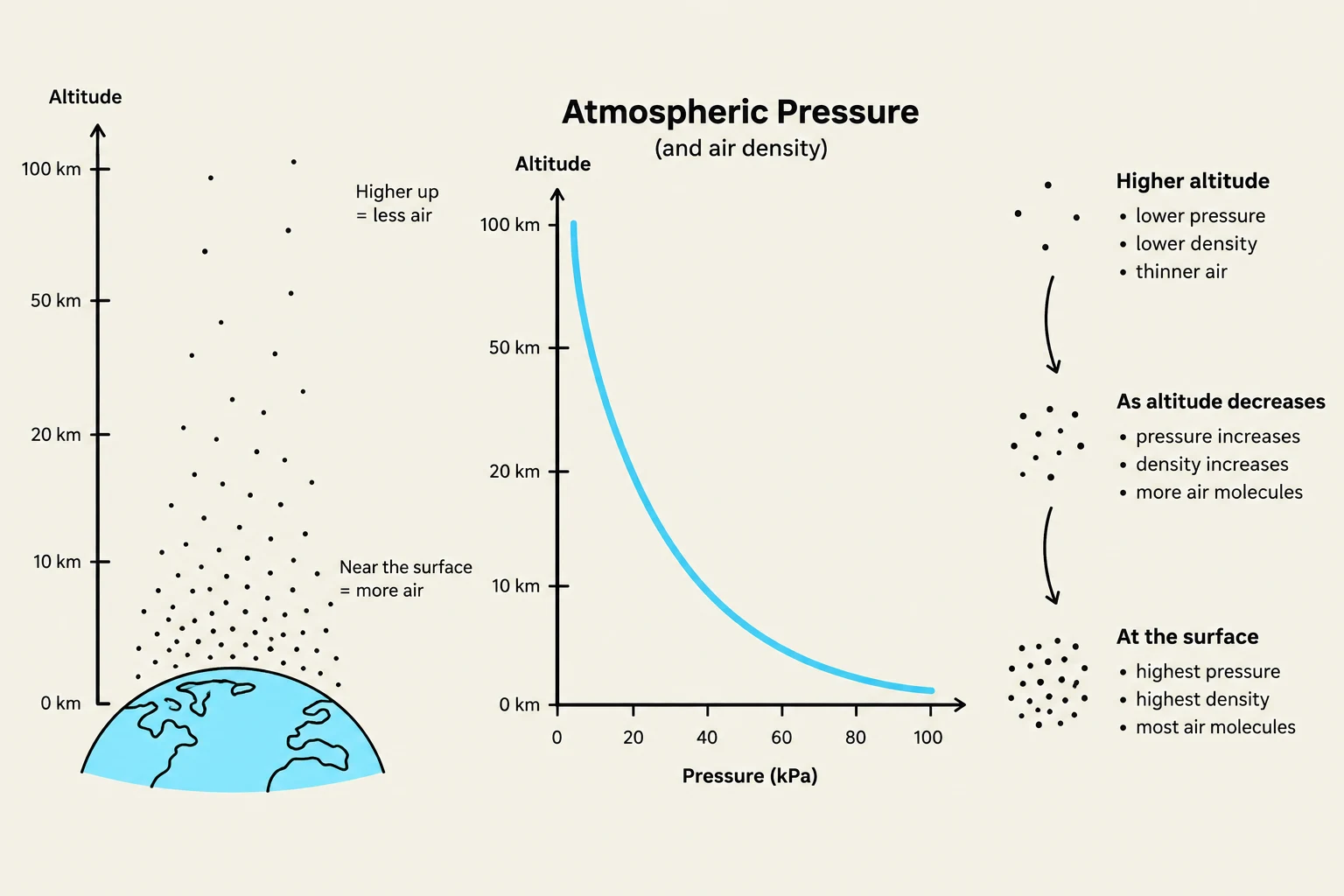
Atmospheric Pressure is the force exerted by the weight of the air above a given point. Because gravity pulls air molecules toward the Earth's surface, the air is densest at sea level. As you move upward, the number of molecules above you decreases, causing pressure to drop exponentially.
Temperature does not change linearly with altitude. Instead, it fluctuates in a "zig-zag" pattern. In some layers, the air gets colder as you go higher, while in others, it actually gets warmer. These temperature shifts are caused by how different parts of the atmosphere absorb energy from the Sun or from the Earth's surface.
Exam Tip: If a question asks why the atmosphere is layered, look for the relationship between temperature gradients and altitude. The boundaries between layers (called "pauses") occur exactly where the temperature trend reverses.
This illustration depicts the relationship between atmospheric pressure, air density, and altitude. As altitude increases, air pressure and density decrease, resulting in thinner air. Conversely, as altitude decreases towards the surface, pressure and density increase due to a higher concentration of air molecules.
The Troposphere: The Layer of Weather
The troposphere is the lowest layer of the atmosphere, extending from the Earth's surface up to approximately 8 to 15 kilometers (depending on latitude and season). This is the layer where we live and where almost all weather occurs.
In the troposphere, temperature decreases with altitude. This happens because the troposphere is primarily heated from below by the Earth's surface, which absorbs solar radiation and re-emits it as thermal energy. As you move away from this heat source, the air cools. This temperature gradient creates instability, allowing warm air to rise and cool air to sink, driving the convection currents that create clouds, rain, and storms.
The Stratosphere: The Protective Shield
Above the troposphere lies the stratosphere. The boundary between these two layers is known as the tropopause. In the stratosphere, the temperature trend reverses: instead of getting colder, the air gets warmer as you go higher.
This temperature inversion is caused by the presence of the ozone layer. Ozone molecules (O3) absorb high-energy ultraviolet (UV) radiation from the sun and convert it into heat. This absorption creates a warm layer that acts as a shield, protecting life on Earth from DNA-damaging radiation. Because the warmer air sits on top of cooler air, the stratosphere is very stable, which is why commercial jet aircraft often fly in the lower stratosphere to avoid the turbulence of the troposphere.
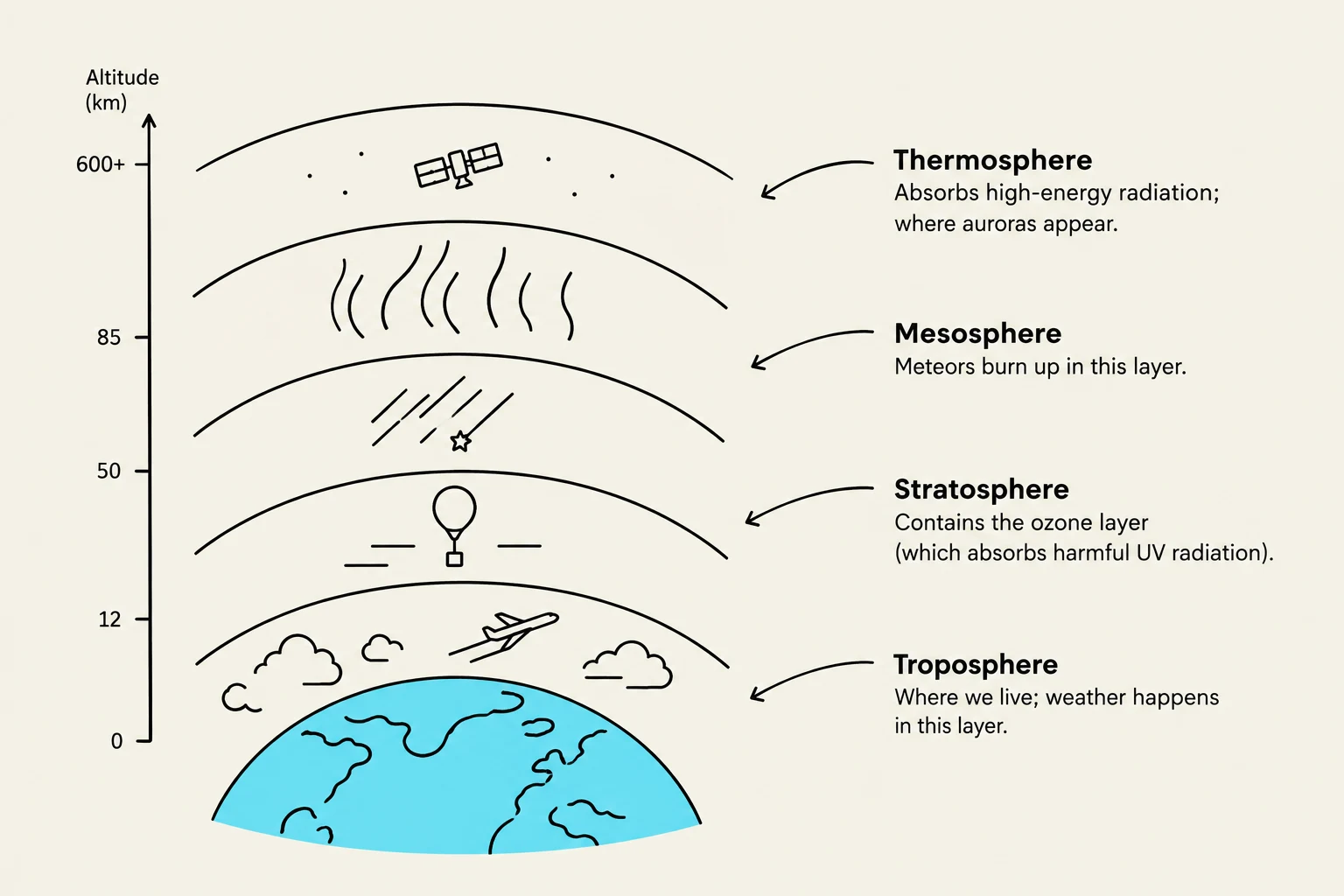
This diagram illustrates the different layers of Earth's atmosphere: the Troposphere, Stratosphere, Mesosphere, and Thermosphere, along with their respective altitudes and key characteristics.
The Mesosphere and Thermosphere: The High Altitudes
As we move higher, we encounter the Mesosphere. The boundary separating the stratosphere from the mesosphere is the stratopause. In the mesosphere, temperatures begin to drop again, reaching the coldest temperatures in the entire atmosphere. This layer is crucial because it is where most meteors burn up upon entry, due to the friction with the remaining gas molecules.
Above the mesosphere is the Thermosphere. The boundary here is the mesopause. In the thermosphere, temperatures rise dramatically. While "temperature" in physics refers to the kinetic energy of particles, the air here is so thin that it wouldn't "feel" hot to a human; however, the individual molecules are moving at incredibly high speeds due to the absorption of intense solar X-rays and UV radiation. This layer also contains the ionosphere, a region of charged particles that helps reflect radio waves back to Earth.
The Exosphere: The Gateway to Space
The final layer is the Exosphere. This is the outermost fringe of the atmosphere, where the air is so thin that molecules can travel hundreds of kilometers without colliding with one another. There is no clear upper boundary to the exosphere; it simply fades into the vacuum of interplanetary space. This is the region where many satellites orbit the Earth.
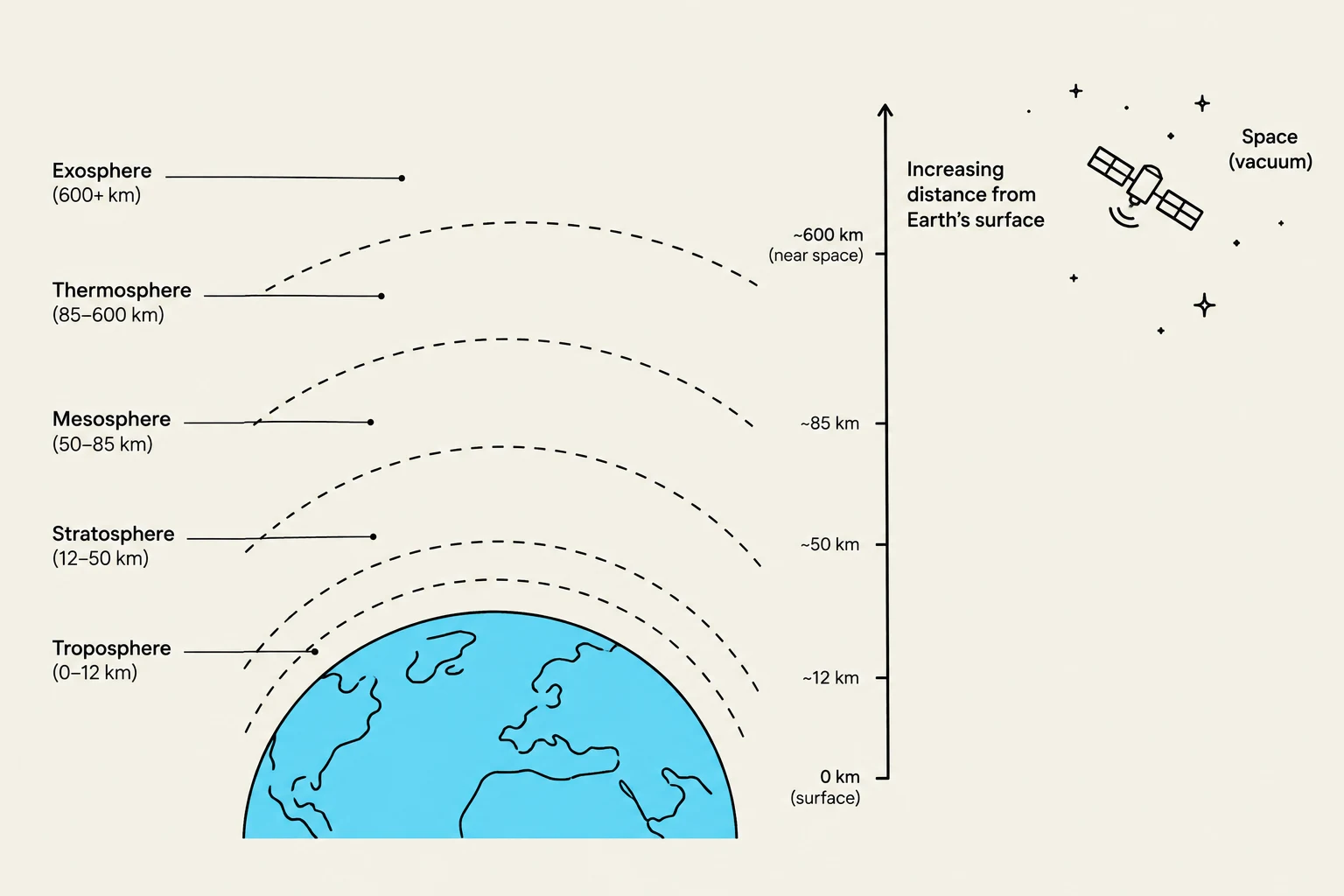
This diagram illustrates the different layers of Earth's atmosphere, from the troposphere closest to the surface to the exosphere extending into space.
Summary Table of Atmospheric Layers
To help synthesize this information, the following table summarizes the key characteristics of each layer:
Layer
Temperature Trend
Key Feature
Troposphere
Decreases with altitude
Weather and life occur here
Stratosphere
Increases with altitude
Contains the Ozone Layer
Mesosphere
Decreases with altitude
Meteors burn up here
Thermosphere
Increases with altitude
High-energy solar absorption
Exosphere
Minimal change
Transition to outer space
By understanding these layers, we gain a clearer picture of how Earth maintains its delicate balance, protecting us from the harsh environment of space while providing the dynamic conditions necessary for life to thrive.
Keep reading for free.
Create an account to finish this reading and make it part of your study routine.