Learn how to calculate and interpret formal charges on atoms within Lewis structures. This concept is crucial for determining the most stable arrangement of electrons in a molecule and understanding charge distribution.
When you look at a Lewis structure, you might see symbols like plus ($+$) or minus ($-$) attached to specific atoms. These are known as formal charges. While we often think of molecules as having a single overall charge (like an ion), the charge is often distributed among the individual atoms that make up the structure.
Understanding formal charges is essential for determining the most stable Lewis structure for a given molecule. It allows chemists to predict which arrangement of electrons is most likely to occur in nature.
The Concept of Formal Charge
The term "formal" is used because, in a real molecule, electrical charge is not strictly localized on a single atom; instead, it is distributed to varying degrees across the surrounding environment. A formal charge is a bookkeeping tool used to track the distribution of valence electrons in a Lewis structure.
To calculate a formal charge, we compare the number of electrons an atom "owns" in a molecule to the number of electrons it possesses in its free, neutral state (its outer-shell electron count).
Key Concept: An atom is considered to have a charge if its valence electron count in the molecule differs from its outer-shell electron count in a free, nonbonded atom.
The Calculation Formulas
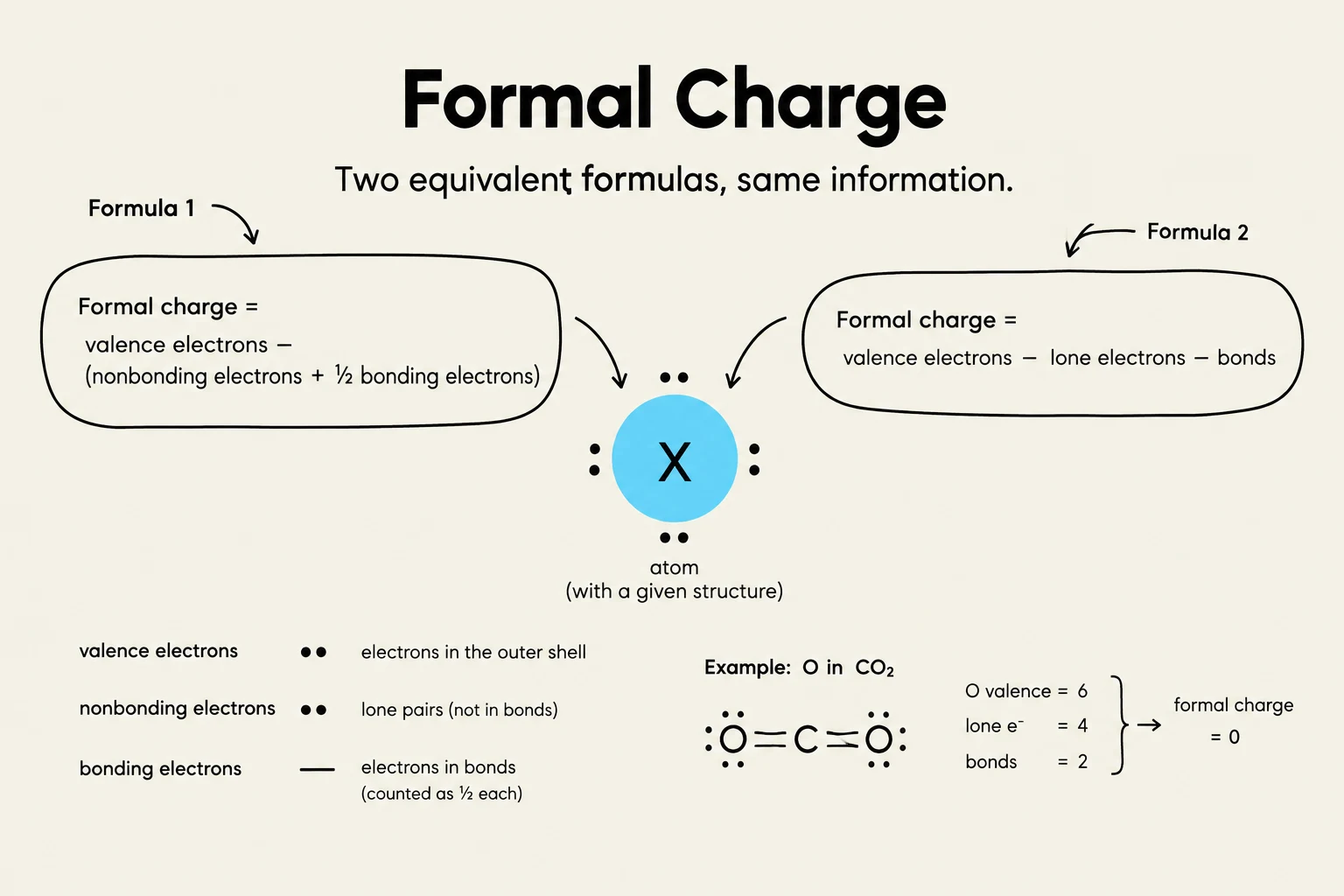
There are two primary ways to express the formal charge calculation. Both methods yield the same result, so you should use the one that feels most intuitive to you.
Method 1: Using Total Electron Counts
This method looks at the total number of electrons surrounding the atom, including both those in lone pairs and those involved in bonds.
Formal charge=(outer-shell electrons in free atom)−(21×(unshared electrons+bonding electrons))
Method 2: Using Valence and Pair Counts
This is often the faster method used by students during exams. It subtracts the electrons that are "taken" by bonds and lone pairs from the total valence electrons available.
This diagram explains the concept of formal charge in chemistry, providing two equivalent formulas and an example calculation for oxygen in carbon dioxide.
Worked Example 1: The Hydronium Ion (H3O+)
The hydronium ion is a classic example of how charge is distributed in a polyatomic ion. In the Lewis structure of H3O+, oxygen is the central atom, bonded to three hydrogen atoms, with one lone pair remaining on the oxygen.
Let's calculate the formal charge for each type of atom:
1. For Hydrogen (H):
Each hydrogen atom is involved in one single bond.
Valence electrons in free H atom: 1
Lone pair electrons: 0
Bonding electrons: 2 (from the single bond)
Formal charge=1−0−21(2)=0
Since the result is zero, the hydrogens bear no formal charge.
2. For Oxygen (O):
The oxygen atom has one lone pair and is bonded to three hydrogens.
Valence electrons in free O atom: 6
Lone pair electrons: 2
Bonding electrons: 6 (three bonds × 2 electrons each)
Formal charge=6−2−21(6)=6−2−3=+1
Because the oxygen atom's electron count in the molecule (5) is one short of its free-atom count (6), the oxygen bears a +1 charge.
The diagram illustrates the molecular structure of a hydronium ion (H3O+), showing the central oxygen atom bonded to three hydrogen atoms and possessing one lone pair of electrons.
Worked Example 2: The Nitrosyl Cation (NO+)
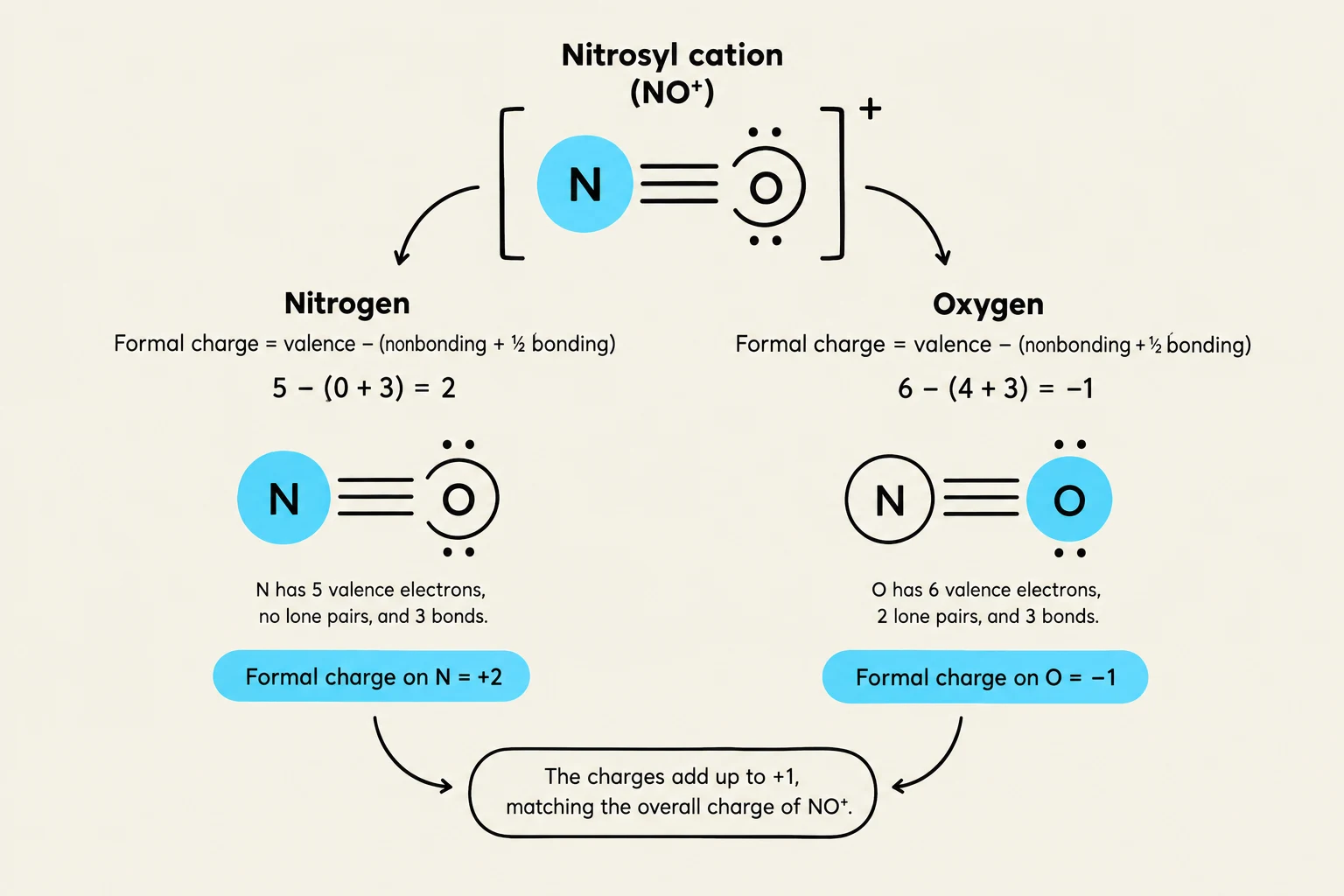
The nitrosyl cation provides a slightly more complex look at bonding, involving a triple bond. In this structure, nitrogen and oxygen are connected by a triple bond, and the nitrogen atom retains a lone pair.
1. For Nitrogen (N):
Valence electrons in free N atom: 5
Lone pair electrons: 2
Bonding electrons: 6 (from the triple bond)
Formal charge=5−2−21(6)=5−2−3=0
The nitrogen atom has a formal charge of zero.
2. For Oxygen (O):
Valence electrons in free O atom: 6
Lone pair electrons: 4 (two lone pairs)
Bonding electrons: 6 (from the triple bond)
Formal charge=6−4−21(6)=6−4−3=−1
Note that in the NO+ ion, the sum of the formal charges (0+(−1)=−1) does not match the overall charge of the ion (+1). This is a common point of confusion for students. Remember that formal charge is a model used to describe the distribution of electrons; while the sum of formal charges must equal the total charge of the species, the specific assignment of those charges helps us identify the most stable Lewis structure.
Exam Tip: Always double-check your math by summing the formal charges of all atoms in your structure. The sum must equal the overall charge of the molecule or ion. If it doesn't, you have likely miscounted your lone pairs or bonding electrons!
This diagram illustrates the formation of the nitrosyl cation (NO+), detailing the formal charges on nitrogen and oxygen atoms based on their valence electrons, lone pairs, and bonds.
Summary Table
To help you practice, keep this quick reference in mind:
Component
Contribution to Valence Count
Lone Pair
Each pair contributes 2 electrons
Shared Pair (Bond)
Each pair contributes 1 electron (or 2 total to the sum)
By mastering these calculations, you can move beyond simply drawing Lewis structures to actually evaluating which structures are the most chemically accurate.
Keep reading for free.
Create an account to finish this reading and make it part of your study routine.