This article explains how to use the 10-year ASCVD risk score to guide medication initiation for patients with Stage 1 hypertension, integrating lifestyle modifications and risk factors for a proactive approach to cardiovascular health.
When managing cardiovascular health, clinicians often face a critical question: "Does this patient need medication right now, or can we manage their risk through lifestyle changes alone?" This decision is particularly nuanced in patients categorized with Stage 1 hypertension or borderline hyperlipidemia. To move away from "gut feeling" and toward evidence-based medicine, clinicians utilize the Atherosclerotic Cardiovascular Disease (ASCVD) Risk Score.
This article explores how to use the 10-year ASCVD risk assessment to determine the appropriate timing for pharmacological intervention in patients who may not yet present with overt, high-risk symptoms.
Understanding the ASCVD Risk Score
This diagram illustrates the various physiological variables that are integrated to calculate an ASCVD risk score.
The ASCVD risk score is a clinical tool used to estimate the probability that a patient will experience a major cardiovascular event—such as a myocardial infarction (heart attack) or stroke—within the next 10 years.
Rather than looking at a single vital sign, such as blood pressure or a single cholesterol number, the ASCVD model integrates multiple physiological variables to create a holistic "risk profile." This allows providers to identify "silent" risks in patients who might otherwise appear relatively healthy.
Key Variables in the Calculation
To calculate the 10-year risk, several specific data points are required:
Age: Risk naturally increases with age.
Sex: Biological sex influences baseline risk profiles.
Race: Certain racial demographics carry different statistical risks for cardiovascular events.
Systolic Blood Pressure: The top number of the blood pressure reading.
Total Cholesterol and HDL Cholesterol: The ratio and levels of lipids in the blood.
Diabetes Status: The presence of diabetes significantly accelerates vascular damage.
Smoking Status: Current smoking is a potent, modifiable risk factor.
Hypertension Treatment: Whether the patient is already taking medication for blood pressure.
Clinical Application: Stage 1 Hypertension and Medication Timing
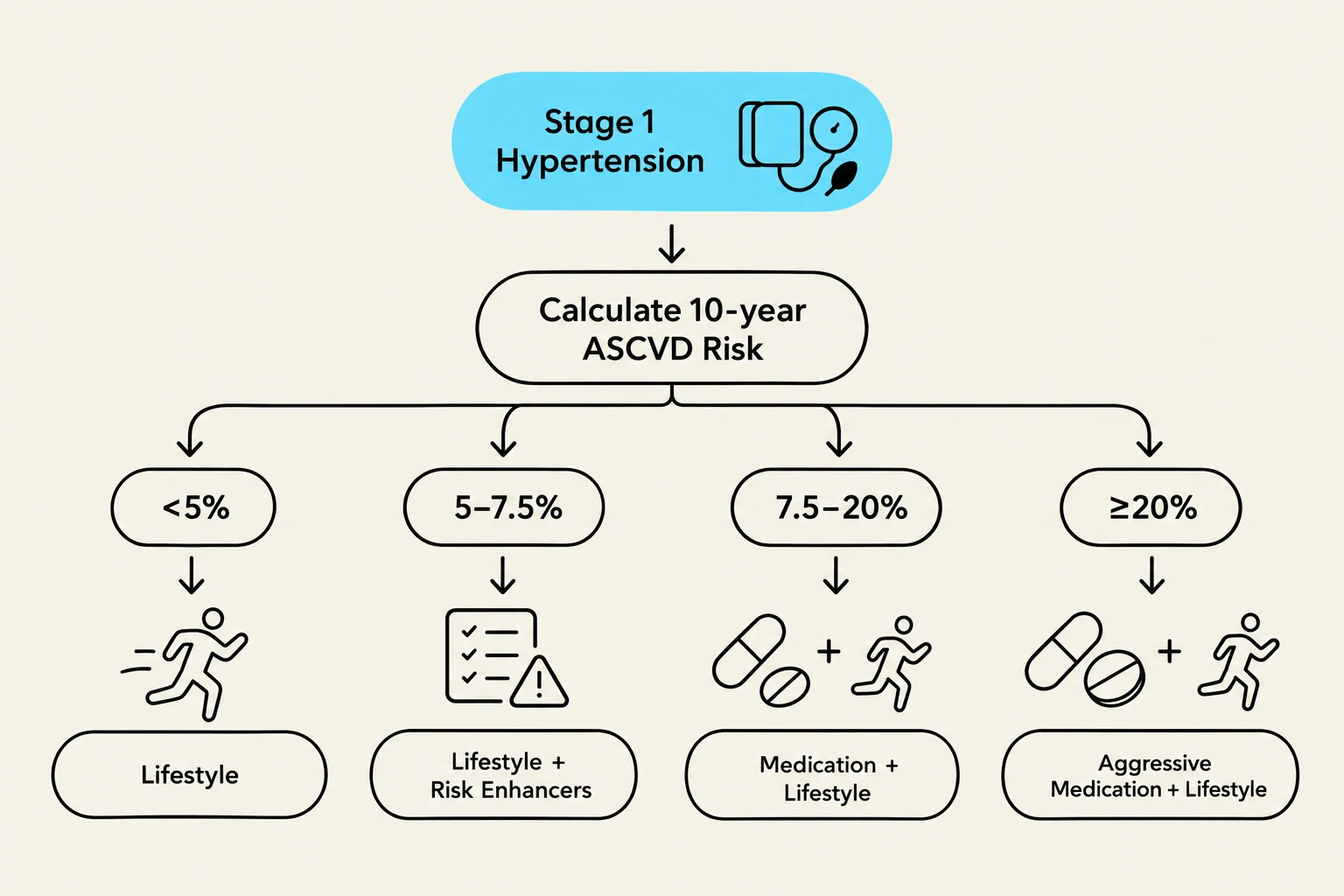
Flowchart for managing Stage 1 Hypertension based on calculated 10-year ASCVD risk, suggesting lifestyle changes, risk enhancers, or medication.
In clinical practice, a patient might be diagnosed with Stage 1 hypertension (systolic 130–139 mmHg or diastolic 80–89 mmHg). At this stage, the decision to initiate medication (such as ACE inhibitors, ARBs, or Calcium Channel Blockers) is not based solely on the blood pressure reading, but on the calculated 10-year ASCVD risk.
The Decision Thresholds
The general clinical framework for managing these patients follows these logic paths:
Low Risk (< 5%): If the 10-year risk is low, the primary focus is on Lifestyle Modification. This includes weight management, the DASH diet (Dietary Approaches to Stop Hypertension), sodium reduction, and increased physical activity.
Borderline Risk (5% to < 7.5%): Clinicians should discuss lifestyle changes and consider "risk enhancers" (such as family history or chronic kidney disease) to decide if medication is warranted.
Intermediate Risk (7.5% to < 20%): This is often the "tipping point." For patients in this range, especially those with Stage 1 hypertension or elevated LDL, the initiation of medication is strongly recommended to prevent future events.
High Risk (≥ 20%): Immediate pharmacological intervention is indicated alongside intensive lifestyle changes.
Exam Tip: When answering NCLEX or nursing school questions regarding hypertension, remember that blood pressure numbers alone do not always dictate medication. Always look for the "risk factors" or "calculated risk" in the patient's history to determine if the priority is lifestyle education or pharmacological administration.
Worked Example: Clinical Decision Making
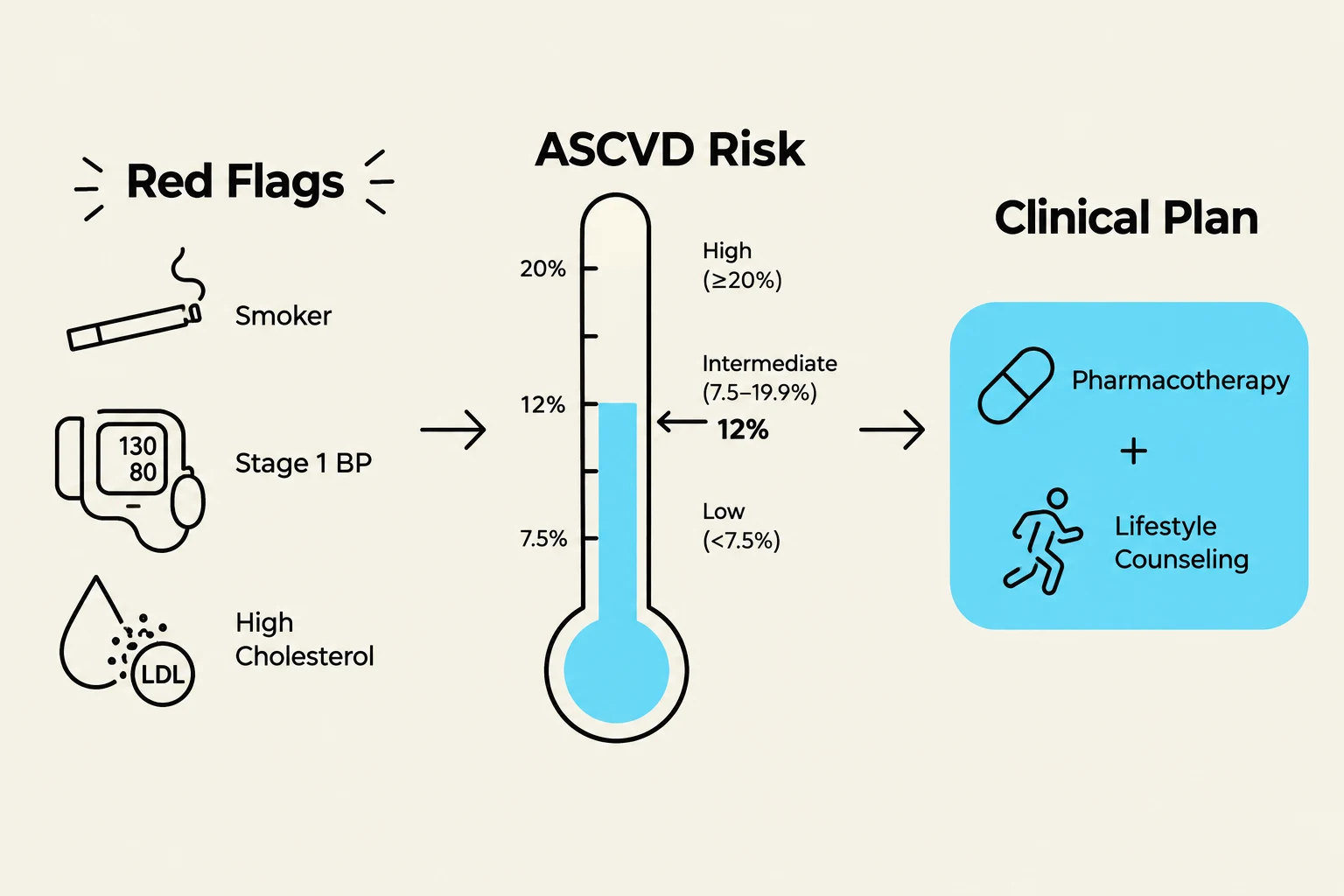
This diagram illustrates factors contributing to ASCVD risk, including smoking, high blood pressure, and high cholesterol. It shows how these factors can lead to different risk levels (low, intermediate, high) and outlines a clinical plan involving pharmacotherapy and lifestyle counseling.
Let's apply this to a hypothetical patient scenario to see how the math and logic intersect.
Step 1: Identify the Risk Factors
The patient has several "red flags": he is a smoker, has Stage 1 hypertension, and has borderline high total cholesterol.
Step 2: Calculate/Consult the Score
Using the ASCVD Risk Estimator (a tool provided by the American College of Cardiology), we input these values. For this specific profile, let's assume the calculated 10-year risk is 12%.
Step 3: Determine the Plan
Because 12% falls into the Intermediate Risk (7.5% to < 20%) category, the clinician would not simply tell the patient to "eat better." Instead, the clinician would likely initiate a combination of:
Pharmacotherapy: Starting a low-dose antihypertensive or a statin.
Lifestyle Counseling: Smoking cessation programs and dietary changes.
Summary Table for Quick Reference
10-Year Risk Category
Risk Percentage
Primary Clinical Action
Low Risk
< 5%
Lifestyle modification only
Borderline Risk
5% to < 7.5%
Lifestyle + consider risk enhancers
Intermediate Risk
7.5% to < 20%
Initiate medication + Lifestyle
High Risk
≥ 20%
Aggressive medication + Lifestyle
Conclusion
The ASCVD risk assessment transforms hypertension management from a reactive process into a proactive one. By using the 10-year risk score, healthcare providers can identify Stage 1 patients who are at high risk for catastrophic events and intervene with medication before a heart attack or stroke occurs. For the student or clinician, the key is to look beyond the blood pressure cuff and evaluate the patient's entire cardiovascular profile.
Keep reading for free.
Create an account to finish this reading and make it part of your study routine.