Explore the conductivity of aqueous solutions, classifying substances as strong electrolytes, weak electrolytes, or non-electrolytes based on their ability to produce mobile ions. Learn to calculate ion ratios and quantities in quantitative chemistry.
When you dissolve a substance in water, the resulting solution might behave in very different ways. Some solutions can carry an electric current with ease, while others act as insulators. This difference in behavior is not random; it is a direct consequence of what is happening at the particle level. To understand why, we must look at the relationship between the types of particles present in a solution and its ability to conduct electricity.
Conductivity and Mobile Ions
In an aqueous solution, the ability to conduct electricity—known as conductivity—depends entirely on the presence of mobile ions. An ion is a charged particle (either a cation with a positive charge or an anion with a negative charge) that is free to move through the liquid. These ions act as charge carriers; when an electric potential is applied, the movement of these ions allows the current to flow.
If a substance dissolves in water but stays as neutral, intact molecules, there are no charged particles to carry the current, and the solution will not conduct electricity.
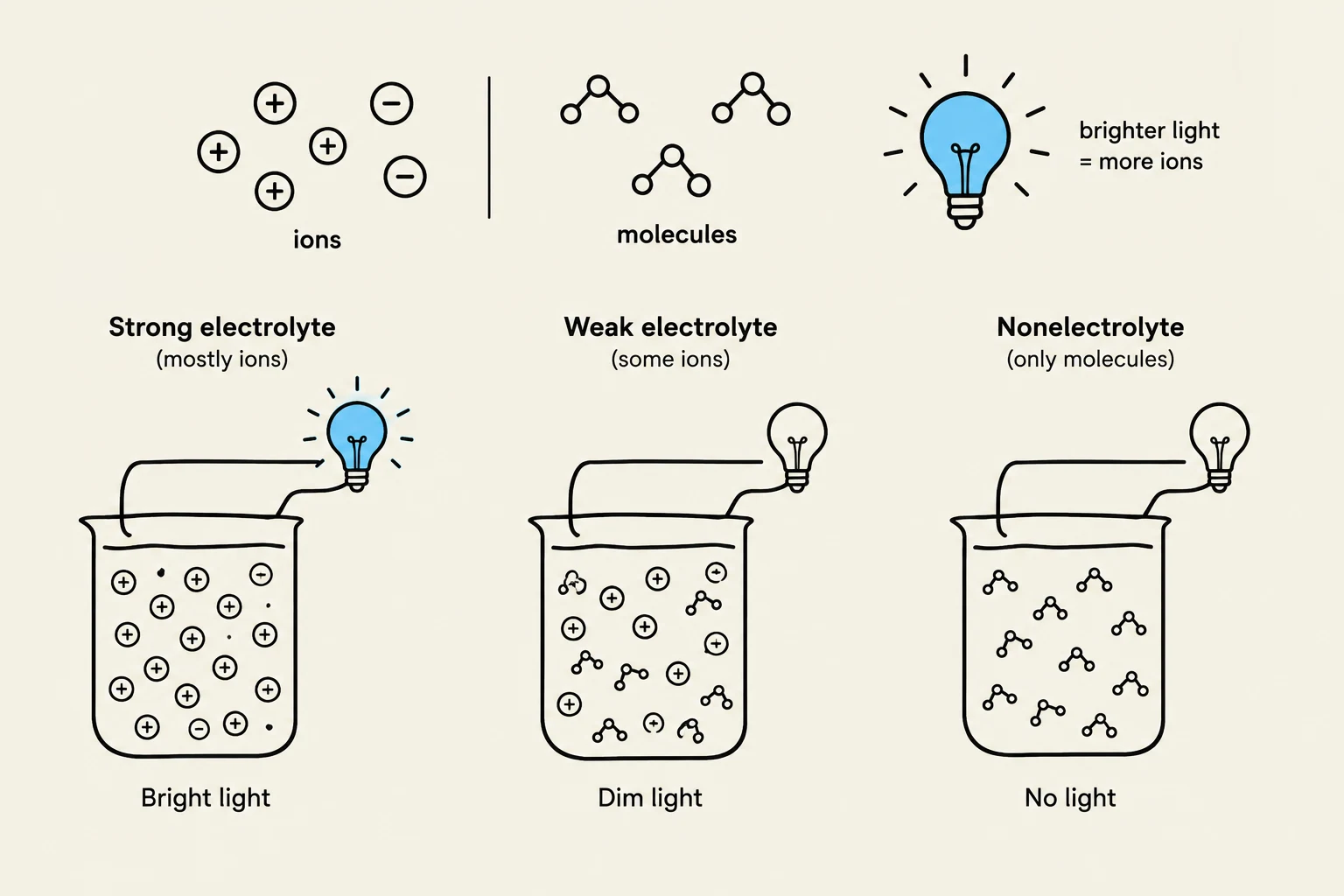
This diagram illustrates the concept of electrolytes and their effect on electrical conductivity. It shows how strong electrolytes, which dissociate into many ions, cause a light bulb to glow brightly. Weak electrolytes, with fewer ions, produce a dim light, while nonelectrolytes, composed only of molecules, do not conduct electricity and result in no light.
Classifying Electrolytes
Chemists classify substances based on how effectively they produce these mobile ions in water. This classification is essential for predicting the electrical properties of a solution.
1. Strong Electrolytes
A strong electrolyte is a substance that dissociates (breaks apart) or ionizes almost completely in solution. Because nearly every formula unit of the substance turns into ions, the solution contains a high concentration of mobile ions, resulting in high electrical conductivity.
Ionic Compounds: Most ionic compounds, such as NaCl, are strong electrolytes because the water simply separates the existing cations and anions.
Strong Acids and Bases: By definition, strong acids (like HCl) and strong bases (like NaOH) are completely ionized in water.
2. Weak Electrolytes
A weak electrolyte is a substance that only partially dissociates in water. In these solutions, most of the substance remains as neutral molecules, while only a small fraction exists as ions. Because there are fewer charge carriers, the conductivity is much lower than that of a strong electrolyte.
Weak Acids and Bases: Examples include acetic acid (CH3COOH) and ammonia (NH3).
3. Non-electrolytes
A non-electrolyte is a substance that dissolves in water but does not produce any ions. The substance remains in its molecular form, meaning there are essentially no mobile ions to carry a current.
Molecular (Covalent) Compounds: Most molecular compounds, such as glucose (C6H12O6), are non-electrolytes.
Exam Tip: When asked to identify the strongest conductor at a given concentration, don't just look for what dissolves. Look for the substance that produces the greatest number of ions per formula unit. For example, CaCl2 will conduct more strongly than NaCl because it produces three ions per unit instead of two.
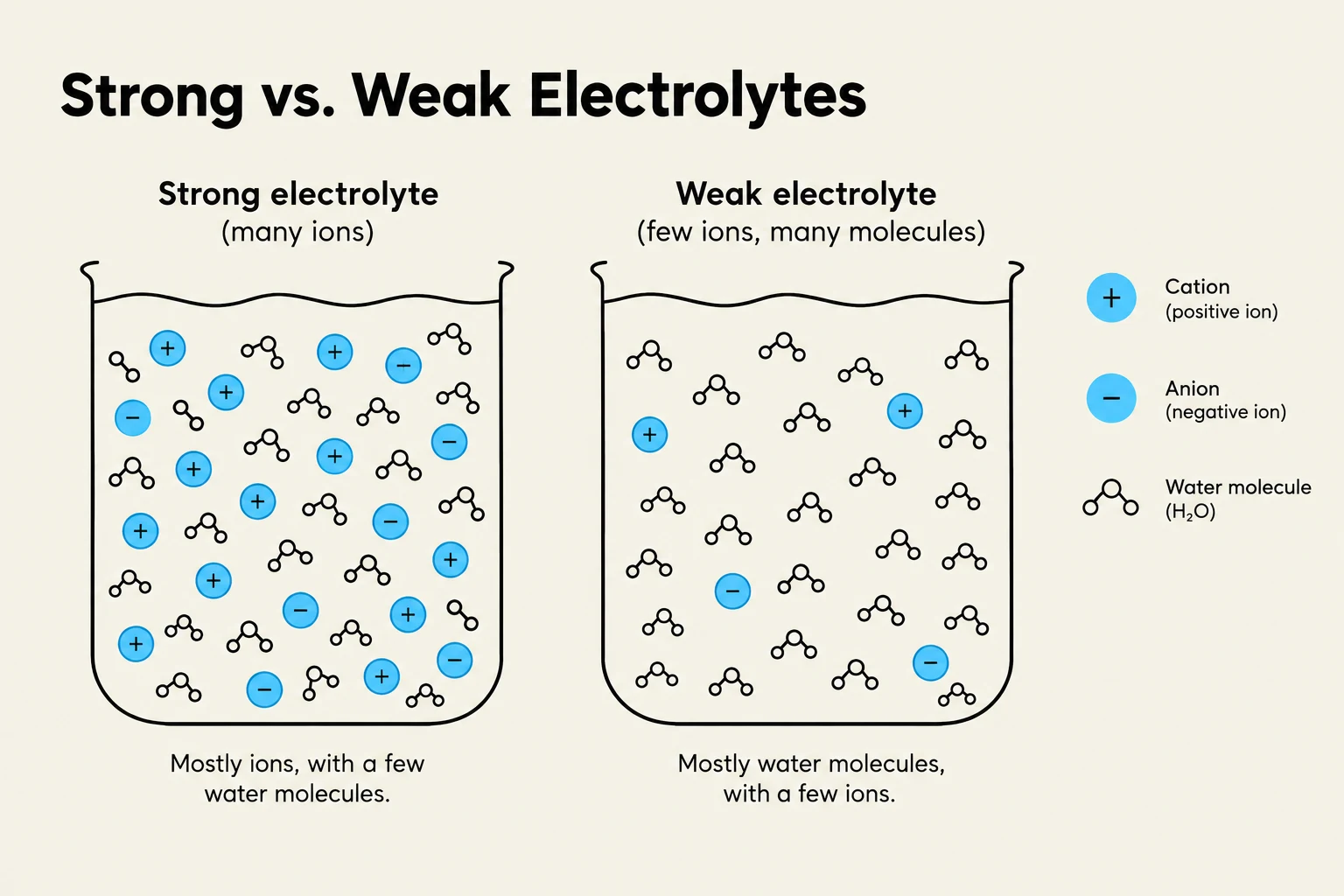
This illustration compares strong and weak electrolytes, showing the difference in ion and molecule concentration in solution.
Using the Ion Ratio
To perform quantitative chemistry, you must be able to translate a neutral chemical formula into its constituent ions. This is done using the ion ratio, which is derived from the subscripts in the chemical formula.
When a compound undergoes dissociation, the subscripts in the neutral formula become the coefficients for the separated ions.
Example: Lithium Sulfate (Li2SO4)
In the formula Li2SO4, the subscript 2 following Li indicates there are two lithium ions for every one sulfate ion. When it dissociates, the equation is written as:
Li2SO4(s)→2Li+(aq)+1SO42−(aq)
This gives us an ion ratio of $2:1$ (two moles of $Li^+$ for every one mole of SO42−).
Quantitative Analysis of Ions
Once you understand the ion ratio, you can calculate the exact amount of specific ions present in a sample. There are two primary pathways depending on the information provided:
Pathway 1: Starting from Moles
If you are given the moles of a compound, you use the ion ratio to find the moles of the specific ion requested, then multiply by Avogadro's number to find the actual number of ions.
Worked Example:
How many $Li^+$ ions are in 2.40 moles of Li2SO4?
Convert to particles:4.80 mol Li+×(6.022×10²³ ions/mol)=2.89×1024 ions of Li+.
Pathway 2: Starting from Mass
If you are given the mass of a compound, you must first convert that mass into moles using the molar mass before applying the ion ratio.
Worked Example:
How many Na+ ions are in 6.87 g of Na2CO3?
Convert mass to moles:MolarMassof6.87 gNa2CO3=moles of Na2CO3
Use the ratio: Multiply by the ratio of Na+ ions (which is 2 from the Na2 subscript).
Convert to particles: Multiply by Avogadro's number.
This diagram illustrates the conversion of mass of a compound to moles of ions in solution, involving molar mass and the number of ions per formula unit.
Summary Table for Quick Reference
Substance Type
Dissociation Level
Conductivity
Example
Strong Electrolyte
Complete
High
$NaCl, HCl, NaOH$
Weak Electrolyte
Partial
Low
CH3COOH,NH3
Non-electrolyte
None (remains molecular)
None
Glucose
Keep reading for free.
Create an account to finish this reading and make it part of your study routine.