This content explores the definition of motivation, its key dimensions (direction, intensity, persistence), and various theoretical approaches used to understand behavior change, including behavioral, cognitive, and cognitive-behavioral perspectives.
Understanding why people start an activity, why they keep doing it, and why they eventually stop is a central question in psychology, particularly in the context of sport and exercise. Motivation is not a single, static trait; rather, it is a dynamic process that involves both the initiation and the continuation of activity directed toward achieving a specific goal. To study this process effectively, psychologists look at three key dimensions: direction (the specific goals or situations a person seeks out), intensity (the amount of effort applied), and persistence (how long that effort is maintained over time).
Core Approaches to Motivation
To understand how these dimensions manifest in real-world behavior, researchers generally categorize motivation into three primary theoretical approaches: the behavioural, the cognitive, and the cognitive-behavioural.
The Behavioural Approach
The behavioural approach posits that motivation is driven by external factors, such as rewards, punishments, and incentives. In this view, motivation is understood through the consequences that follow a specific behavior. This approach relies on several core principles:
Positive Reinforcement: Providing a reward following a behavior to increase the likelihood of it being repeated.
Negative Reinforcement: The removal of an unpleasant stimulus to increase a desired behavior.
Punishment: Applying an unpleasant consequence to decrease the likelihood of a behavior occurring again.
Extinction: When a behavior is no longer reinforced, it will eventually stop.
The Cognitive and Cognitive-Behavioural Approaches
In contrast to the external focus of behaviourism, the cognitive approach emphasizes that motivation is a product of internal mental processes, including thoughts, expectations, and goals. It suggests that what we think about our abilities and our outcomes dictates how we act.
The cognitive-behavioural approach serves as an integration of these two perspectives. It seeks to understand and influence motivated behavior by looking at the interplay between internal thoughts and beliefs (cognitions) and observable actions (behaviours).
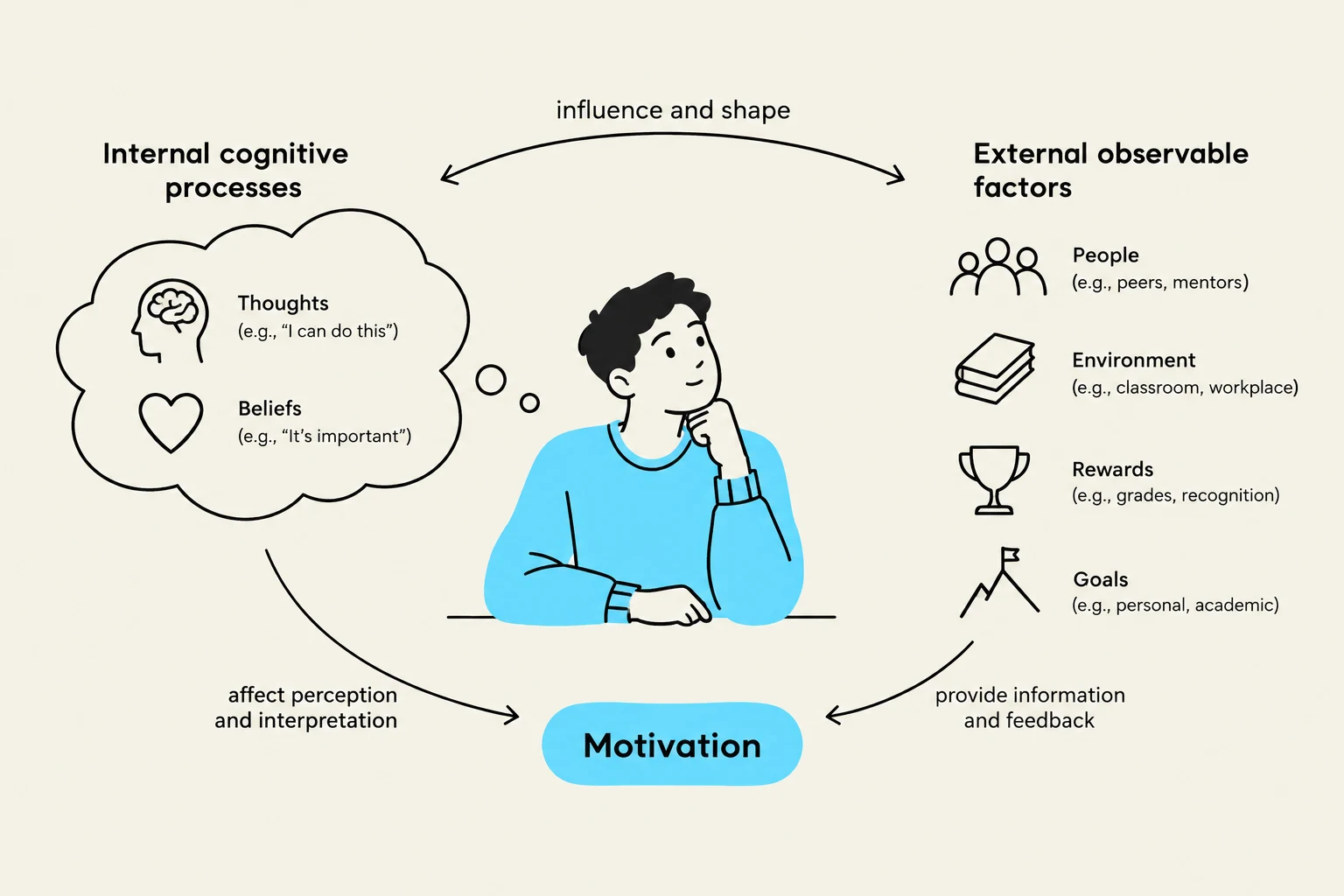
This diagram illustrates the interplay between internal cognitive processes (thoughts and beliefs) and external observable factors (people, environment, rewards, and goals) in shaping motivation. Motivation, in turn, affects perception and interpretation, and is influenced by and shapes cognitive processes.
Exam Tip: When distinguishing between these approaches, remember: Behavioural = External consequences; Cognitive = Internal thoughts; Cognitive-Behavioural = The interaction of both.
Major Models of Behavioural Change
Several models help explain how individuals move through different stages of motivation and how they eventually adopt new habits.
The Transtheoretical Model (Stages of Change)
This model explains how individuals initiate and adopt regular physical activity through five distinct stages:
Precontemplation: Not intending to take action in the foreseeable future.
Contemplation: Intending to change in the next six months.
Preparation: Intending to take action in the immediate future.
Action: Making specific overt modifications in lifestyle.
Maintenance: Working to prevent relapse.
Progression through these stages is influenced by self-efficacy (belief in one's capability), the process of change (cognitive and behavioral strategies), and decisional balance (the perceived pros versus cons of changing).
Theory of Planned Behaviour (TPB)
The TPB suggests that a person's intention to engage in a behavior is the most significant predictor of that behavior. This intention is shaped by three factors:
Attitude: The individual's evaluation of the behavior.
Subjective Norms: The perceived social pressure from others.
Perceived Behavioural Control: The belief in one's ability and control over the behavior.
Social Cognitive Theory
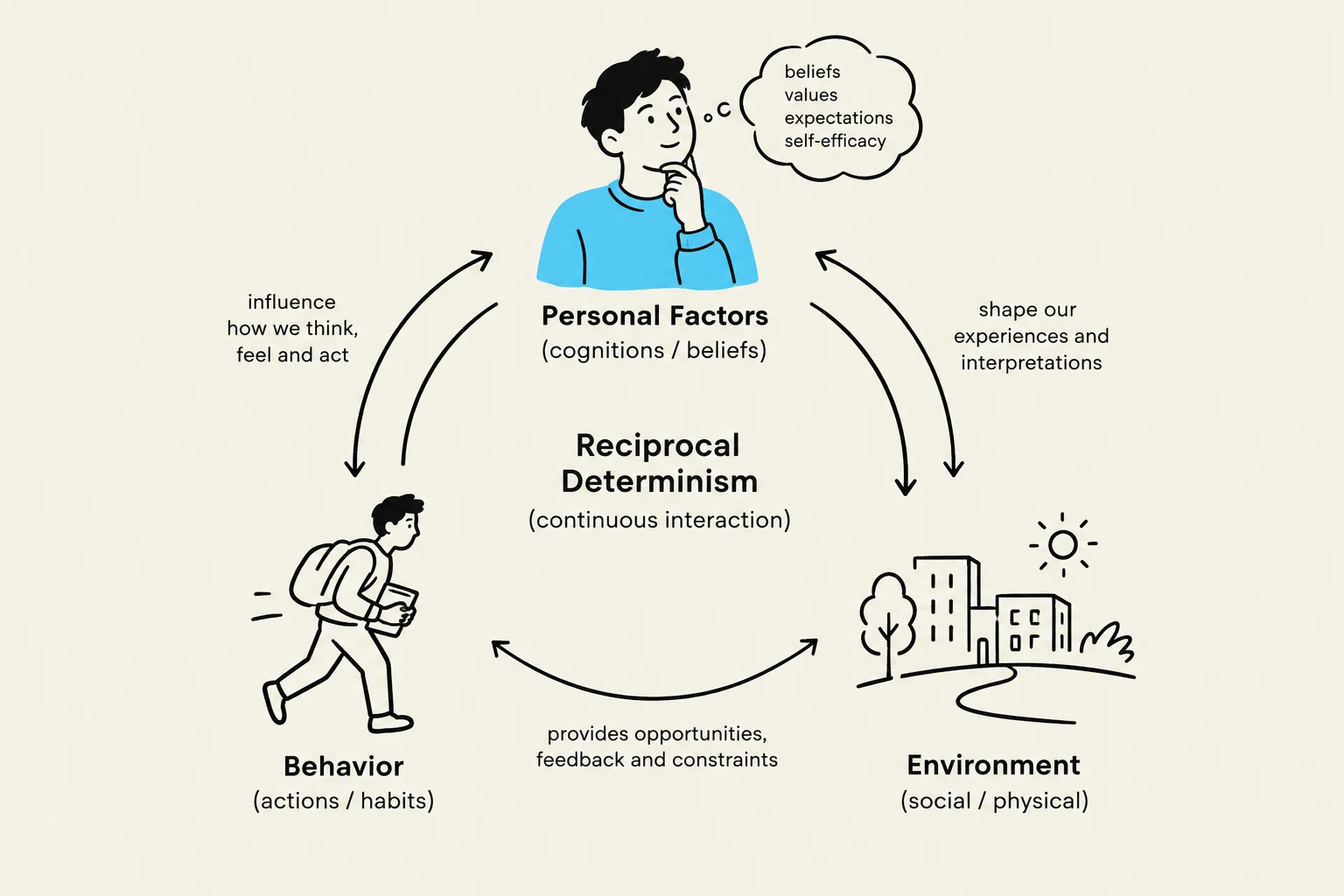
This theory introduces the concept of reciprocal determinism, which states that behavior is influenced by a continuous, three-way interaction between personal factors (beliefs, goals), environmental factors (social support, facilities), and the behavior itself. A central pillar here is self-efficacy, which can be built through mastery experiences, observing others (vicarious experiences), social persuasion, and managing physiological states.
This diagram illustrates the concept of Reciprocal Determinism, showing the continuous interaction between personal factors (cognitions/beliefs), behavior (actions/habits), and the environment (social/physical).
Understanding the Quality of Motivation
Not all motivation is created equal. Some forms of motivation are more sustainable than others.
Self-Determination Theory (SDT)
SDT views motivation along a continuum, ranging from amotivation (a total lack of intention to act) to intrinsic motivation (acting for inherent satisfaction and enjoyment). Between these lies extrinsic motivation, which can take several forms:
External regulation: To get a reward or avoid punishment.
Introjected regulation: To avoid guilt or shame.
Identified regulation: Because the behavior is valued and important.
Integrated regulation: Because the behavior is aligned with one's core identity.
To achieve high-quality, autonomous motivation, three basic psychological needs must be met: Autonomy (feeling in control), Competence (feeling capable), and Relatedness (feeling connected to others).
Achievement Goal Theory
This theory suggests that motivation stems from how an individual defines "success".
Task-orientation: Success is defined by self-improvement and skill development.
Ego-orientation: Success is defined by outperforming others.
These can be further broken down into a 2x2 framework involving "approach" (striving for success) and "avoidance" (striving to avoid failure/incompetence).
Advanced Perspectives: Non-Conscious and Social Processes
Non-Conscious Processes
Motivation is not always a deliberate, conscious choice. Dual-process models suggest we operate using two systems:
System 1 (Automatic): Fast, effortless, and unintentional.
System 2 (Reflective): Slow, effortful, and intentional.
Understanding these allows for the creation of environments where exercise becomes an automatic habit.
Social Approaches
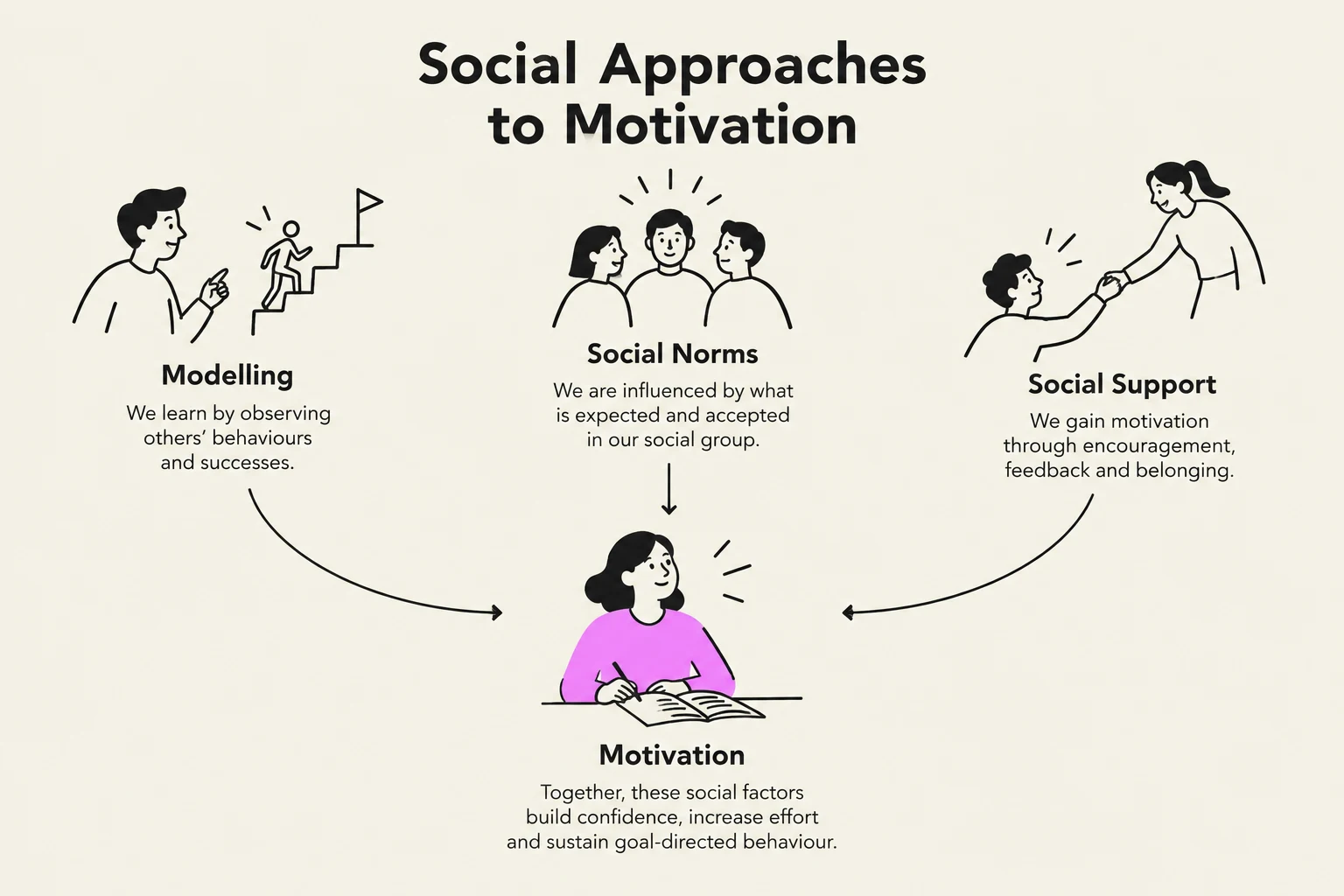
Finally, social approaches emphasize that motivation is heavily influenced by others through modelling, social norms, and social support. For example, parents and coaches play critical roles by providing resources, emotional support, and creating a supportive climate that fulfills an athlete's psychological needs.
This diagram illustrates social approaches to motivation, including modeling, social norms, and social support, all contributing to overall motivation.
Keep reading for free.
Create an account to finish this reading and make it part of your study routine.