


Logic is the bedrock of mathematical reasoning and the foundation of automated reasoning. While it may seem like an abstract branch of philosophy, propositional logic has profound practical applications in computer science, ranging from the design of hardware circuits to the verification of complex software systems. By providing a precise way to represent and manipulate statements, logic allows us to move from the ambiguity of natural language to the absolute certainty of mathematical proof.
The Building Blocks: Propositions and Variables
At the heart of this study are propositions. A proposition is a declarative sentence that is either true or false, but not both. For example, "Washington, D.C., is the capital of the United States" is a proposition, whereas "What time is it?" is not, because it does not declare a fact.
To work with these statements mathematically, we use propositional variables (often denoted by letters like $p, q, r, s$) to represent them. These variables act as placeholders for truth values: True () or False ().
Exam Tip: When identifying propositions, remember they must be declarative. Sentences with variables like are not propositions unless you assign a specific value to .
Logical Connectives and Compound Propositions
We rarely work with isolated statements. Instead, we combine them using logical connectives to form compound propositions. These connectives allow us to build complex logical structures from simple, atomic ones.
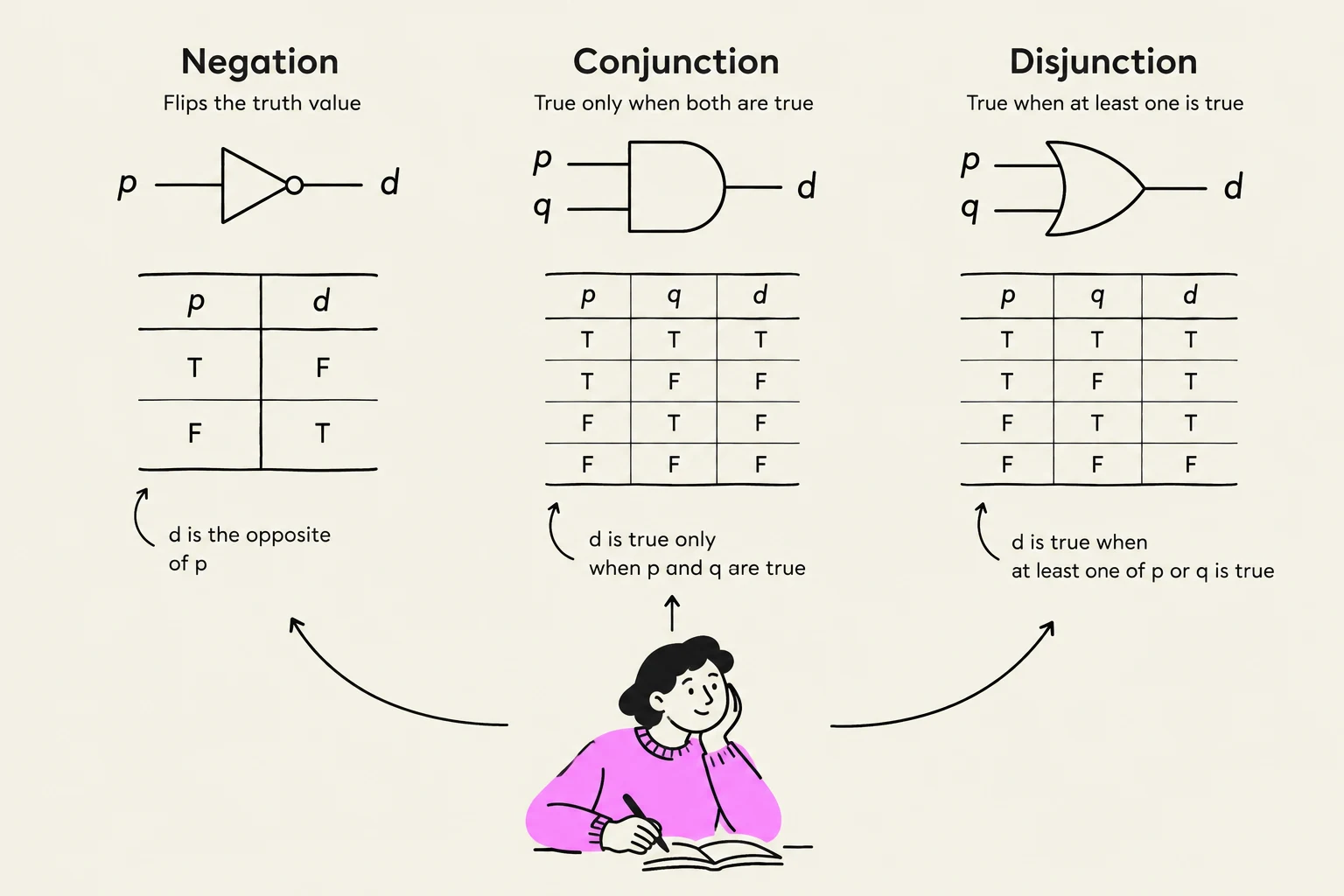
The most common connectives include:
- Negation (): The "not" operator, which flips the truth value.
- Conjunction (): The "and" operator, which is true only if both and are true.
- Disjunction (): The "or" operator (inclusive), which is true if at least one statement is true.
- Exclusive Or (): The "XOR" operator, which is true if exactly one of the statements is true, but not both.

Keep reading for free.
Create an account to finish this reading and make it part of your study routine.
Continue reading freeAlready have an account? Log in
Updated