Explore Newton's laws of motion, including the first, second, and third laws, and their applications in physics problems. Learn about essential problem-solving tools like free-body diagrams and vector addition, and see real-world examples such as drag force on a barge, tension in suspended objects, and normal force in
Understanding how objects move requires more than just observing their speed or direction; it requires an analysis of the forces acting upon them. This field of study, known as dynamics, is governed by Newton's laws of motion. By combining these laws with mathematical tools like vector addition and trigonometry, we can predict the behavior of everything from a simple traffic light to a massive barge in the ocean.
The Foundation: Newton's Laws of Motion
To solve complex physics problems, we must first establish the fundamental principles that govern motion.
Newton's First Law
Newton's first law states that an object will remain at rest or move at a constant velocity unless acted upon by a net external force. This implies that if the sum of all forces acting on an object is zero, its acceleration is also zero.
Newton's Second Law
The second law provides the mathematical link between force and motion:
Fnet=ma
where Fnet is the net force, m is the mass, and a is the acceleration. This law tells us that the acceleration of an object is directly proportional to the net force acting on it and inversely proportional to its mass.
Newton's Third Law
While not the primary focus of every calculation, the third law—that every action has an equal and opposite reaction—is crucial when identifying force pairs, such as the force a person exerts on a scale and the force the scale exerts back on the person.
Essential Problem-Solving Tools
Applying Newton's laws to real-world scenarios requires a systematic approach to organizing forces.
Free-Body Diagrams (FBD)
A free-body diagram is a simplified sketch used to visualize all the forces acting on a specific object. By isolating the object of interest, we can clearly see the direction and magnitude of various forces, such as gravity, tension, and friction.
Vector Addition and Components
Forces are vectors, meaning they have both magnitude and direction. When multiple forces act on an object at different angles, we use vector addition to find the resultant force.
For example, if two perpendicular forces act on an object, we can use the Pythagorean theorem to find the magnitude of the total applied force (Fapp):
Fapp=Fx2+Fy2
The direction (θ) can be found using the inverse tangent function:
θ=tan−1(FxFy)
Exam Tip: When solving problems with multiple forces, always resolve your vectors into horizontal (x) and vertical (y) components. This turns a complex multi-directional problem into two simpler one-dimensional problems.
Real-World Applications
Case Study 1: Drag Force on a Barge
In fluid dynamics, we encounter drag force, which is a type of frictional force exerted by fluids (like water or air) that opposes the motion of an object.
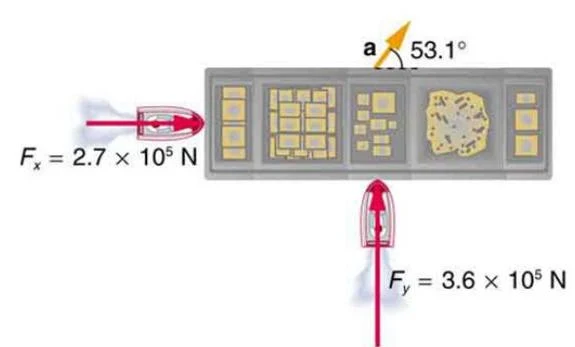
Consider a barge being pushed by two tugboats. One tugboat exerts 2.7×10⁵ N in the x-direction, and another exerts 3.6×10⁵ N in the y-direction.
A diagram illustrating forces acting on an object, with components Fx and Fy indicated.
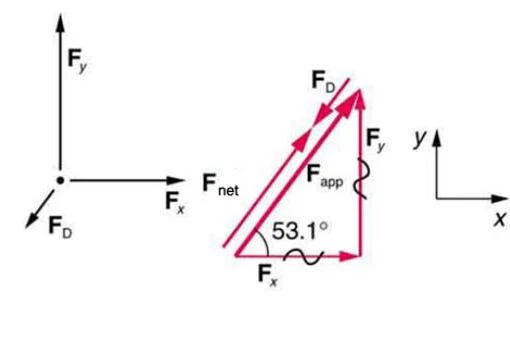
A vector diagram illustrating the decomposition of forces into their horizontal (Fx) and vertical (Fy) components, along with an applied force (Fapp) and a drag force (FD), resulting in a net force (Fnet).
To find the drag force (FD) resisting a barge of mass 5.0×10⁶ kg accelerating at 7.5×10⁻² m/s2, we follow these steps:
Calculate the total applied force (Fapp):Fapp=(2.7×10⁵)2+(3.6×10⁵)2=4.5×10⁵ N
Apply Newton's Second Law:
Since the drag force opposes the applied force, the net force is:
Fnet=Fapp−FD
Setting this equal to ma:
Fapp−FD=ma
Solve for FD:FD=Fapp−maFD=(4.5×10⁵ N)−(5.0×10⁶ kg)(7.5×10⁻² m/s2)=7.5×104 N
Case Study 2: Tension in Suspended Objects
Tension is the force exerted by a string, cable, or wire when it is pulled tight. When an object is suspended by wires at different angles, the tension in each wire will differ.
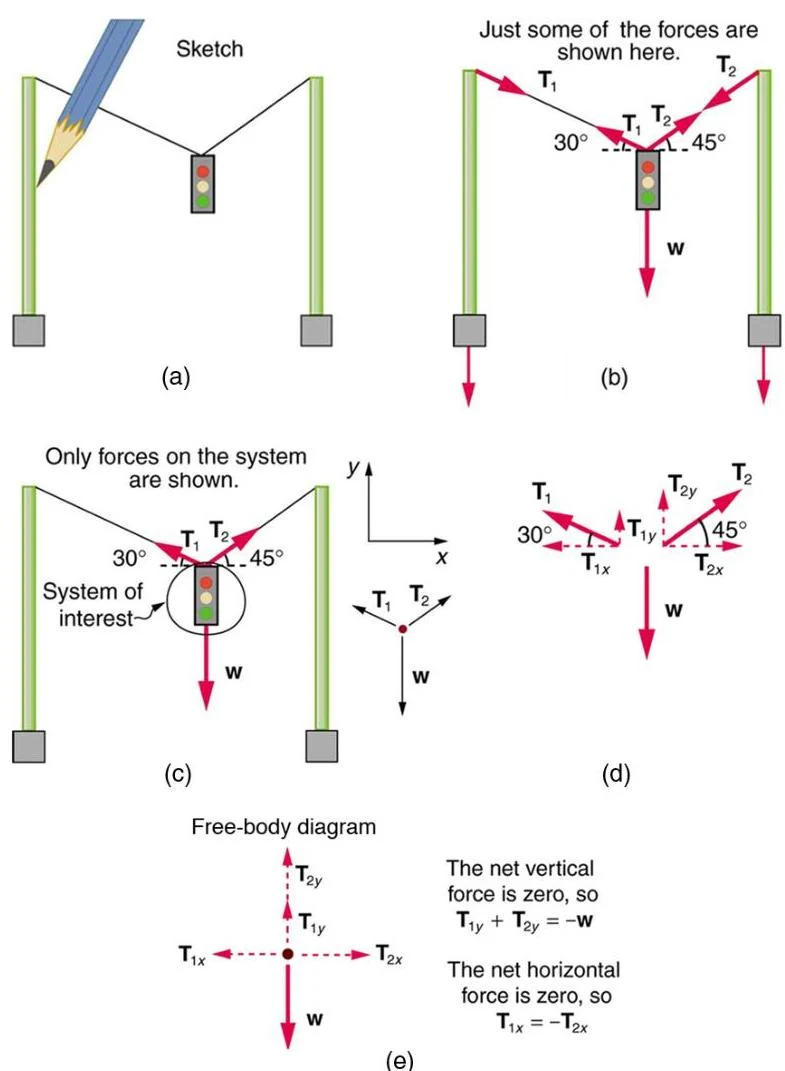
For a traffic light suspended by two wires at different angles, we must ensure that the net force in both the x and y directions is zero (static equilibrium):
Horizontal:T1x=T2x
Vertical:T1y+T2y=w (where w is weight)
This illustration shows a free-body diagram of forces acting on a traffic light suspended by two ropes. It breaks down the forces into their horizontal and vertical components and demonstrates the equilibrium conditions.
Case Study 3: Normal Force in an Elevator
A common misconception is that the "normal force" (the upward force supporting an object) is always equal to the object's weight. However, if an object is accelerating, this is not the case.
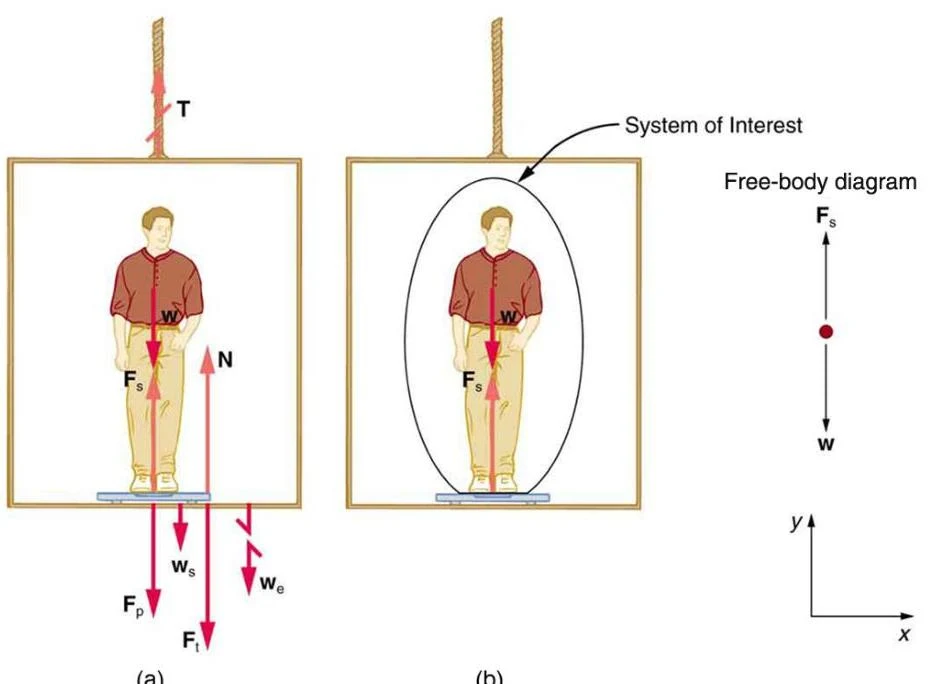
If you stand on a scale in an elevator that is accelerating upward, the scale must push up with more force than your weight to create that upward acceleration:
Fs=ma+mg
Diagrams illustrating forces acting on a person in a box, including a free-body diagram.
If the elevator moves at a constant speed, the acceleration is zero, and the scale reading returns to your actual weight (Fs=mg).
Integrating Dynamics and Kinematics
The most powerful way to use these laws is to integrate them with kinematics (the study of motion without considering its causes). When a problem asks for a force but only provides velocity and time, you must first find the acceleration using kinematic equations before applying Newton's Second Law.
Example Strategy for Integrated Problems:
Identify Principles: Determine if you need kinematics (for a,v,Δt) or dynamics (for $F, m$).
Solve Kinematics: Find the acceleration (a=ΔtΔv).
Solve Dynamics: Use the acceleration to find the net force (Fnet=ma).
By following these steps, you can bridge the gap between how an object moves and why it moves.
Keep reading for free.
Create an account to finish this reading and make it part of your study routine.