An overview of antimicrobial proteins, including interferons and the complement system, as key components of the innate immune response against pathogens.
When a pathogen—such as a virus or a bacterium—breaches the body's physical barriers like the skin or mucous membranes, the immune system immediately deploys a multi-layered defense strategy. While the third line of defense (adaptive immunity) is highly specific and provides long-term memory, the body relies heavily on the second line of defense for immediate protection. This second line consists of innate immunity: a local, non-specific response that guards equally against a broad range of pathogens without the ability to "remember" them for future encounters. Central to this innate response are antimicrobial proteins, which act as rapid-response tools to inhibit microbial reproduction and facilitate pathogen destruction.
The Two Families of Antimicrobial Proteins
Antimicrobial proteins are primarily categorized into two distinct families: interferons and the complement system. While they function through different biological mechanisms, both serve the ultimate goal of neutralizing threats before they can establish a systemic infection.
Interferons: The Viral Alarm System
Interferons are a specific type of cytokine—small proteins that regulate immunity—secreted by cells that have already been infected by a virus. Unlike many other immune components, interferons do not directly kill the virus; instead, they act as a warning signal.
These proteins function in an autocrine manner (acting on the cell that secreted them) and a paracrine manner (acting on neighboring cells). When an interferon binds to surface receptors on a healthy neighboring cell, it activates a second-messenger system within that cell. This activation triggers the synthesis of defensive proteins that can break down viral genes or prevent the virus from replicating its genetic material.
Furthermore, interferons play a critical role in recruiting cellular "soldiers." They activate Natural Killer (NK) cells and macrophages. NK cells are large lymphocytes that patrol the body to destroy host cells that have become infected or cancerous by releasing proteins that create holes in the target cell's membrane. By activating these cells, interferons ensure that infected cells are destroyed before they can release a "swarm" of newly replicated viruses into the surrounding tissue.
Diagram illustrating how an infected cell releases interferons, which then bind to receptors on healthy neighboring cells, signaling them to prepare for potential infection.
The Complement System: A Multi-Pathway Cascade
While interferons focus heavily on viral threats, the complement system provides a robust defense against a wide array of pathogens, including bacteria. This system consists of a group of 30 or more globular proteins synthesized mainly by the liver. These proteins circulate in the blood in an inactive form to prevent them from damaging the body's own healthy tissues.
Activation occurs when these proteins encounter a pathogen through one of three distinct routes:
The Classical Pathway: Triggered by the binding of antibodies to an antigen.
The Alternative Pathway: Triggered by the direct interaction of complement proteins with the surface of a pathogen.
The Lectin Pathway: Triggered by the binding of lectins to specific carbohydrate patterns on microbial surfaces.
Exam Tip: Remember that the complement system is a "cascade." One activated protein triggers the next, leading to a massive, amplified response that results in rapid pathogen destruction.
Mechanisms of Pathogen Destruction
Once the complement system is activated, it utilizes four primary mechanisms to eliminate the threat: inflammation, immune clearance, phagocytosis, and cytolysis.
1. Inflammation
The complement protein C3a plays a vital role in the inflammatory response. It stimulates mast cells and basophils to secrete histamine. Histamine acts as a vasodilator, increasing blood flow to the site of infection and attracting neutrophils and macrophages to the area. This influx of white blood cells accelerates the destruction of the invading pathogen.
2. Immune Clearance
The complement system helps the body "clean up" foreign substances from the bloodstream. The protein C3b binds to antigen-antibody (Ag-Ab) complexes. These complexes are then attached to red blood cells (RBCs). As these RBCs circulate through the liver and spleen, specialized macrophages strip the complexes away and destroy them, leaving the RBCs unharmed. This is the principal method for clearing foreign antigens from the blood.
3. Phagocytosis and Opsonization
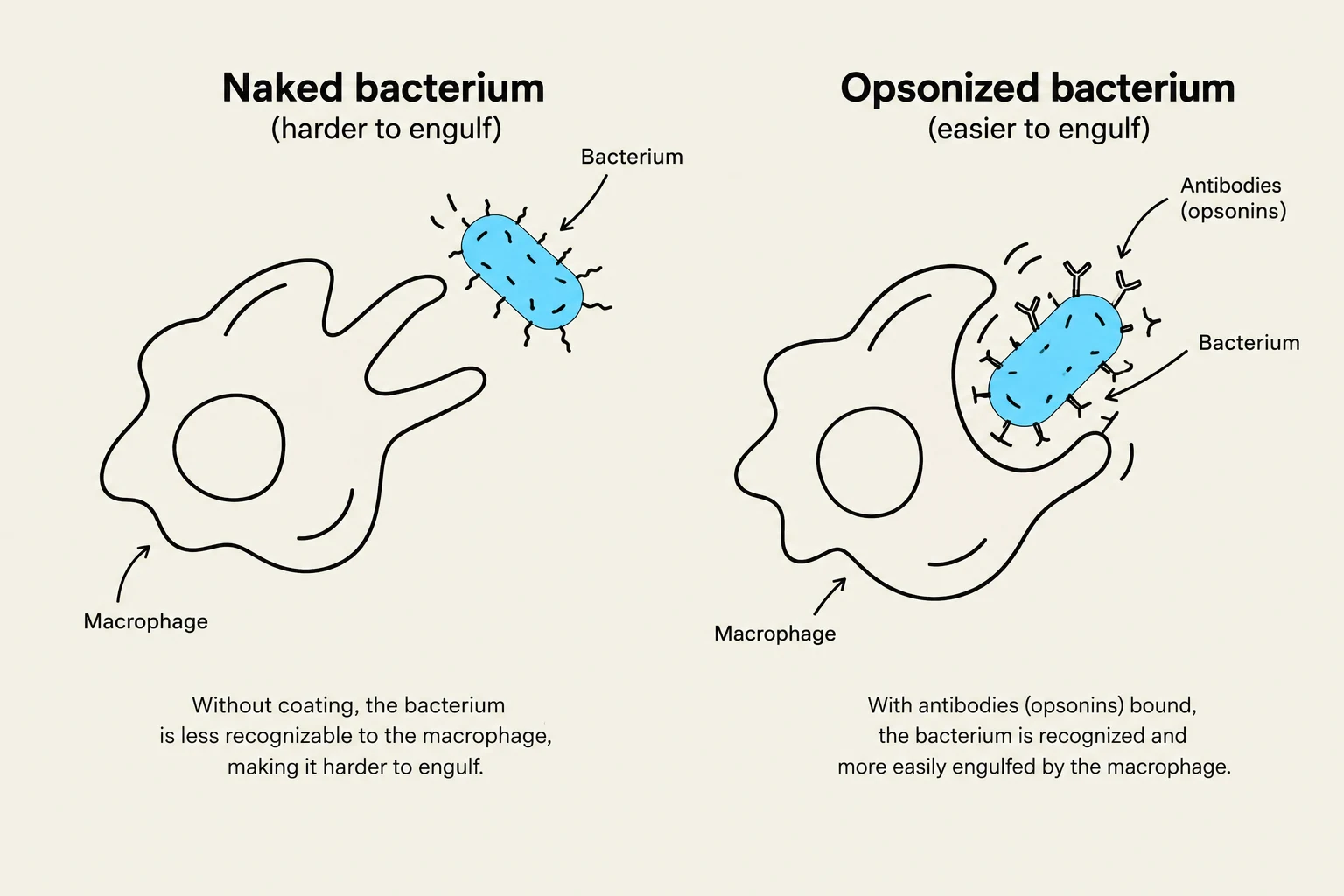
Many pathogens, such as certain bacteria, are "naked," meaning they lack the molecular markers that make them easy for immune cells to grab. To solve this, the complement system performs opsonization. During this process, C3b coats the microbial cell, acting like a molecular "handle" or "tag". This creates specific binding sites that allow neutrophils and macrophages to attach to and ingest the pathogen much more effectively.
This illustration depicts the difference between a naked bacterium and an opsonized bacterium, showing how antibodies (opsonins) facilitate phagocytosis by macrophages.
4. Cytolysis via the Membrane Attack Complex (MAC)
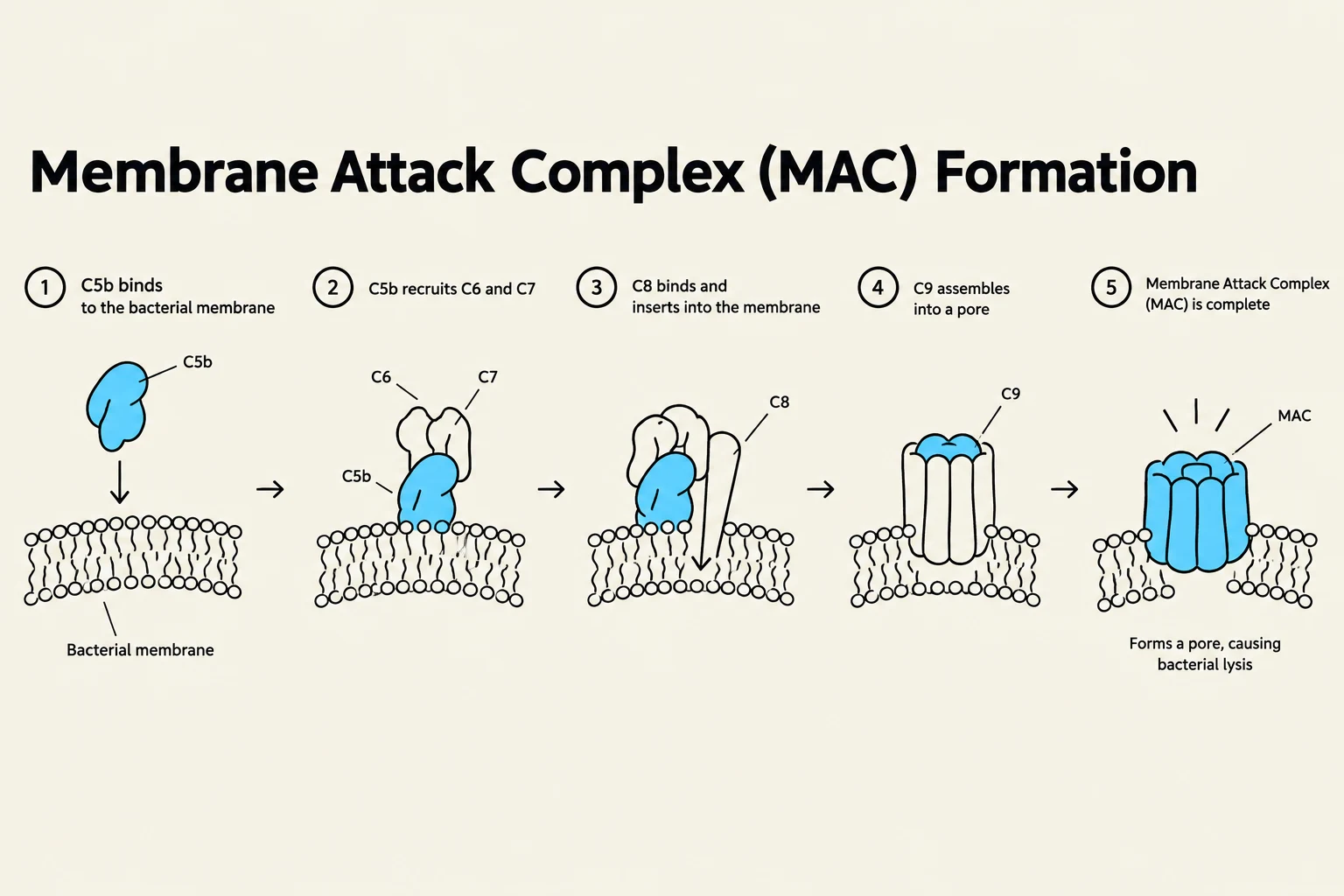
The most direct method of destruction is cytolysis, which involves physically rupturing the pathogen's cell membrane. The process follows a specific biochemical sequence:
C3b facilitates the splitting of the complement protein C5 into two fragments: C5a and C5b.
C5b binds to the surface of the target cell and attracts additional complement proteins.
These proteins polymerize to form the Membrane Attack Complex (MAC).
The MAC creates a physical hole (pore) in the target cell membrane.
As a result of this pore, electrolytes leak out of the cell and water flows in rapidly due to osmotic pressure, causing the cell to swell and eventually rupture.
Diagram illustrating the formation of the Membrane Attack Complex (MAC) and its role in causing bacterial lysis.
Summary of Innate vs. Adaptive Responses
To understand the role of these proteins, it is helpful to contrast the two main branches of the immune system:
Feature
Innate Immunity
Adaptive Immunity
Response Time
Immediate / Short-term
Delayed (days)
Specificity
Non-specific (broad range)
Highly specific (targeted)
Memory
None
Long-term memory
Key Components
Antimicrobial proteins, NK cells, Macrophages, Inflammation
T cells, B cells, Antibodies
While antimicrobial proteins like interferons and the complement system provide the essential "first responders" to any infection, they work in tandem with the more sophisticated adaptive immune system to ensure the body is both defended in the moment and prepared for the future.
Keep reading for free.
Create an account to finish this reading and make it part of your study routine.