Learn how to annualize returns for short-term investments like Treasury bills, comparing Holding Period Return (HPR), Annual Percentage Rate (APR), and Effective Annual Rate (EAR), including continuous compounding.
When investing in short-term instruments like Treasury bills (T-bills), investors often encounter different ways of expressing interest rates. A single return figure might tell you what you earned over a few months, but it doesn't immediately tell you how that investment compares to a year-long bank account or a long-term bond. To make meaningful comparisons, we must learn how to "annualize" these returns using different compounding conventions.
Understanding the Holding Period Return (HPR)
The first step in analyzing any investment is determining the actual return earned during the specific window the money was committed. For Treasury bills, which are typically sold at a discount and mature at face value, this is known as the Holding Period Return (HPR).
Unlike a standard bond that pays periodic coupons, a T-bill's return comes from the difference between the discounted purchase price and the face value received at maturity.
Example Calculation:
Suppose you purchase a T-bill with a $$10,000$ face value for $$9,900$. The bill matures in six months. At maturity, you receive the full $$10,000$. The HPR is calculated as follows:
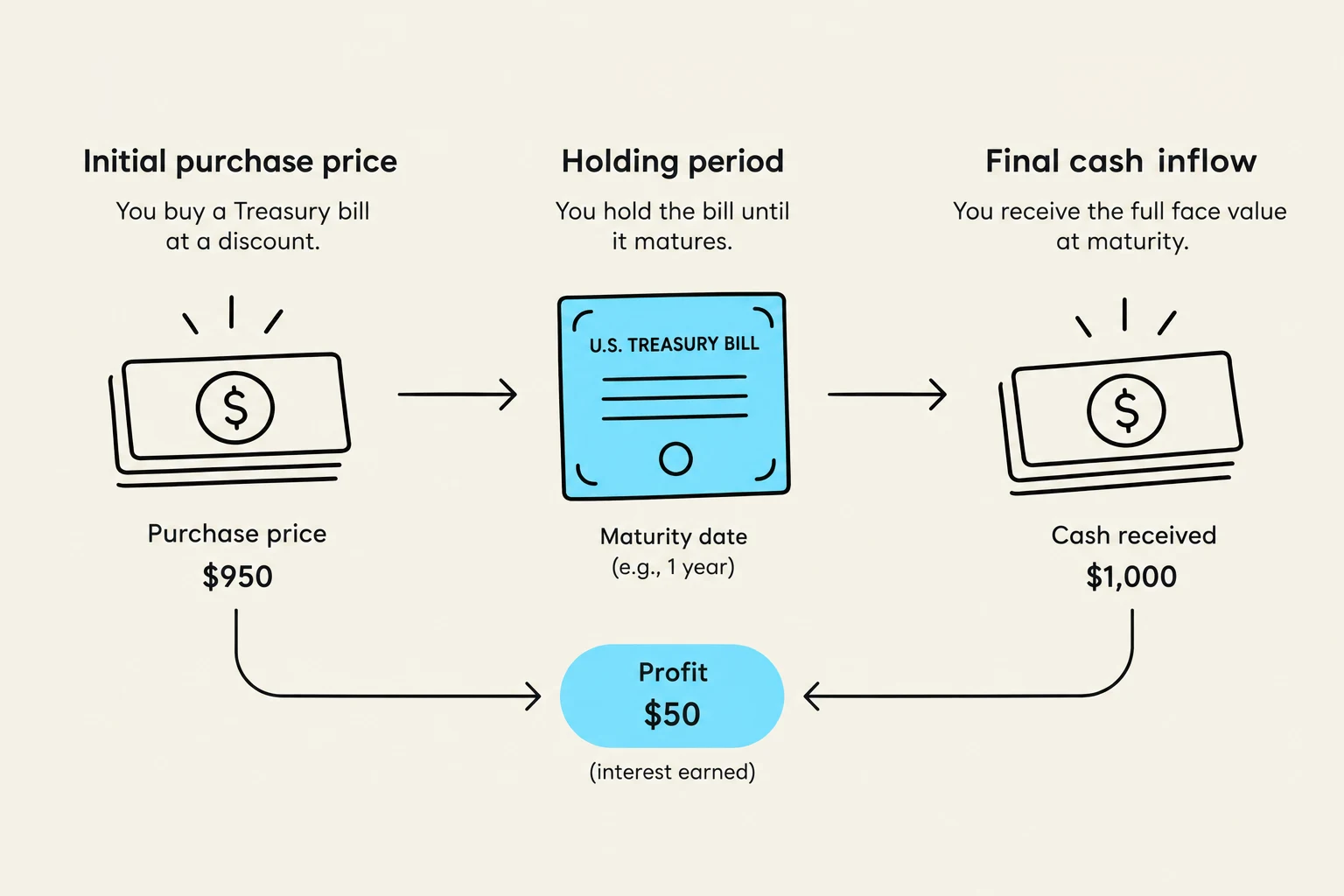
This diagram illustrates the process of purchasing a U.S. Treasury bill at a discount, holding it until maturity, and receiving the full face value, resulting in a profit from the interest earned.
Annual Percentage Rate (APR) vs. Effective Annual Rate (EAR)
Once we have the HPR, we need to scale it to a one-year timeframe. However, there are two primary ways to do this, and they yield different results.
The Annual Percentage Rate (APR)
The APR is the simplest method of annualization. It essentially takes the return for a specific period and multiplies it by the number of such periods in a year. In our six-month example, there are two six-month periods in a year, so we simply double the HPR:
APR=1.01%×2=2.02%
The Effective Annual Rate (EAR)
The EAR is a more accurate representation of the actual wealth generated over a year because it accounts for compounding—the idea that you could reinvest your initial principal plus your earnings at the end of the first period.
Using our example, if we reinvest the $$10,000$ at the same rate for the second six months, the calculation is:
1+EAR=(1+HPR)n
1+EAR=(1.0101)2=1.0203
EAR=0.0203=2.03%
Exam Tip: Always check if a question asks for the "nominal" rate (often referring to APR) or the "effective" rate (EAR). The EAR will always be higher than the APR if there is more than one compounding period per year.
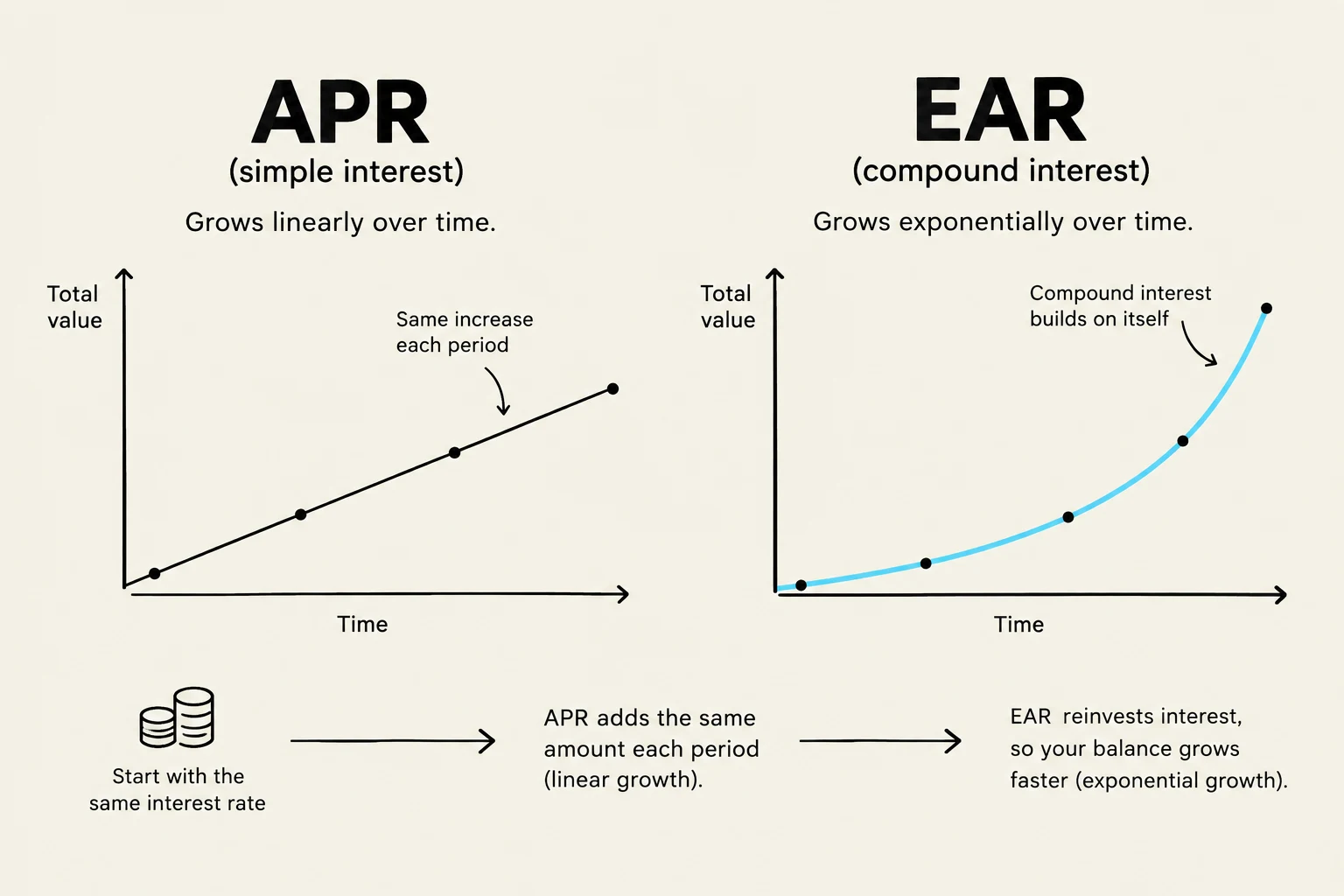
This illustration compares Annual Percentage Rate (APR) with simple interest, showing linear growth, to the Annual Equivalent Rate (EAR) with compound interest, demonstrating exponential growth.
Continuous Compounding
In theoretical finance and complex modeling, we often assume that interest is compounded not just monthly or daily, but every single infinitesimal moment. This is known as continuous compounding.
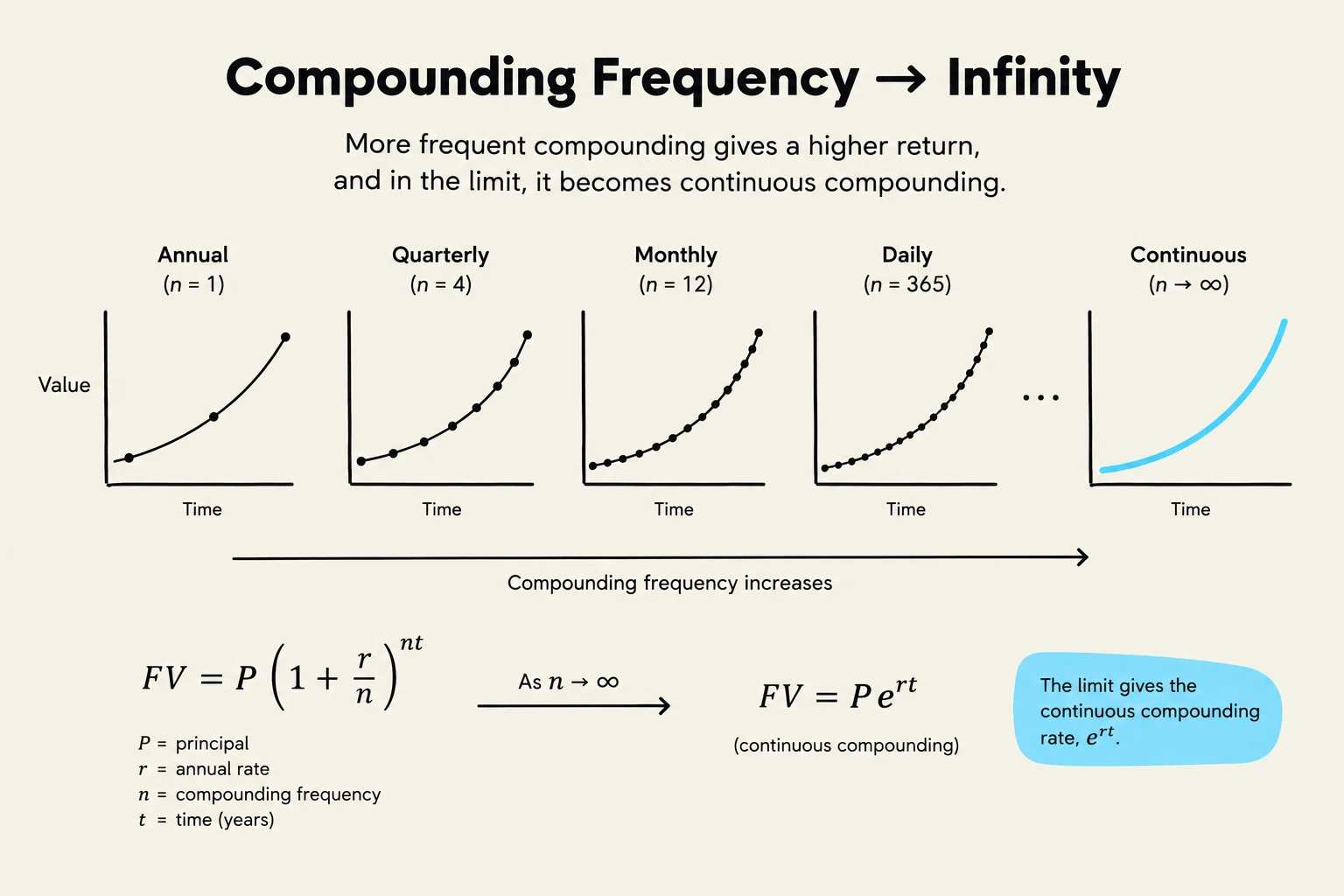
As the frequency of compounding (n) approaches infinity, the relationship between the APR and the EAR stabilizes into a specific mathematical form involving the constant e (approximately 2.718).
The relationship is defined by the following formula:
1+EAR=eAPR
Alternatively, if you are working backward from an EAR to find the continuously compounded rate, you use the natural logarithm (ln):
APR=ln(1+EAR)=rcc
In this context, rcc is the specific notation used to denote a continuously compounded rate.
This illustration demonstrates how compounding frequency affects investment growth, showing that as compounding frequency increases towards infinity, the growth approaches continuous compounding, represented by the formula FV = Pe^rt.
Summary Table of Annualization
To keep these concepts straight, refer to this summary of our Treasury-bill example:
Metric
Formula/Method
Result
HPR
(Profit/Initial Price)
$1.01%$
APR
HPR×Periods per Year
$2.02%$
EAR
(1+HPR)n−1
$2.03%$
While these calculations provide a mathematical foundation for comparing returns, remember that they do not account for the two most significant real-world risks: the uncertainty of future investment outcomes and the eroding effect of inflation.
Keep reading for free.
Create an account to finish this reading and make it part of your study routine.