The history of life on Earth is a story of adaptation, and perhaps no group demonstrates this more effectively than the angiosperms. While early land plants were tethered to moist environments for survival, the evolution of seed plants allowed vegetation to colonize diverse, often arid, landscapes. Today, flowering plants (angiosperms) are the most successful group of the modern era, thanks to a suite of evolutionary innovations ranging from sophisticated reproductive strategies to advanced internal plumbing.
From Homospory to Heterospory
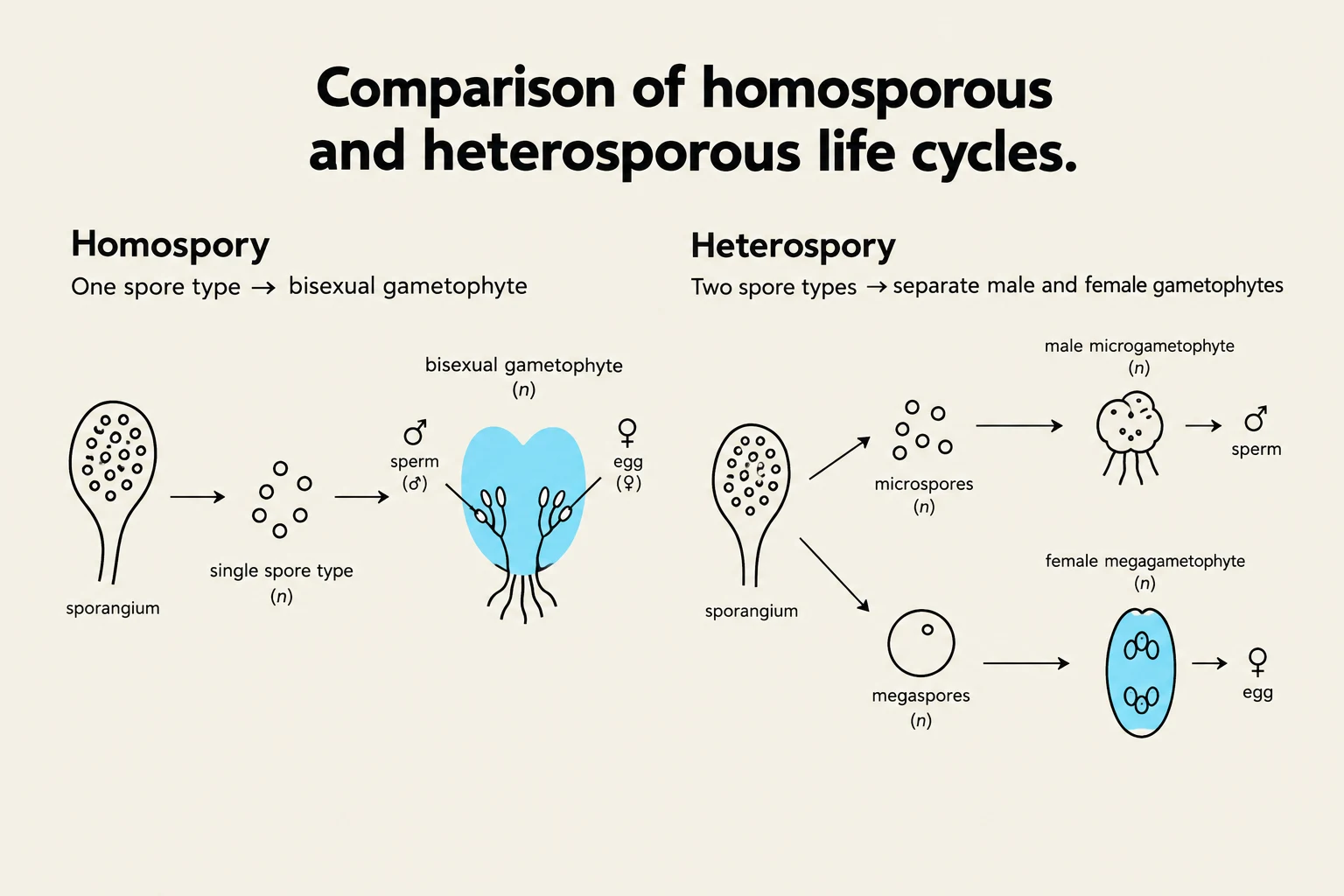
Comparison of homosporous and heterosporous life cycles in plants, illustrating the differences in spore types and gametophyte development.
To understand why angiosperms are so successful, we must first look at the fundamental shift in how plants reproduce. Early land plants, such as non-vascular mosses and seedless vascular plants like the ostrich fern, utilize a life cycle known as homospory. In a homosporous system, a single type of spore is produced, which then develops into a gametophyte that houses both male and female reproductive organs.
However, a major evolutionary turning point occurred with the transition to heterospory. In heterosporous plants, the organism produces two distinct types of spores:
Microspores: These are smaller spores that develop into the microgametophyte (commonly known as pollen).
Megaspores: These are larger spores that develop into the megagametophyte (the female reproductive structure within the ovule).
This division of labor allows for much greater specialization in reproduction. In seed plants, the relationship between the generations also shifts: while a moss gametophyte nourishes the sporophyte, in seed plants, the sporophyte (the visible, diploid plant) provides the nourishment for the gametophyte.
The Evolution of the Seed
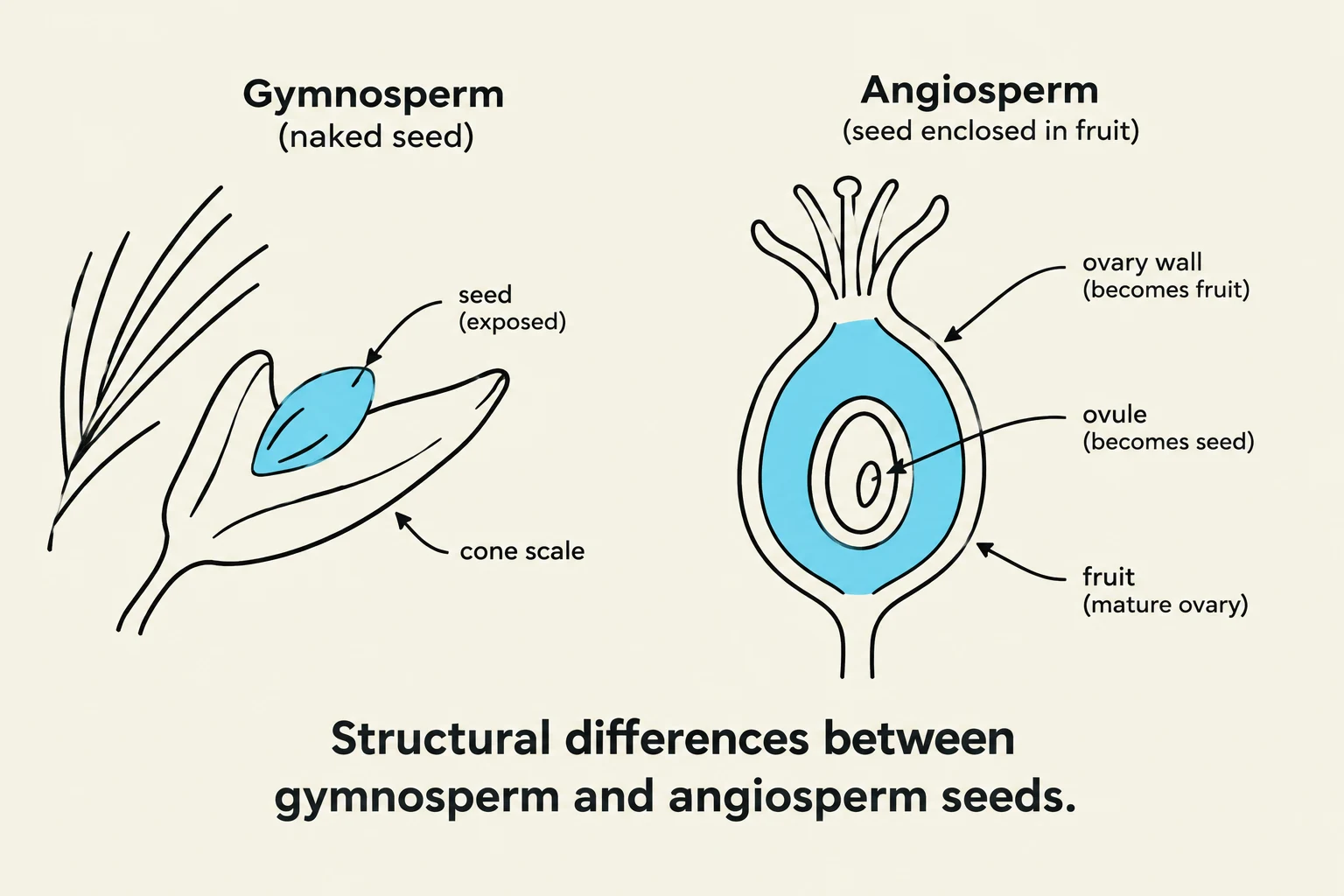
This diagram illustrates the structural differences between gymnosperm and angiosperm seeds, highlighting that gymnosperms have naked seeds exposed on cone scales, while angiosperms have seeds enclosed within a fruit derived from the ovary wall.
The development of the seed is one of the most significant advantages in plant evolution. In heterosporous plants, the megasporangium is enclosed within protective layers called integuments to produce an ovule. Once fertilization occurs, these ovules become seeds.
Seeds offer several critical advantages over the spores of ferns or mosses:
Protection and Nutrition: Seeds act as a mobile food source for the developing embryo.
Dormancy and Timing: Seeds ensure that germination occurs only when environmental conditions are ideal for survival.
Dispersal: Unlike spores, which are often single cells, seeds are robust packages capable of traveling to new habitats.
Gymnosperms vs. Angiosperms
It is important to distinguish between the two main groups of seed plants. Gymnosperms (from the Greek for "naked seeds"), such as the spruce tree, produce seeds that are not enclosed in an ovary. In contrast, angiosperms, such as the mango tree, enclose their seeds within an ovary, which eventually matures into a fruit.
Exam Tip: Comparing Spore Strategies
When reviewing for exams, remember the distinction in spore retention. Mosses and ferns generally release their spores into the environment, whereas seed plants (gymnosperms and angiosperms) retain their spores within the parent plant to develop into gametophytes.
Angiosperm Reproductive Innovations
Angiosperms have taken the heterosporous blueprint and optimized it through several key "synapomorphies" (shared derived traits) that drive their massive success.
Animal-Facilitated Pollination
While many gymnosperms rely on the wind to move pollen from male to female cones (a process that requires producing massive amounts of pollen to ensure success), angiosperms have mastered animal pollination. By using petals to attract pollinators like insects or birds, angiosperms increase their odds of successful pollination while requiring a lower relative investment in pollen production.
The Complexity of the Flower
The flower is a highly modified structure composed of specialized "sporophylls" (leaves that bear spores). A typical flower consists of four whorls:
Sepals: Protective outer layers.
Petals: Colorful structures designed to attract pollinators.
Stamens: The male reproductive organs, derived from microsporophylls.
Carpels: The female reproductive organs, derived from megasporophylls, which eventually become the fruit.
Double Fertilization and Endosperm
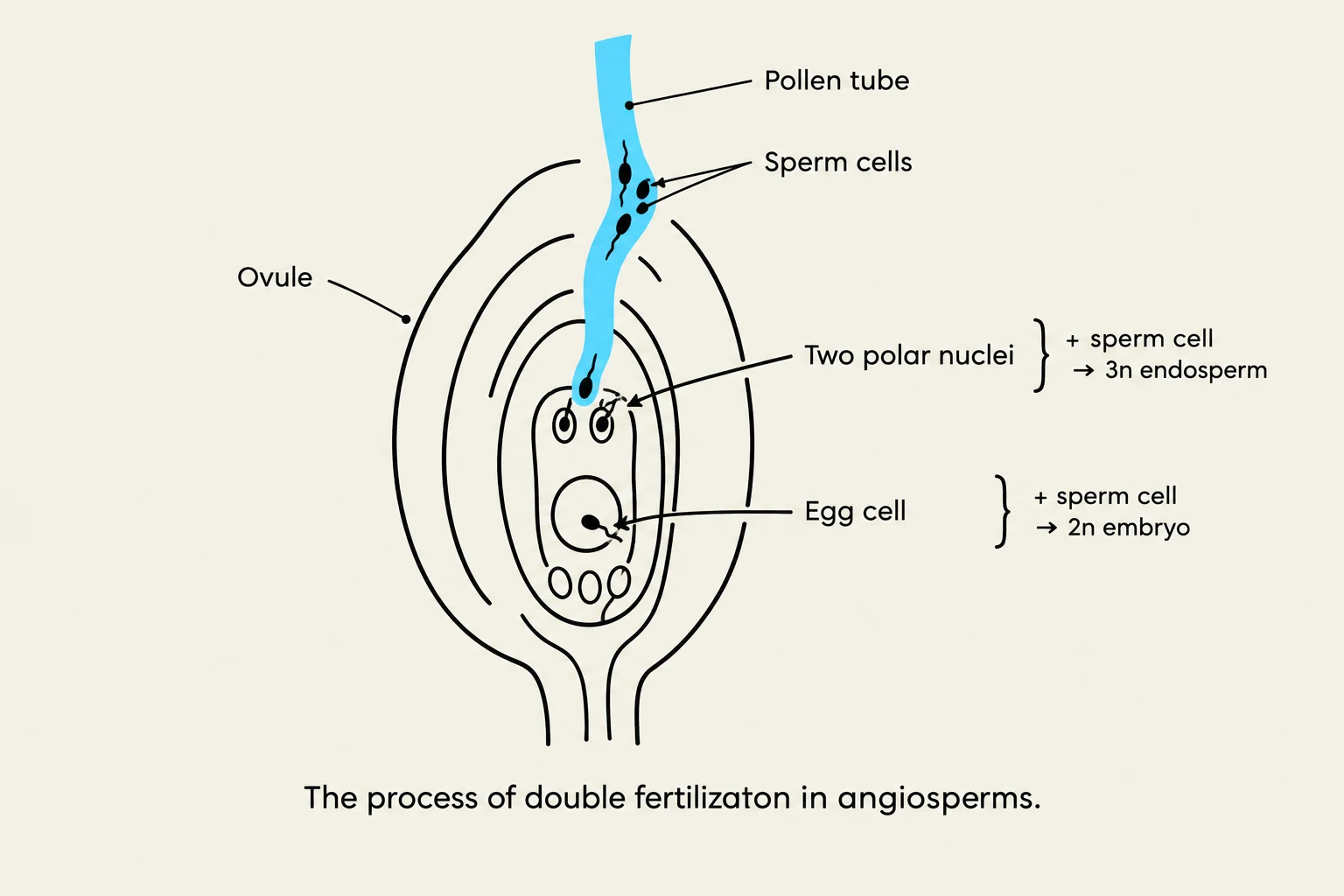
The process of double fertilization in angiosperms.
One of the most unique features of the angiosperm life cycle is double fertilization. During this process, the microgametophyte (pollen) delivers two sperm cells to the ovule:
One sperm fertilizes the egg to form the diploid ($2n$) embryo.
The second sperm fertilizes the polar nuclei to form a triploid ($3n$) endosperm.
The endosperm serves as a highly efficient food source for the developing embryo, ensuring the seedling has the energy required to grow before it can support itself via photosynthesis.
Advanced Vascular Tissue
Beyond reproduction, angiosperms have achieved dominance through physiological efficiency. They possess new conducting cell types in their xylem tissue. This improved vascular system allows for more efficient transport of water and nutrients, supporting larger growth forms and higher metabolic rates compared to their ancestors.
By combining water-independent reproduction (via pollen), protected and nourished offspring (via seeds and endosperm), and efficient nutrient transport (via advanced xylem), angiosperms have secured their place as the dominant plant group on Earth.
Keep reading for free.
Create an account to finish this reading and make it part of your study routine.