


The urinary system is a vital regulatory network responsible for maintaining homeostasis by managing blood volume, blood pressure, blood pH, and ion concentrations such as , $K^+$, , and $Cl^-$. It also serves as the body's primary filtration system, excreting metabolic wastes like urea and bilirubin, as well as foreign toxins and drugs. At the heart of this process is the nephron, the functional unit of the kidney. Within each nephron, the very first step of urine formation occurs in the renal corpuscle, where blood plasma is filtered through a highly specialized, three-layered structure known as the glomerular filtration membrane.
The Renal Corpuscle and Bowman's Capsule
To understand the filtration membrane, one must first understand its anatomical context. The renal corpuscle is the site where blood filtration begins. It consists of two primary components: the glomerulus and Bowman's capsule.
The glomerulus is a "tangled ball" of capillaries that receives blood via the afferent arteriole. Surrounding this capillary bed is Bowman's capsule, a double-walled epithelial cup that captures the fluid (filtrate) that escapes the capillaries.
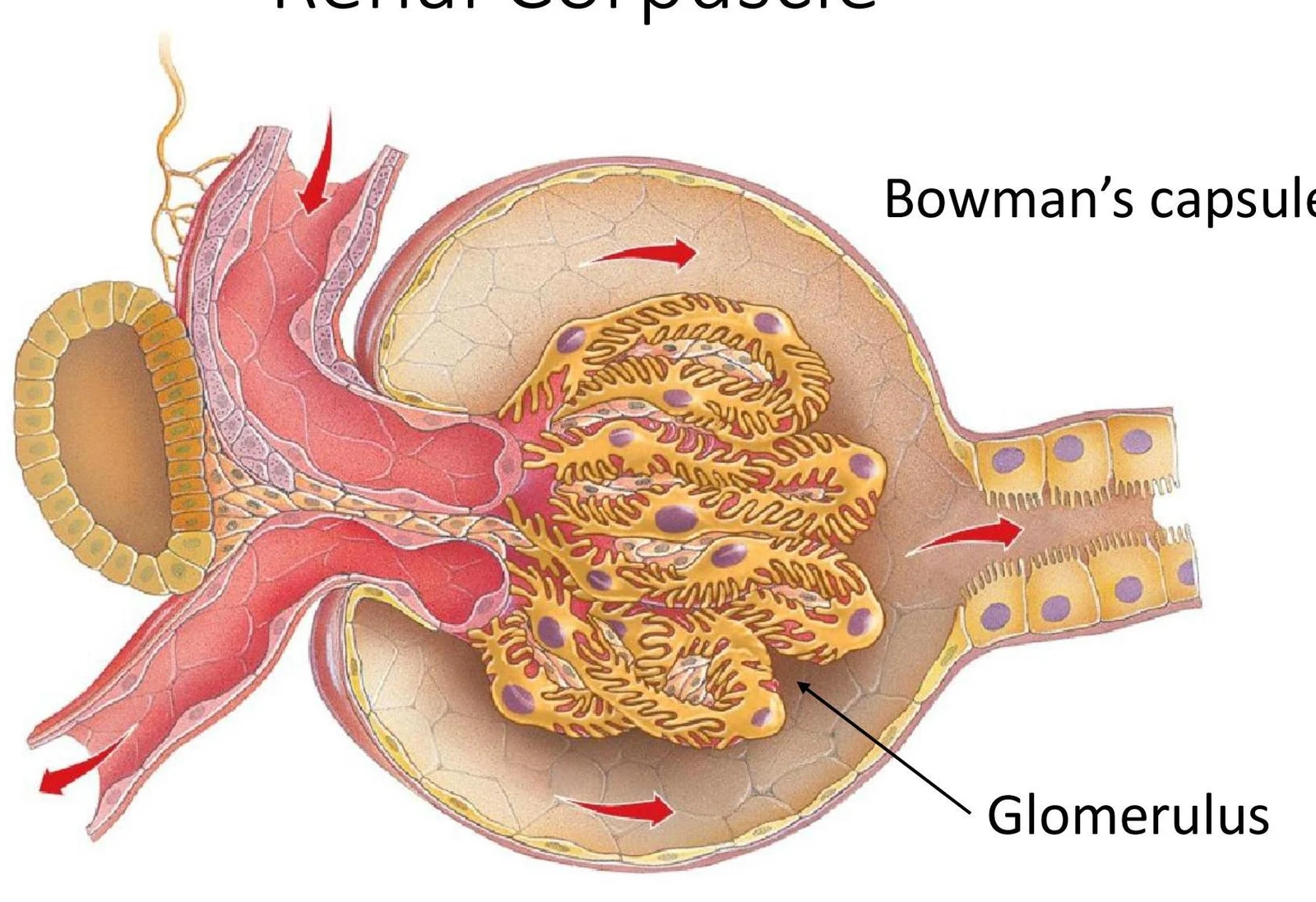
As blood flows through the glomerular capillaries, it must pass through the filtration membrane to enter the space within Bowman's capsule. This membrane acts as a sophisticated biological sieve, selecting which substances stay in the blood and which enter the renal tubules to eventually become urine.
Layer 1: Fenestrations of the Glomerular Endothelial Cells
The first barrier encountered by blood cells is the endothelial layer of the glomerular capillaries. Unlike the continuous endothelium found in many other vessels, the glomerular endothelial cells are "leaky". They contain numerous large pores called fenestrations.

Keep reading for free.
Create an account to finish this reading and make it part of your study routine.
Continue reading freeAlready have an account? Log in
Updated