An educational overview of the lymphatic system, detailing its structure, the formation and composition of lymph, lymphatic vessels, secondary lymphoid organs like lymph nodes and the spleen, and its crucial roles in fluid balance, transport, and immunity.
The lymphatic system is a complex and vital network of vessels and secondary lymphoid organs designed to drain fluid from the extracellular compartment and maintain physiological balance. While often overshadowed by the circulatory system, the lymphatic system is essential for fluid homeostasis, the absorption of fats, and the orchestration of the body's immune responses.
The Extracellular Compartment and Tissue Fluid
To understand how the lymphatic system works, one must first understand the environment in which it operates. The body's fluids are divided into compartments. The most significant for this system is the extracellular compartment, which contains the interstitial space.
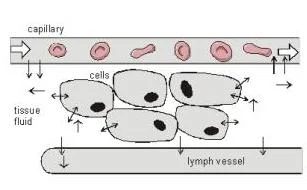
The interstitial space is the area surrounding the cells of the body. It is bathed in tissue fluid (also known as interstitial fluid), which is the widest distributed tissue in the body. This fluid occupies the space between the blood capillaries and the individual cells, providing a medium for nutrient exchange and waste removal.
Diagram illustrating the exchange of substances between a capillary, tissue fluid, cells, and a lymph vessel.
Lymph Formation and Composition
Lymph formation occurs when blood plasma escapes from the capillaries of the circulatory system and enters the extracellular compartment. As plasma moves through the tissues, approximately 8/10 of it is reabsorbed directly by the venous system, but the remaining 1/10 must be collected and returned to the blood via the lymphatic vessels.
Once this fluid enters the lymphatic vessels, it is referred to as lymph. Lymph is a transudative fluid that is transparent, yellowish in appearance, and alkaline in nature.
Composition of Lymph
The composition of lymph is primarily water, which acts as the solvent, but it also carries various solutes:
Water: Makes up $96%$ of the volume.
Proteins: $2-6%$ of the volume.
Lipids: $5-15%$ of the volume.
Carbohydrates: Primarily glucose, at approximately 132 mg/100 ml.
Electrolytes: Including sodium, calcium, potassium, chloride, and bicarbonate.
Cells: Predominantly lymphocytes.
Note on Chyle: A specialized form of lymph produced by the small intestine, which is particularly rich in lipids absorbed from the digestive tract, is known as chyle.
Lymphatic Vessels and Drainage Organization
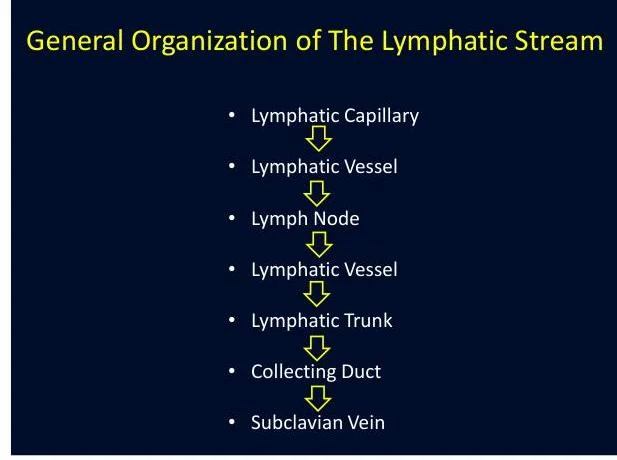
The lymphatic system lacks a central pump like the heart. Instead, the movement of lymph relies on external mechanisms such as breathing and muscle contractions. The flow follows a specific hierarchical path:
Lymphatic Capillaries: Blind-ended vessels that pick up fluid.
Lymphatic Vessels: Larger channels that transport the fluid.
Lymph Nodes: Filtration stations.
Lymphatic Trunks: Large vessels that collect lymph from specific regions.
Collecting Ducts: The final large vessels that return lymph to the venous system.
Diagram illustrating the general organization of the lymphatic stream, showing the flow from lymphatic capillaries to the subclavian vein through vessels, lymph nodes, and collecting ducts.
The drainage is organized into two main systems: superficial and deep. Superficial lymph vessels drain the skin and follow the patterns of venous drainage, eventually emptying into deep lymph vessels. Deep lymph vessels typically accompany the arteries.
The Major Lymphatic Ducts
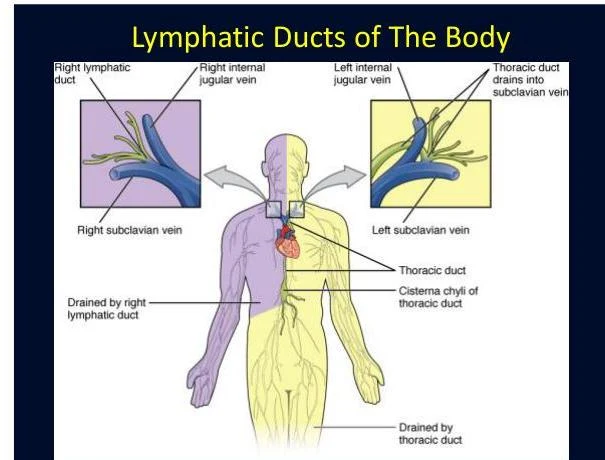
All lymph eventually returns to the circulatory system through two primary ducts located near the subclavian veins:
Thoracic Duct: Located on the left side, it handles the majority of the body's lymph flow, approximately 100 ml/hour.
Right Lymphatic Duct: Located on the right side, it drains a smaller portion, approximately 20 ml/hour.
Diagram illustrating the lymphatic ducts of the human body, including the thoracic duct and its drainage into the subclavian vein.
Secondary Lymphoid Organs and Immunity
While primary lymphoid organs (like the bone marrow and thymus) are responsible for the production and maturation of lymphocytes, the secondary lymphoid organs are the sites where immunological activity actually occurs.
Lymph Nodes
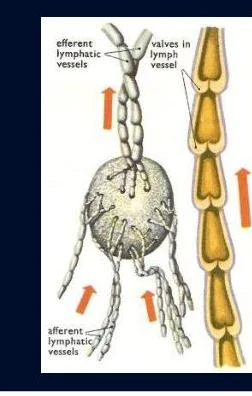
Lymph nodes are kidney or bean-shaped structures distributed throughout the body. They act as biological filters. Lymph enters the node through afferent channels, percolates through sinuses where it is cleaned by phagocytes and macrophages, and finally leaves through the efferent channel.
Diagram illustrating the structure and function of a lymph node and lymphatic vessels, showing afferent and efferent vessels and valves within a lymph vessel.
In clinical oncology, the sentinel lymph node is a critical concept. It is hypothesized to be the first node in a chain to receive drainage from a tumor. Identifying and analyzing these nodes is a standard procedure for determining if a cancer has begun to metastasize.
The Spleen
The spleen is another vital component of the system. It functions to collect waste products from the blood, remove dead or dying red blood cells, and facilitate the elaboration of lymphocytes.
Functional and Clinical Importance
The lymphatic system serves three primary functional roles:
Fluid Balance: It assists capillaries by returning leaked plasma proteins to the circulatory system and helps determine cell volume.
Transport: It moves cellular debris that cannot enter the blood vessels and absorbs fats from the digestive system.
Immunity: It serves as a major constituent of the immune system and a primary site for immunological activity.
Clinical Considerations
Because the lymphatic system is a continuous network, it can serve as a conduit for the spread of both infections and malignant diseases (cancer).
Clinical Alert: Lymphoedema
If the lymphatic vessels become blocked or damaged, the fluid cannot be drained effectively. This accumulation of fluid in the interstitial space leads to a condition known as lymphoedema.
At rest, the human body produces between 3 to 4 Litres of lymph per day. Maintaining the integrity of this system is crucial for preventing both localized swelling and the systemic spread of disease.
Keep reading for free.
Create an account to finish this reading and make it part of your study routine.