Language Specialization
In most individuals (over 90% of right-handers), language is lateralized to the left hemisphere. Two critical areas govern this:
- Broca’s Area: Located near the motor area for the lips and tongue; it manages grammar and speech production. Damage leads to expressive aphasia (knowing what to say but being unable to form words).
- Wernicke’s Area: Located near the auditory and visual cortices; it acts as a "dictionary" for meaning. Damage leads to receptive aphasia (a meaningless stream of words).
The Motor and Somatosensory Homunculi
The cortex maps specific body parts to specific brain regions. This mapping is visualized through "homunculi"—distorted representations of the human body based on cortical real estate.
The Primary Motor Cortex (located in the precentral gyrus) controls voluntary muscle movement via the corticospinal and corticobulbar tracts. The Primary Somatosensory Cortex (located in the postcentral gyrus) processes sensory input.
Clinical Pearl: The Homunculus and Blood Supply
The size of a body part on the homunculus reflects its density of innervation, not its physical size; hence, the hands, lips, and tongue occupy disproportionately large areas.
Furthermore, the split in the homunculus matches the arterial supply:
- Medial surface (Leg/Foot): Supplied by the Anterior Cerebral Artery (ACA).
- Lateral surface (Face/Arm): Supplied by the Middle Cerebral Artery (MCA).
The Thalamus, Hypothalamus, and Limbic System
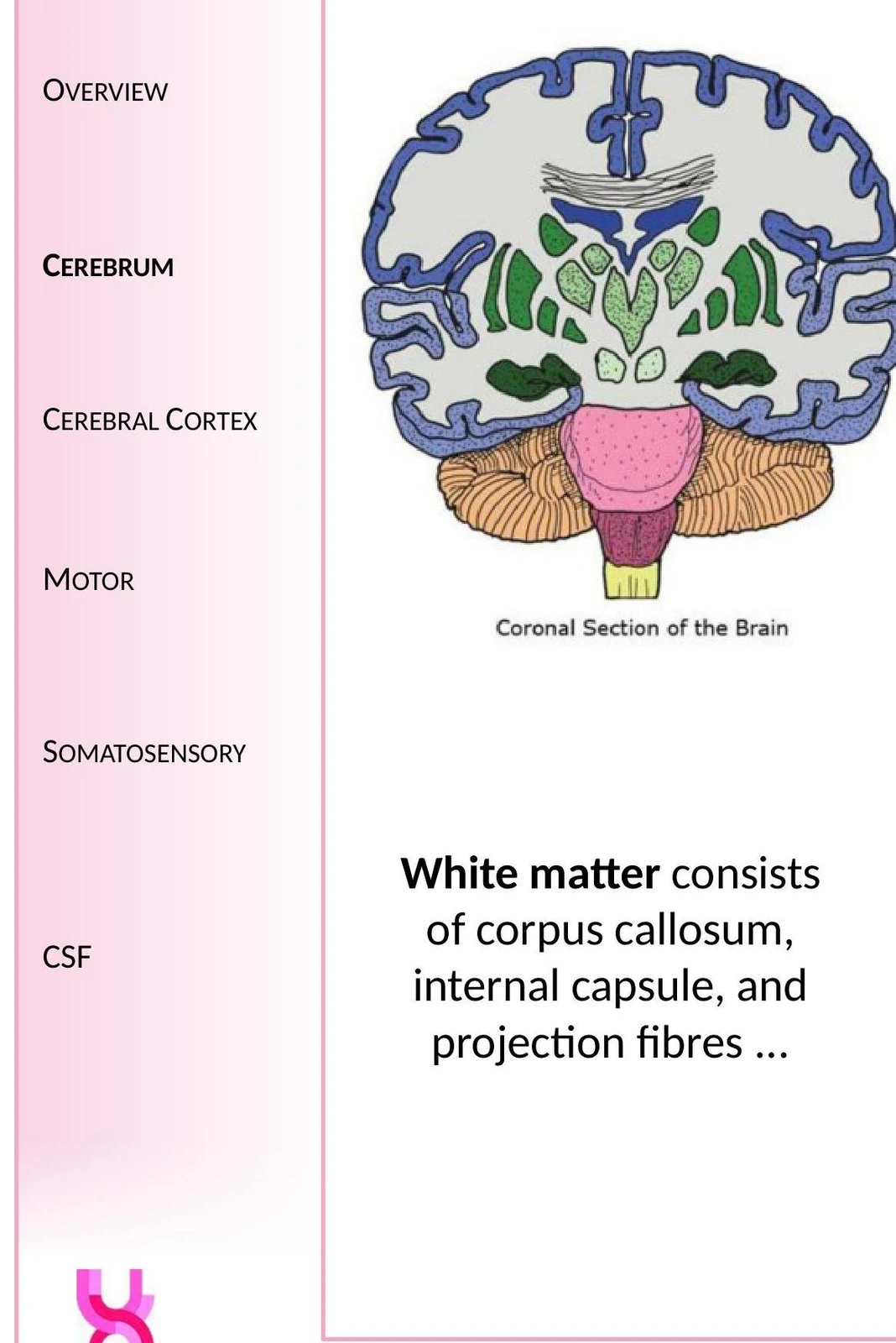
Deep within the cerebrum lie structures that regulate homeostasis, emotion, and sensory relay.
The Thalamus: The Relay Station
The thalamus contains approximately 50 distinct nuclei that act as a gateway for sensory and motor information. It regulates consciousness and sleep. Key nuclei include:
- Ventral Posterior (VP): Relays sensory info (VPL for the body; VPM for the face).
- Lateral Geniculate Nucleus (LGN): Relays visual information to the occipital lobe.
- Medial Geniculate Nucleus (MGN): Relays auditory information to the temporal lobe.
The Hypothalamus and Limbic System
The Hypothalamus is central to "The 2 H's": Homeostasis and Hormones.
The Limbic System supports emotion, motivation, long-term memory, and the stress response. Key components include the Amygdala (regulating anxiety, fear, and aggression) and the Cingulate Gyrus (processing emotions and reward-based decisions).
Basal Ganglia and Movement Facilitation
The basal ganglia are deep grey matter structures that facilitate movement by influencing the motor cortex. Their primary role is to increase the suppression of unwanted movements.
They operate through two primary pathways:
- Direct Pathway: "Frees" the thalamus to allow movement to proceed.
- Indirect Pathway: Inhibitory in nature, preventing unwanted movements from reaching the thalamus.
Damage to these inhibitory circuits can lead to various movement disorders, such as Parkinson’s disease, Huntington’s disease, or Tourette syndrome.
Protection: Meninges and CSF Circulation
The brain is protected by three layers of membranes called the meninges:
- Dura mater: The tough, outermost layer.
- Arachnoid mater: The thin middle layer.
- Pia mater: The delicate layer adherent to the brain surface.
Between these layers are critical spaces: the extradural (potential space), subdural (where bridging veins reside), and subarachnoid (which contains Cerebrospinal Fluid and major arteries).
Cerebrospinal Fluid (CSF) is produced by the choroid plexi in the ventricles. It circulates through the ventricular system and is eventually reabsorbed into the venous system via arachnoid granulations.
Clinical Note: Hydrocephalus and ICP
- Obstructive Hydrocephalus: Occurs when a physical mass (like a tumor) blocks CSF flow through the aqueduct.
- Communicating Hydrocephalus: Occurs when flow is open, but reabsorption fails (often after meningitis or hemorrhage).
- Normal Pressure Hydrocephalus (NPH): Often seen in older adults, presenting with a triad of gait disturbance, urinary incontinence, and cognitive decline.
Vascular Supply
The brain's blood supply is provided by the Circle of Willis, a circulatory anastomosis at the base of the brain. The major territories are supplied by:
- Anterior Cerebral Artery (ACA)
- Middle Cerebral Artery (MCA)
- Posterior Cerebral Artery (PCA).
Understanding these territories is vital for clinical practice, as the specific pattern of a patient's deficit (e.g., whether the leg or the face is more affected) can pinpoint which artery has been compromised by a stroke or lesion.