


The brainstem serves as the critical conduit between the higher centers of the brain and the spinal cord. It is not merely a "bridge" but a complex processing hub that regulates life-sustaining functions, including respiration, heart rate, and consciousness. To understand neuroanatomy, one must master the transition from the midbrain down through the pons and the medulla oblongata, eventually reaching the spinal cord.
The Pons: The Bridge of Communication
The pons is located between the midbrain above and the medulla oblongata below. Its name, derived from the Latin word for "bridge," is highly descriptive of its primary anatomical role. The pons acts as a massive relay station, facilitating communication between the cerebral cortex and the cerebellum.
Structurally, the pons is characterized by its bulbous appearance, which is caused by a large number of transverse fibers. These fibers, known as the pontocerebellar tracts, carry information from the pontine nuclei to the cerebellum, allowing for the coordination of motor movements and balance.
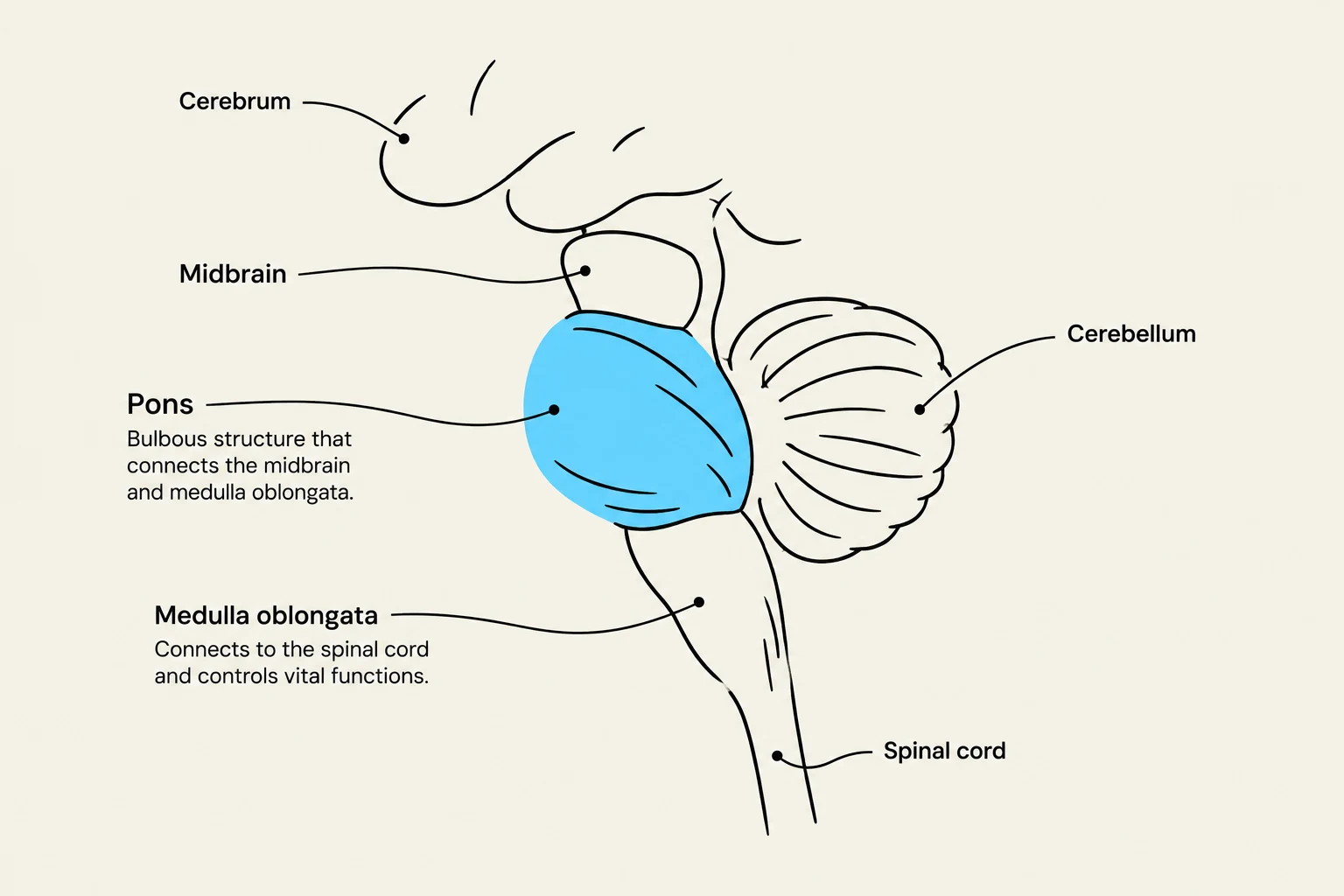
Beyond its relay functions, the pons contains several cranial nerve nuclei that control essential functions. For example, the nuclei for the trigeminal nerve (CN V), which manages facial sensation and mastication, are located within the pontine region.
Exam Tip: When studying the pons, remember that it is the primary site for the "pontine respiratory group," which helps regulate the rhythm of breathing by communicating with the medulla.
Keep reading for free.
Create an account to finish this reading and make it part of your study routine.
Continue reading freeAlready have an account? Log in
Updated