


The human foot is a complex mechanical structure designed to support body weight, absorb shock, and facilitate locomotion. This functionality is made possible by a sophisticated arrangement of bones connected by various types of joints. Understanding the specific classifications of these joints—whether they are simple hinge joints or more complex condylar joints—is essential for grasping how the foot achieves its wide range of motion, from the subtle gliding of the midfoot to the precise movement of the toes.
The Midfoot: Intertarsal and Tarsometatarsal Joints
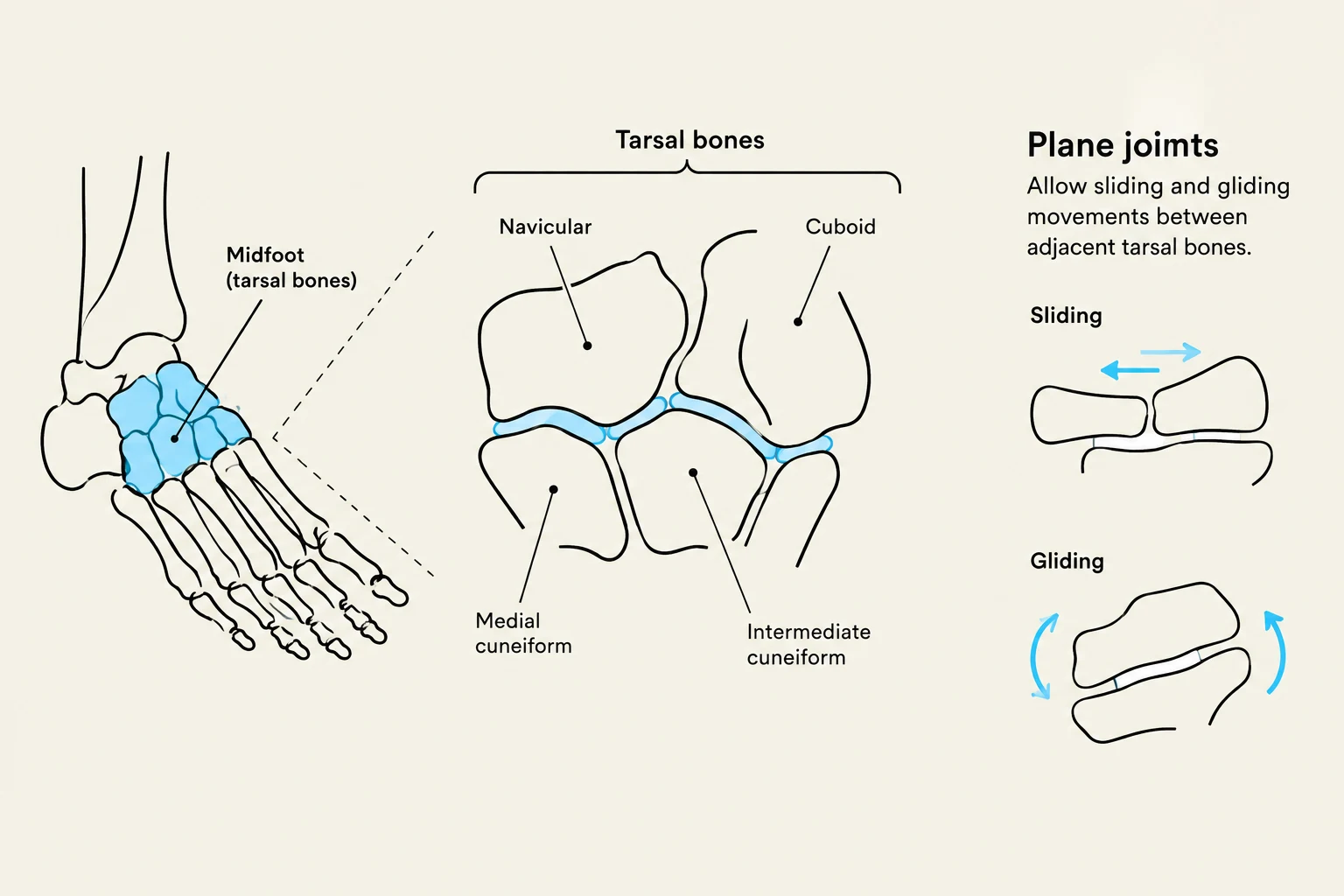
The proximal portion of the foot involves the tarsal bones and the metatarsals. These bones are connected by joints that prioritize stability and minor adjustments in foot shape during the gait cycle.
Intertarsal Joints
The intertarsal joints occur between the individual bones of the tarsus. These are classified as plane joints. In a plane joint, the articulating surfaces are relatively flat, which allows for a specific type of movement known as sliding/gliding. This movement is subtle but crucial for the foot to adapt to uneven terrain.
Tarsometatarsal Joints
Moving slightly distal, the tarsometatarsal joints connect the tarsal bones to the metatarsal bones. Similar to the intertarsal joints, these are also plane joints that facilitate sliding/gliding movements.
Keep reading for free.
Create an account to finish this reading and make it part of your study routine.
Continue reading freeAlready have an account? Log in
Updated