Anatomy and Biomechanics of the Hip and Pelvic Floor
Explores the structure and function of the human hip complex, including the pelvic floor, hip joint musculature, and biomechanics of movement, stability, and gait.
The human hip complex is a masterpiece of biological engineering, designed to solve a fundamental physiological conflict: the need for extreme stability to support the weight of the upper body, balanced against the need for mobility to allow for locomotion. As the central point of the skeletal architecture, the hip absorbs descending forces from gravity (the weight of the Head, Arms, and Trunk, or HAT) and ascending ground reaction forces (GRF). To understand how we walk, climb stairs, or maintain balance, we must examine the specialized layers of the pelvic floor and the complex muscular groups that govern the hip joint.
The Pelvic Floor: The Body's Internal Diaphragm
The pelvic floor is not a single muscle but a sophisticated, three-layered diaphragm that supports the abdominopelvic viscera. It plays a critical role in maintaining urinary and fecal continence, resisting increases in intra-abdominal pressure, and facilitating the transfer of forces to provide core stability.
The layers are organized from superficial to deep:
Superficial Layer: Comprised of the ischiocavernous and bulbospongiosus muscles.
Urogenital Diaphragm: A middle layer containing the sphincter urethrae, compressor urethrae, and urethrovaginal sphincter.
Pelvic Diaphragm: The largest and most significant component, consisting of the levator ani group—which includes the pubococcygeus, puborectalis, and iliococcygeus—and the coccygeus muscle.
Clinical Note: Because the pelvic floor acts as the base of the "core," dysfunction in these layers can lead to issues with pelvic pain or incontinence, which significantly impacts a patient's occupational participation and self-esteem.
Hip Joint Musculature: Functional Groups
The muscles surrounding the hip are categorized by their primary actions. However, their roles are not static; they change based on the position of the joint, a phenomenon known as inversion of function.
Hip Flexors
Flexors are essential for mobility, such as swinging the leg during gait.
Iliopsoas: The most critical hip flexor, particularly vital when simultaneous hip and knee flexion are required, such as when climbing stairs.
Sartorius: A versatile muscle that acts as a flexor, abductor, and external rotator.
Rectus Femoris: A flexor whose efficiency is highest when the knee is flexed.
Tensor Fasciae Latae (TFL): Assists in flexion, abduction, and internal rotation.
Hip Extensors
Extensors provide the power needed to move the body forward or resist gravity.
Gluteus Maximus: The strongest hip extensor, which is most effective when working against large resistance in a neutral position.
Hamstrings: These contribute to extension but are highly sensitive to knee position. If the knee is flexed beyond 90∘, the hamstrings may experience active insufficiency, meaning they are too short to produce effective force.
Hip Abductors and Adductors: The Stabilizers
While flexors and extensors drive movement, the abductors and adductors manage stability.
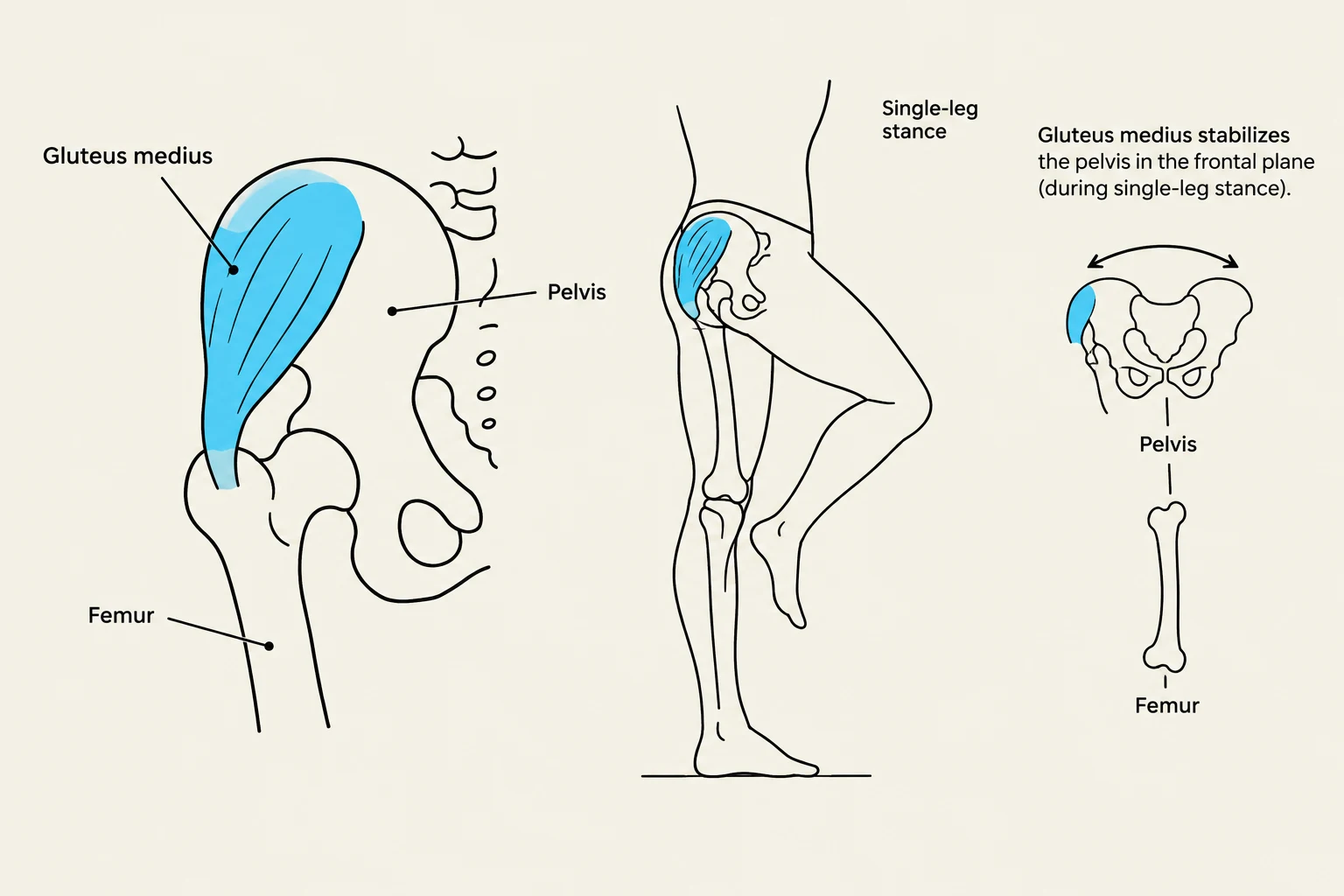
Abductors (Gluteus Medius and Minimus): These are the most important hip stabilizers. They are critical during a single-limb stance (when one foot is off the ground) to prevent the pelvis from dropping on the opposite side.
Adductors (Pectineus, Adductor Longus, Adductor Magnus, and Gracilis): These muscles work synergistically with the abductors to enhance side-to-side pelvic stabilization.
Diagram illustrating the gluteus medius muscle and its role in stabilizing the pelvis during a single-leg stance.
Hip Rotators and "Joint Compressors"
A group of muscles including the piriformis, gemelli, and obturators act as "joint compressors," similar to a rotator cuff in the shoulder. While they primarily provide external rotation, hip flexion significantly increases internal rotation torque in many muscles, helping to stabilize the femoral head within the acetabulum.
Biomechanics of Movement: Open vs. Closed Chains
To understand how these muscles function in real life, we must distinguish between Open Chain and Closed Chain movements.
Open Chain: The distal segment (the foot) is free to move. This allows the hip to move independently of the lower limb (e.g., swinging your leg while sitting).
Closed Chain: The distal segment (the foot) is fixed to a surface. In this state, hip motion often occurs as a result of the pelvis moving relative to the fixed femur (e.g., squatting or walking).
Exam Tip: Inversion of Function
Remember that a muscle's role is determined by the joint angle. For example, the adductors act as hip flexors when the hip is in a neutral position, but they act as hip extensors when the hip is in a flexed position.
Clinical Application: Stability and Gait
The importance of hip musculature is most evident when stability fails. During a single-leg stance, the stance-side hip must support approximately 5/6 of the total body weight. This creates an "External Hip Adduction moment" caused by gravity, which tries to tilt the pelvis downward.
To counter this, the stance-side hip abductors (Gluteus Medius/Minimus) must produce an "Internal Hip Abduction moment". The relationship can be expressed as:
Internal Abduction Moment=External Adduction Moment
If the abductors are weak, they cannot produce enough torque to stabilize the pelvis. This results in the pelvis dropping on the side of the lifted leg, a clinical sign known as a Trendelenburg gait.
Summary of Functional Loading
The hip must constantly manage forces from two directions:
Descending Forces: The weight of the Head, Arms, and Trunk (HAT).
Ascending Forces: Ground Reaction Forces (GRF) from the floor.
Whether you are climbing stairs (requiring massive force, up to 7x body weight) or simply standing, the coordination of the pelvic floor and the hip musculature ensures that these forces are distributed safely through the joint, allowing for efficient and stable movement.
Diagram illustrating the forces acting on the hip joint, showing the downward force (HAT) and upward force (G) and their net effect.
Keep reading for free.
Create an account to finish this reading and make it part of your study routine.