Learn about the standardized language of anatomy, including the anatomical position, directional terms, body planes, and regional vocabulary used for clear communication in healthcare and science.
In the study of human anatomy, precision is paramount. To ensure that healthcare professionals and scientists communicate clearly without ambiguity, a standardized language has been developed. This language relies on a specific reference point known as the anatomical position, a set of directional terms to describe relationships between structures, and specific planes used to divide the body for visualization. Without these conventions, a description like "the pain is on the side of the leg" would be too vague for clinical use; instead, we might say "the pain is located on the lateral aspect of the femoral region".
The Anatomical Position
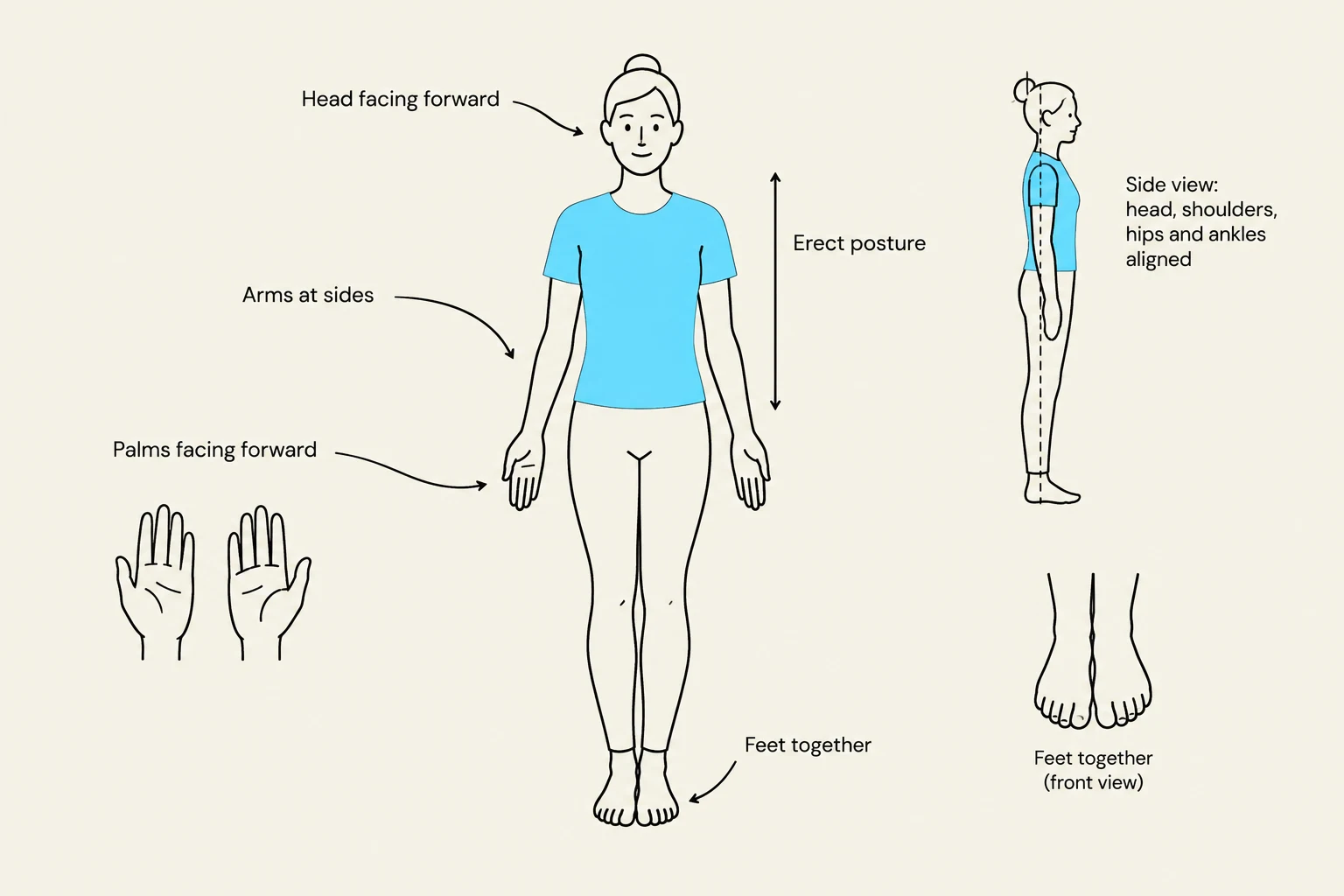
All anatomical terminology is established using the anatomical position as a universal reference point. Even if a patient is lying down, curled in a ball, or upside down, medical descriptions always refer back to this standard orientation to avoid confusion.
In the anatomical position:
The body is erect (standing upright).
The feet are together and flat on the ground.
The head and eyes are facing forward.
The arms are at the sides, with the palms facing forward and the thumbs pointing away from the body.
Exam Tip: When answering questions about "left" or "right," always remember you are describing the subject's left or right, not your own. If a patient is in anatomical position, their left arm is on your right side as you look at them.
Diagram illustrating correct standing posture with labels for head, arms, palms, and feet alignment.
Directional Terms
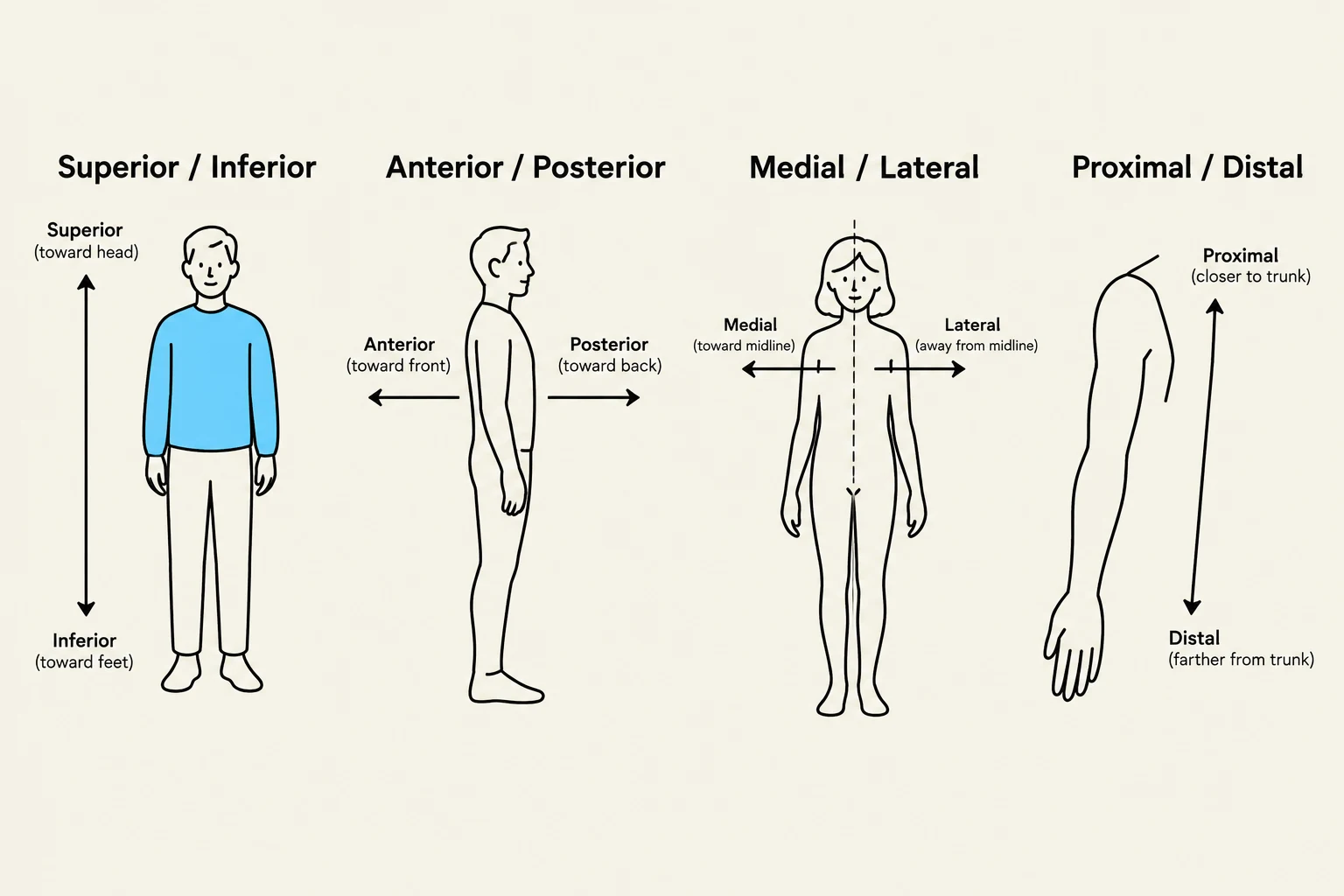
Directional terms act as a biological compass, describing the relative location of one structure in relation to another. These terms are often used in pairs to describe opposite directions.
Superior and Inferior
Superior (also known as cephalic or cranial) refers to a structure being toward the head or the upper part of a structure. Conversely, inferior (or caudal) refers to a structure being toward the tail or the lower part of a structure. For example, the forehead is superior to the nose.
Anterior and Posterior
Anterior (or ventral) describes the front of the body. Posterior (or dorsal) describes the back of the body. In the brain, "ventral" can specifically refer to the underside.
Medial and Lateral
Medial refers to a position nearer to the midline or center plane of the body. Lateral refers to being farther from the midline. For instance, your nose is medial to your eyes, while your ears are lateral to your nose.
Proximal and Distal
These terms are used specifically when describing the limbs (arms and legs) in relation to where they attach to the axial skeleton.
Proximal: Nearer to the root of the limb or the beginning of the structure.
Distal: Farther from the root of the limb or the beginning of the structure.
Worked Example: Consider the human arm. The elbow is proximal to the wrist because it is closer to the shoulder (the root), but the wrist is distal to the elbow because it is farther from the shoulder.
Other Essential Terms
Superficial vs. Deep: Superficial refers to being nearer to the surface (like the skin), while deep refers to being farther from the surface (like internal organs).
Ipsilateral vs. Contralateral: Ipsilateral means on the same side of the body, while contralateral means on opposite sides.
Prone vs. Supine: If the whole body is lying face downward, it is prone; if lying face upward, it is supine.
Palmar and Plantar: These refer to specific surfaces: the palm side of the hand (palmar) and the sole of the foot (plantar).
An illustration showing anatomical directional terms: Superior/Inferior, Anterior/Posterior, Medial/Lateral, and Proximal/Distal.
Body Planes and Sections
To view the internal structures of a three-dimensional body, scientists use imaginary flat surfaces called planes. When a cut is actually made along one of these planes, the resulting two-dimensional view is called a section.
Sagittal Planes
The sagittal plane runs vertically and divides the body into left and right portions.
Midsagittal Plane: A vertical plane that passes exactly through the midline, creating equal right and left sides.
Parasagittal Plane: A vertical plane that divides the body into unequal left and right sides.
Note: Sections made in the sagittal plane are often called longitudinal sections.
Frontal (Coronal) Plane
The frontal or coronal plane is a vertical plane that divides the body into anterior (front) and posterior (back) parts.
Transverse (Horizontal) Plane
The transverse (also called horizontal or axial) plane runs parallel to the ground, dividing the body into upper (superior) and lower (inferior) halves. In medical imaging like CT scans, these are often referred to as transverse sections.
Other Section Types
Median Section: A cut made specifically in the midline.
Oblique Section: A slanting or diagonal cut that does not follow the standard planes.
Anatomical Regions
The body is divided into specific regions to help pinpoint locations for clinical examination or surgery.
Axial and Appendicular Regions
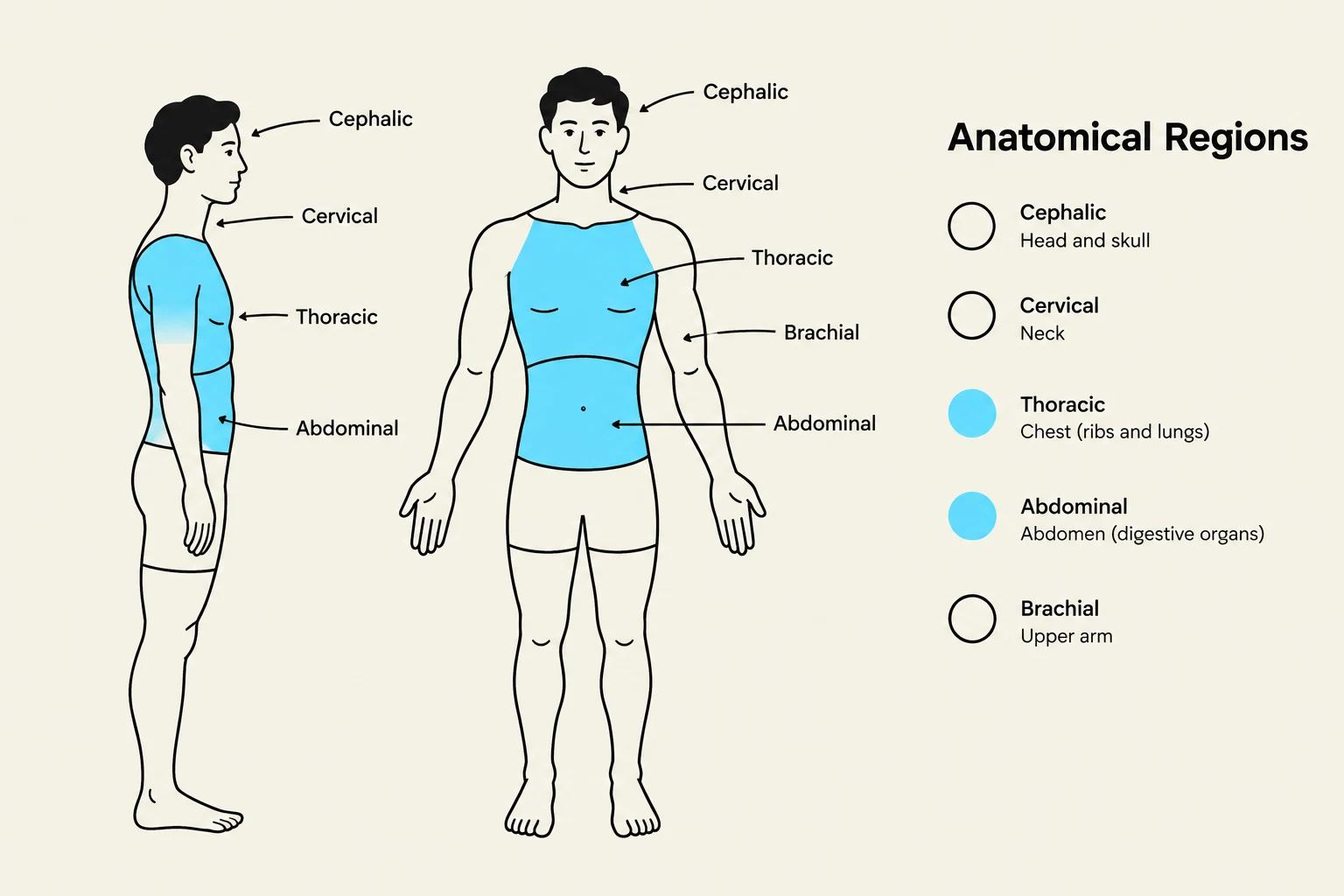
While the body is often divided into the axial (head, neck, trunk) and appendicular (limbs) portions, specific regional terms are used for precision:
The Head and Neck:
Cephalic: The head.
Cervical: The neck.
The Trunk:
Thoracic: The chest.
Abdominal: The middle region between the diaphragm and the pelvis.
Umbilical: The navel area.
Pelvic: The region of the hip bones and sacrum.
Lumbar: The inferior region of the spine.
The Upper Limbs:
Brachial: The upper limb/arm.
Antecubital: The front of the elbow.
Antebrachial: The forearm.
Carpal: The wrist.
Manus: The hand.
The Lower Limbs:
Femoral: The thigh.
Patellar: The kneecap.
Popliteal: The back of the knee.
Crural: The leg.
Digital: The fingers or toes.
This diagram illustrates the major anatomical regions of the human body, including the cephalic, cervical, thoracic, abdominal, and brachial areas, with corresponding descriptions.
Study Tip: When learning regional terms, use your own body as a map. Point to your "antecubital" region or your "popliteal" region to build muscle memory for these terms.
Keep reading for free.
Create an account to finish this reading and make it part of your study routine.