


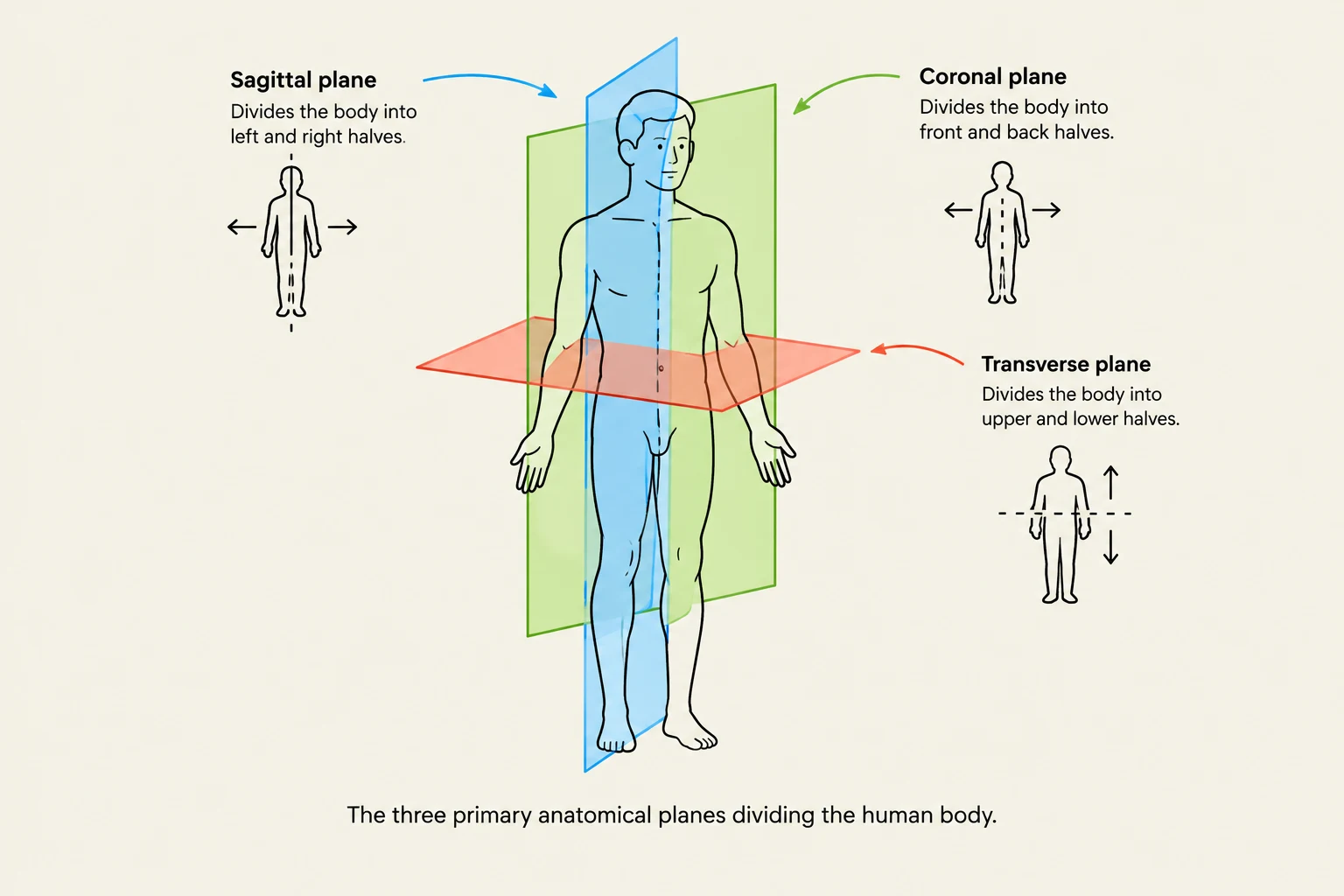
When studying human anatomy, the body is often treated as a three-dimensional map. To communicate precisely about the location of organs, the extent of an injury, or the orientation of a surgical incision, healthcare professionals cannot rely on vague terms like "the side" or "the middle." Instead, they use a standardized system of imaginary lines and specific cuts to organize the body's complex structures.
Planes and Sections: The Basics of Division
To understand how the body is mapped, we must first distinguish between two fundamental concepts: planes and sections.
Planes are imaginary anatomical dividing lines that are used to separate and organize various body structures. Think of these as the "blueprints" or the directions in which a cut might be made.
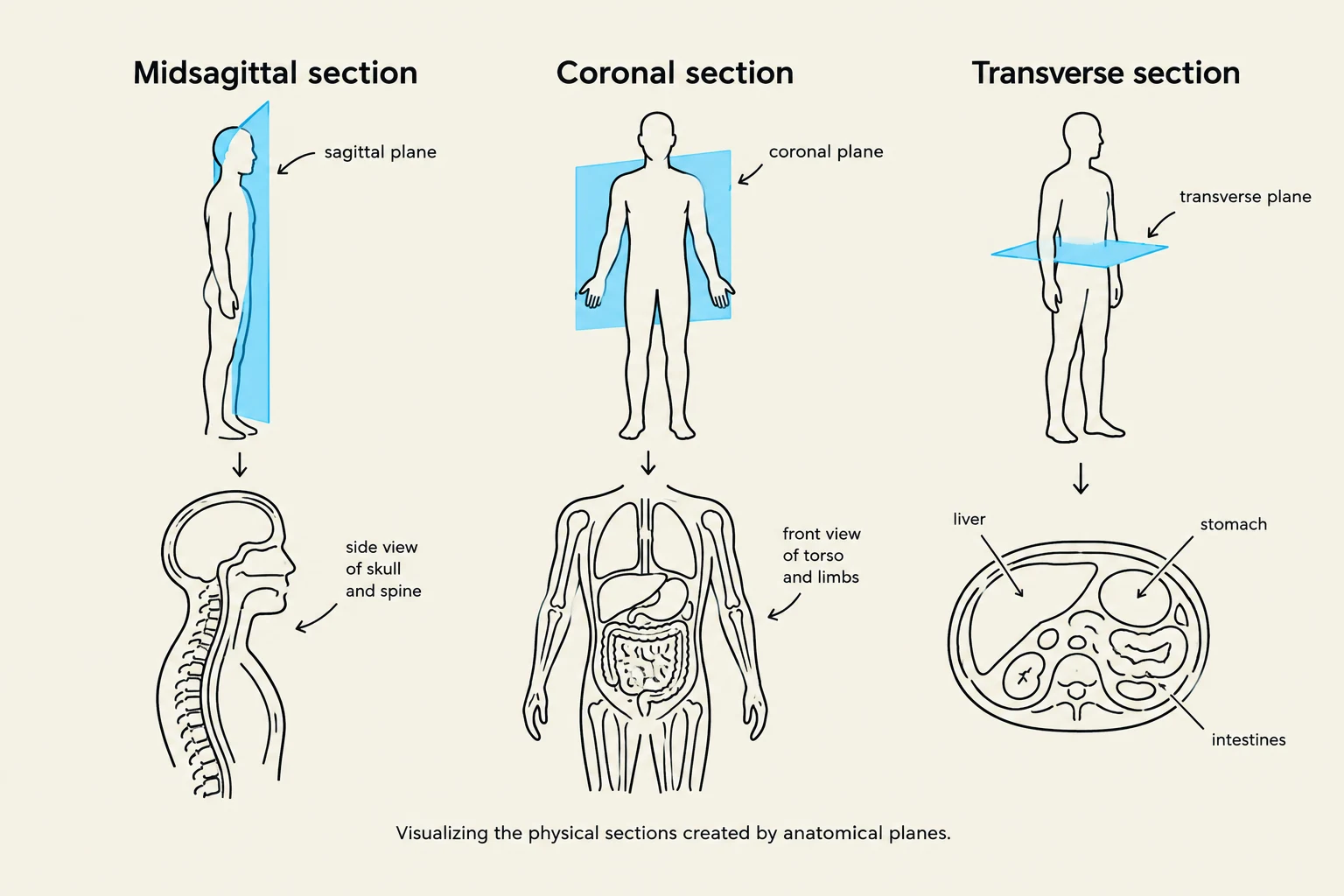
A section, on the other hand, is the actual physical cut made through the body along the direction of a specific plane. For example, if a surgeon follows a "transverse plane," the resulting slice through the tissue is a "transverse section."
The Three Primary Anatomical Planes
1. The Sagittal Plane
The sagittal plane divides the body into right and left parts.
Within this category, there is a more specific division known as the midsagittal plane. If a sagittal plane starts in the middle of the skull and proceeds downward, bisecting the sternum (breastbone) and the vertebral column (spine), it divides the body into perfectly equal right and left halves.

Keep reading for free.
Create an account to finish this reading and make it part of your study routine.
Continue reading freeAlready have an account? Log in
Updated