Modern molecular biology relies on our ability to manipulate, copy, and read the genetic code. By isolating specific DNA sequences and inserting them into new environments, scientists can study how genes work, produce life-saving proteins, and even edit genomes with surgical precision. This article explores the fundamental toolkit used to analyze gene structure and function, from the initial cutting of DNA to the sophisticated world of CRISPR gene editing.
Cutting and Separating DNA
The first step in analyzing a gene is often breaking a large genome into manageable pieces. This is achieved using restriction enzymes, which are proteins typically obtained from bacteria. These enzymes act as molecular scissors, cleaving both strands of the DNA double helix at specific nucleotide sequences.
Depending on the enzyme used, the cut can result in two types of ends:
Blunt ends: The strands are cut straight across.
Sticky (staggered) ends: The cut leaves short, single-stranded overhangs. These "sticky ends" are incredibly useful because they can join back together through complementary base-pairing with other DNA fragments cut by the same enzyme.
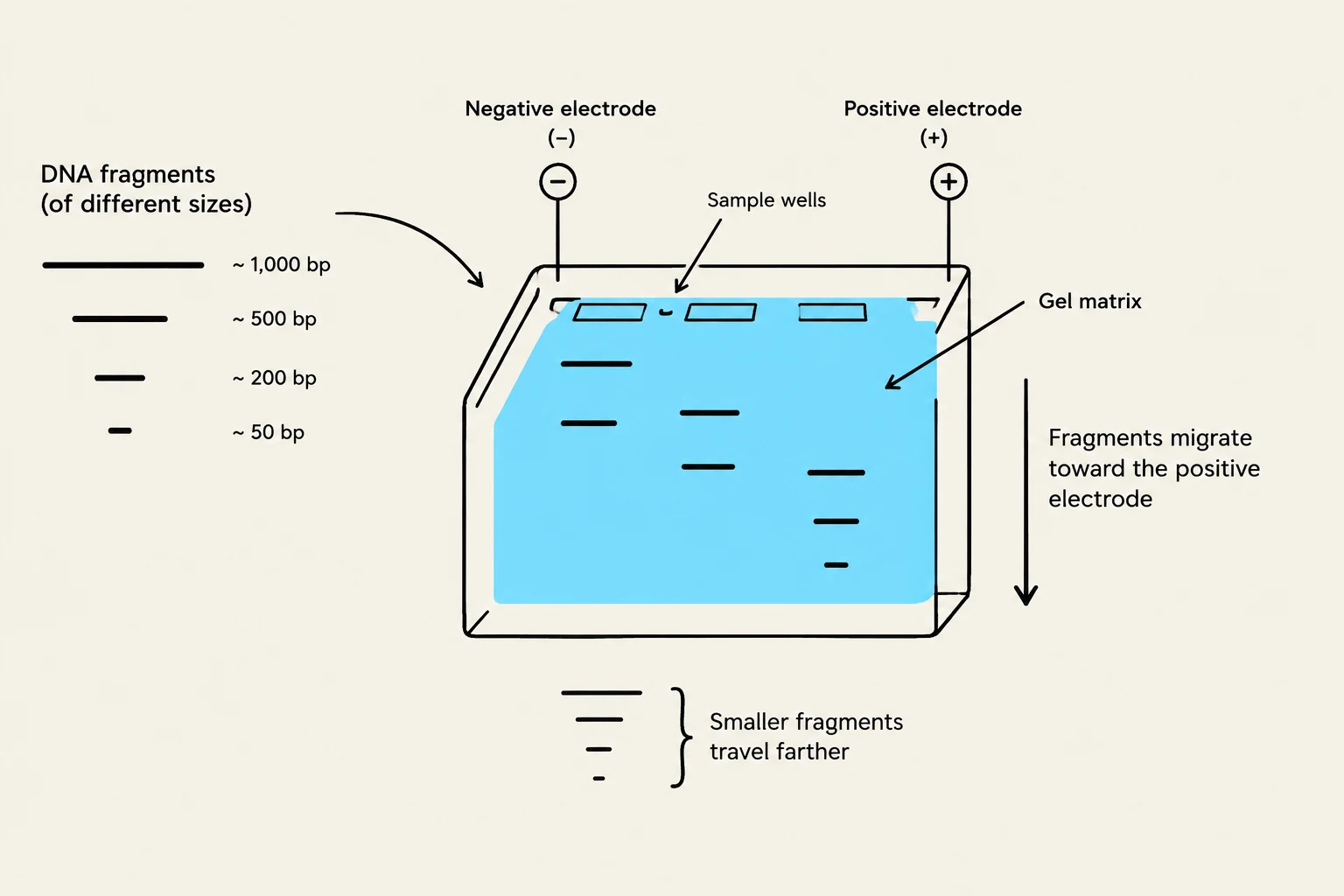
Once DNA has been cleaved, scientists must determine the size of the resulting fragments. This is done via gel electrophoresis. In this process, DNA molecules are placed in a gel matrix and subjected to an electric field. Because DNA is negatively charged, it migrates toward the positive electrode. The gel acts as a sieve: large fragments move slowly through the pores, while small fragments migrate much faster. By comparing the position of a band to fragments of known sizes, researchers can estimate the length of their DNA pieces.
This diagram illustrates the principle of gel electrophoresis, a technique used to separate DNA fragments based on their size. DNA samples are loaded into wells in a gel matrix, and an electric current is applied. DNA fragments, being negatively charged, migrate towards the positive electrode. Smaller fragments move more easily through the gel matrix and thus travel farther than larger fragments.
Exam Tip: Remember that in gel electrophoresis, DNA moves toward the positive electrode because DNA is negatively charged. Also, larger fragments move slower than smaller ones.
DNA Cloning and Recombinant DNA
Once a specific DNA fragment is isolated, it can be "cloned"—meaning many identical copies are produced. This process involves creating recombinant DNA, which is a DNA molecule composed of sequences from different sources.
To clone a gene, scientists typically use a vector, such as a plasmid. Plasmids are small, circular, double-stranded DNA molecules found in bacteria. For cloning purposes, these are engineered to include a replication origin, cleavage sites for restriction enzymes, and often antibiotic resistance genes to help identify successful clones.
The procedure generally follows these steps:
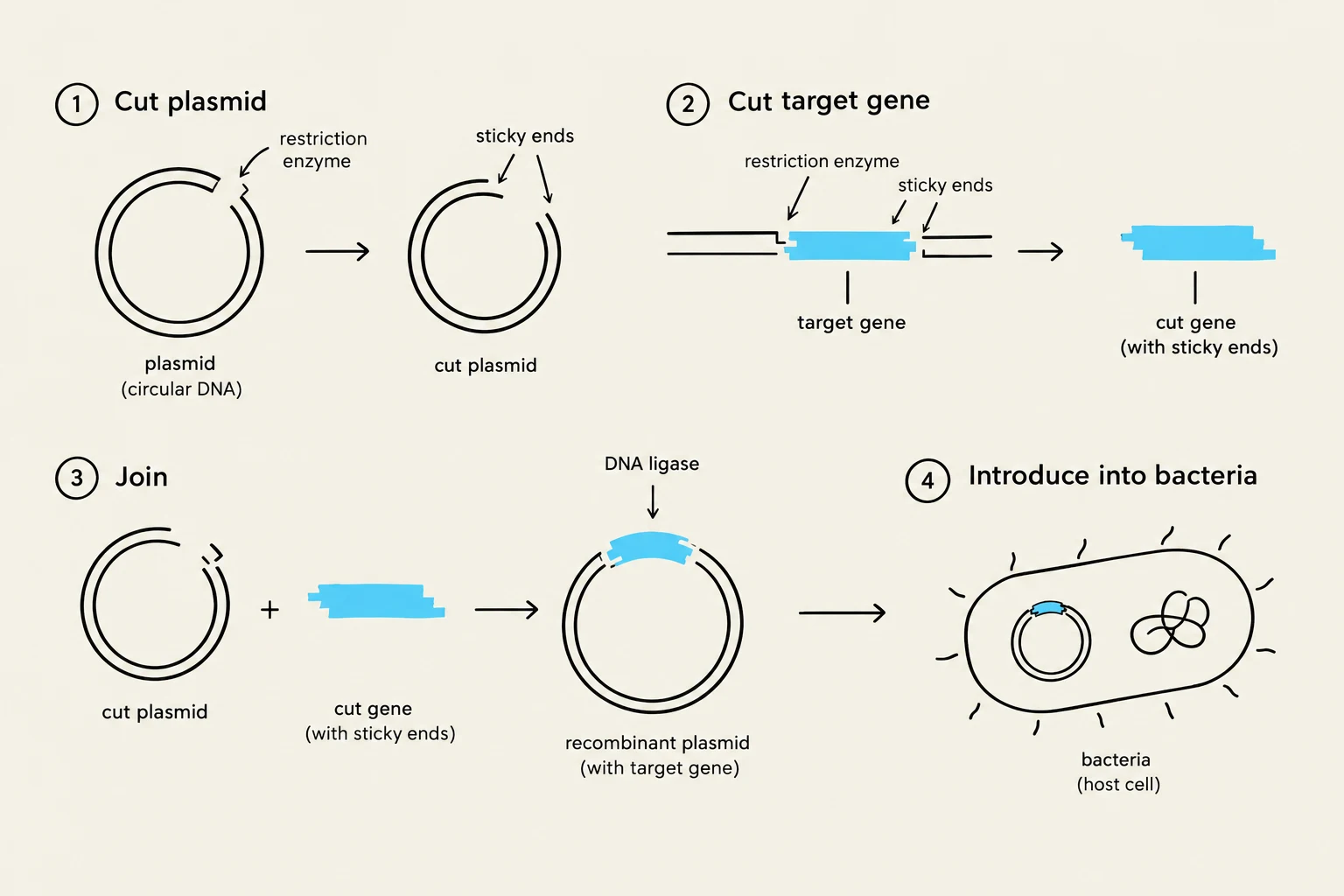
Cleavage: The plasmid and the target DNA fragment are both cut with the same restriction enzyme.
Ligation: The enzyme DNA ligase is added to covalently link the two fragments together, creating a recombinant plasmid.
Transformation: The recombinant plasmid is introduced into bacterial cells through a process called transformation.
As the bacteria divide, they replicate the recombinant plasmid, effectively creating millions of copies of the target gene.
Diagram illustrating the process of creating recombinant DNA by cutting a plasmid and a target gene with restriction enzymes, joining them with DNA ligase, and introducing the recombinant plasmid into a bacteria host cell.
Genomic and cDNA Libraries
To study the entire genetic makeup of an organism, researchers construct "libraries."
A genomic library is a collection of cloned DNA molecules that represents an entire genome.
A cDNA (complementary DNA) library is prepared from mRNA. Because mRNA represents only the genes being actively expressed, a cDNA library contains predominantly protein-coding sequences and lacks introns, regulatory DNA, and promoters.
To find a specific sequence within these libraries, scientists use nucleic acid hybridization. This technique relies on the ability of single-stranded DNA or RNA to find and bind to a complementary sequence. This process involves two critical stages:
Denaturation: Breaking the hydrogen bonds between nucleotide pairs (usually via heat or alkali treatment) to separate double-stranded DNA into single strands.
Renaturation (Hybridization): Allowing the single strands to find their complementary partners and reform base pairs.
Amplification and Sequencing
When only a tiny amount of DNA is available, PCR (Polymerase Chain Reaction) is used to amplify it in a test tube. PCR uses a heat-stable DNA polymerase and specific primers to direct the synthesis of a desired DNA segment through repeated cycles of denaturation, hybridization, and synthesis. This is highly sensitive and is used in everything from detecting viruses (like SARS-CoV-2) to forensic DNA profiling using short tandem repeats (STRs).
To read the actual order of nucleotides, scientists use DNA sequencing.
Dideoxy sequencing uses chain-terminating nucleotides (ddNTPs) to stop DNA synthesis at specific bases, allowing the sequence to be reconstructed.
Next-generation sequencing (NGS) has revolutionized the field by making sequencing much faster and cheaper, allowing for the rapid analysis of entire genomes.
Exploring Gene Function
Knowing the sequence of a gene is only the beginning; scientists must also determine what that gene does. Several methods are used to explore gene function:
In situ hybridization: This technique reveals where and when a gene is expressed within a tissue by using labeled probes to detect mRNA in place.
Reporter genes: By attaching a gene like Green Fluorescent Protein (GFP) to a gene's regulatory sequence, researchers can track where a protein is produced in a living organism.
RNA interference (RNAi): This method "silences" a gene by introducing double-stranded RNA that matches the target gene, preventing its expression.
Transgenic organisms: By inserting a "transgene" into an organism, scientists can observe the effects of a specific gene (e.g., studying obesity by inserting or deleting the leptin gene).
CRISPR/Cas9: This is a precise gene-editing tool. A guide RNA directs the Cas9 enzyme to a specific genomic location to create a double-stranded break, which can then be repaired using an altered version of the gene as a template.
Through these diverse methods, molecular biology continues to bridge the gap between understanding the code of life and manipulating it for medicine, agriculture, and basic research.
Keep reading for free.
Create an account to finish this reading and make it part of your study routine.