Analyzing the Marketing Environment: Micro and Macro Forces
This content explains the marketing environment, dividing it into the microenvironment (company, suppliers, competitors, intermediaries, publics, customers) and the macroenvironment (demographic, economic, natural, technological, political, and cultural forces). It also discusses reactive versus proactive strategic res
In the world of business, no company operates in a vacuum. Every decision a marketing manager makes—from pricing a new product to choosing a distribution channel—is influenced by a complex web of external factors. This web is known as the marketing environment: the collection of actors and forces outside of marketing that affect a company's ability to build and maintain successful relationships with its target customers.
To manage these influences effectively, marketers divide the environment into two distinct layers: the microenvironment and the macroenvironment.
The Microenvironment: Your Immediate Value Delivery Network
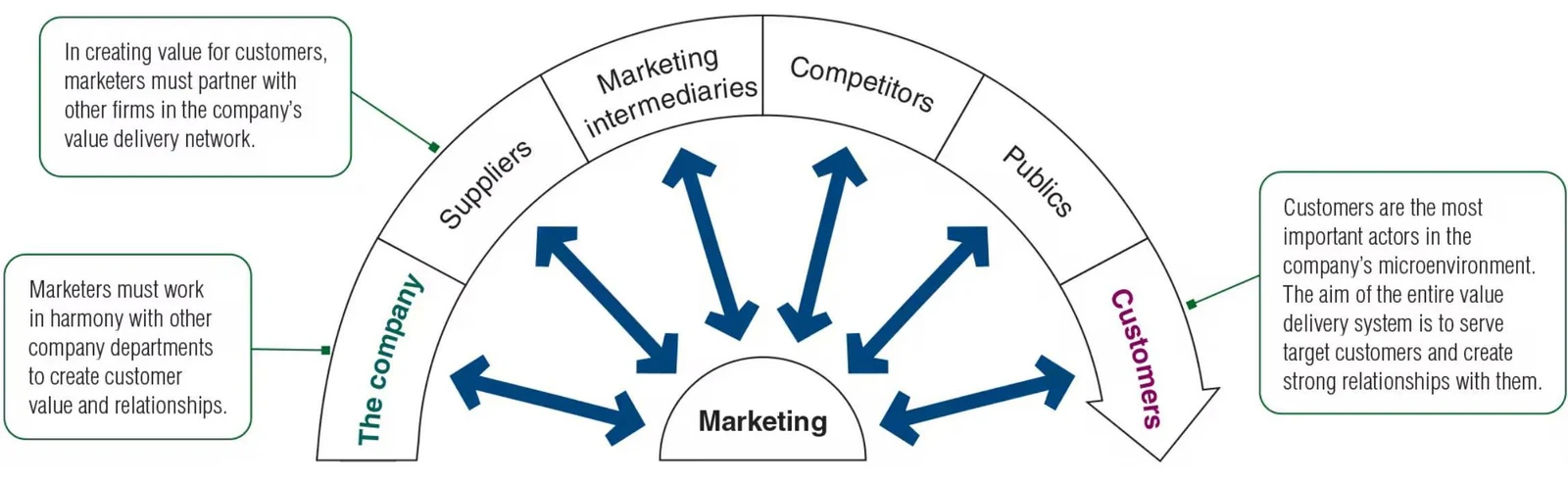
The microenvironment consists of actors close to the company that directly affect its ability to engage and serve its customers. Rather than working alone, companies must partner with various entities to create a value delivery network.
This diagram illustrates the microenvironment of a company's marketing efforts, showing key actors such as suppliers, marketing intermediaries, competitors, publics, and customers, all interacting with the company's marketing function.
Internal and Immediate Actors
Within this layer, several key groups play vital roles:
The Company: Marketing cannot succeed in isolation. It must work in harmony with other internal departments, including top management, finance, R&D, purchasing, logistics, human resources, and accounting. All these departments share the responsibility of understanding customer needs and creating value.
Suppliers: These are the entities that provide the resources needed to produce a company's offerings. Because they are so critical, supplier issues—such as labor strikes, price trends of key inputs, or supply shortages—can significantly disrupt marketing efforts. For example, IKEA relies on a massive global network of suppliers to maintain its promise of affordable, well-designed furniture.
Competitors: To succeed, a company must provide greater customer value and satisfaction than its competitors. This requires gaining a strategic advantage by positioning offerings strongly against both direct and indirect competitors.
Intermediaries and Publics
Beyond the immediate production cycle, other actors facilitate the movement of goods and the perception of the brand:
Marketing Intermediaries: These firms help the company promote, sell, and distribute its products to the end user. They include:
Resellers: Wholesalers and retailers that act as distribution channels.
Physical distribution firms: Companies that help stock and move goods.
Marketing services agencies: Research firms, advertising agencies, and media firms.
Financial intermediaries: Banks, credit companies, and insurance companies that help finance or insure transactions.
Publics: A "public" is any group that has an actual or potential interest in or impact on an organization's ability to achieve its objectives. This includes media publics (news and editorial opinions), citizen-action publics (consumer or environmental groups), and local publics (neighborhood residents).
The Ultimate Goal: The Customer
While all these actors are important, customers are the most critical component of the microenvironment. The entire purpose of the value delivery system is to serve target customers and build lasting relationships with them. Customer markets can be diverse, ranging from consumer markets (individuals buying for personal use) and business markets (buying for production) to reseller, government, and international markets.
Exam Tip: If a question asks which actor is the most important in the microenvironment, the answer is always the customer.
The Macroenvironment: The Broader Societal Landscape
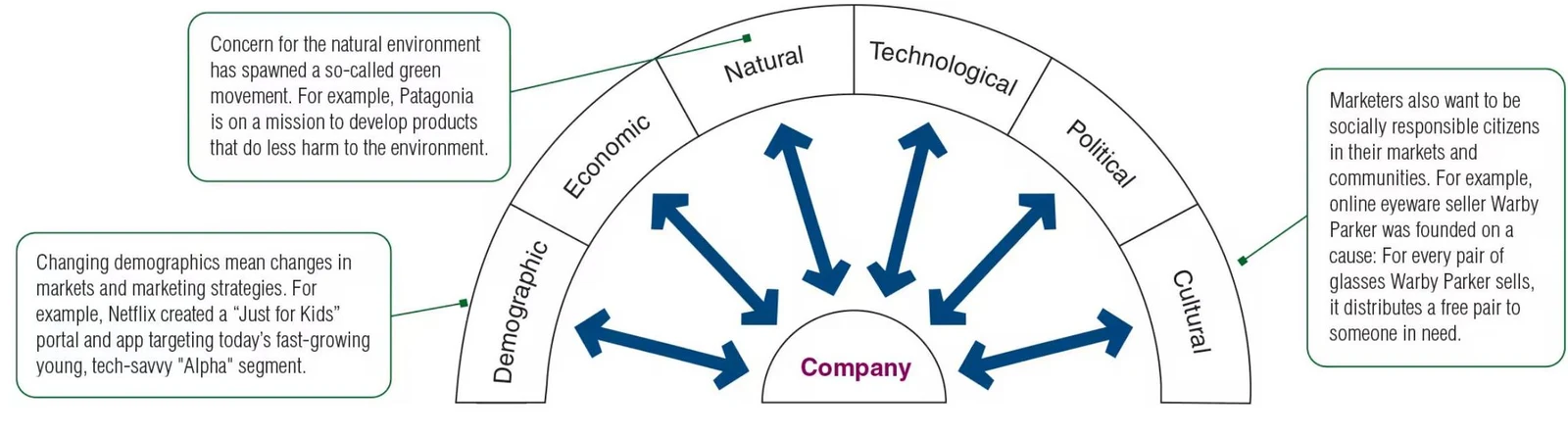
While the microenvironment focuses on the immediate network, the macroenvironment comprises the larger societal forces that affect the entire microenvironment. These are broader trends that a company cannot control but must navigate.
This diagram illustrates the PESTLE analysis framework, showing external factors (Political, Economic, Social, Technological, Legal, Environmental) that can impact a company.
Demographic and Economic Forces
Demography: This is the study of human populations (size, density, age, gender, etc.). Marketers closely track age structures (such as the affluent Baby Boomers or the tech-savvy Generation Alpha) and family structures to adapt their strategies.
Economic Environment: Economic factors influence consumer purchasing power and spending patterns. For instance, during recessions, consumers may buy less and seek more value, whereas shifts in the economy might lead to a rise in the "sharing economy" (e.g., Uber or Airbnb).
Natural, Technological, and Political Forces
Natural Environment: This includes the physical environment and the natural resources needed as inputs. Modern marketers face challenges like resource shortages, pollution, and increasing pressure for sustainability.
Technological Environment: New technologies create entirely new markets. From the Internet of Things (IoT) to Artificial Intelligence (AI) and RFID tracking, technology constantly reshapes how products are made and sold.
Political and Legal Environment: This includes laws and government agencies that protect companies, consumers, and society. Examples include the Nutrition Labeling and Education Act and the Children's Online Privacy Protection Act (COPPA).
Cultural Forces
Culture consists of institutions and forces that affect society's values, perceptions, and behaviors. Marketers distinguish between core beliefs (which are highly persistent and passed through generations) and secondary beliefs (which are more open to change).
Strategic Responses: Reactive vs. Proactive
How a company responds to these environmental forces defines its strategic posture:
Reactive Approach: These companies passively accept the environment. They view external forces as uncontrollable and simply adapt when they are forced to. For example, a company might only switch to sustainable packaging after customers begin demanding it.
Proactive Approach: These firms take aggressive action to shape the environment. They might influence legislation, use social media to shape public opinion, or anticipate needs before they arise. A proactive company would develop sustainable packaging before its competitors to capture the market early.
Key Takeaway: While you cannot control the macroenvironment, a proactive stance allows a company to turn environmental shifts into competitive advantages.
Keep reading for free.
Create an account to finish this reading and make it part of your study routine.