Analyzing the Marketing Environment: Micro and Macro Forces
This content explains the microenvironment and macroenvironment forces that affect a company's ability to serve its customers, including demographic, economic, natural, technological, political, and cultural factors.
In the world of marketing, success is not determined solely by the quality of a product or the creativity of an advertisement. Instead, companies operate within a complex web of external forces that can either facilitate growth or present significant obstacles. To build and maintain successful relationships with target customers, marketing managers must constantly analyze and adapt to these changing environments.
Understanding these forces requires a distinction between two primary layers: the microenvironment and the macroenvironment.
The Microenvironment: Immediate Actors
The microenvironment consists of the actors close to the company that directly affect its ability to serve its customers. These are forces that a company can often influence through direct relationships and strategic management.
The microenvironment includes several key players:
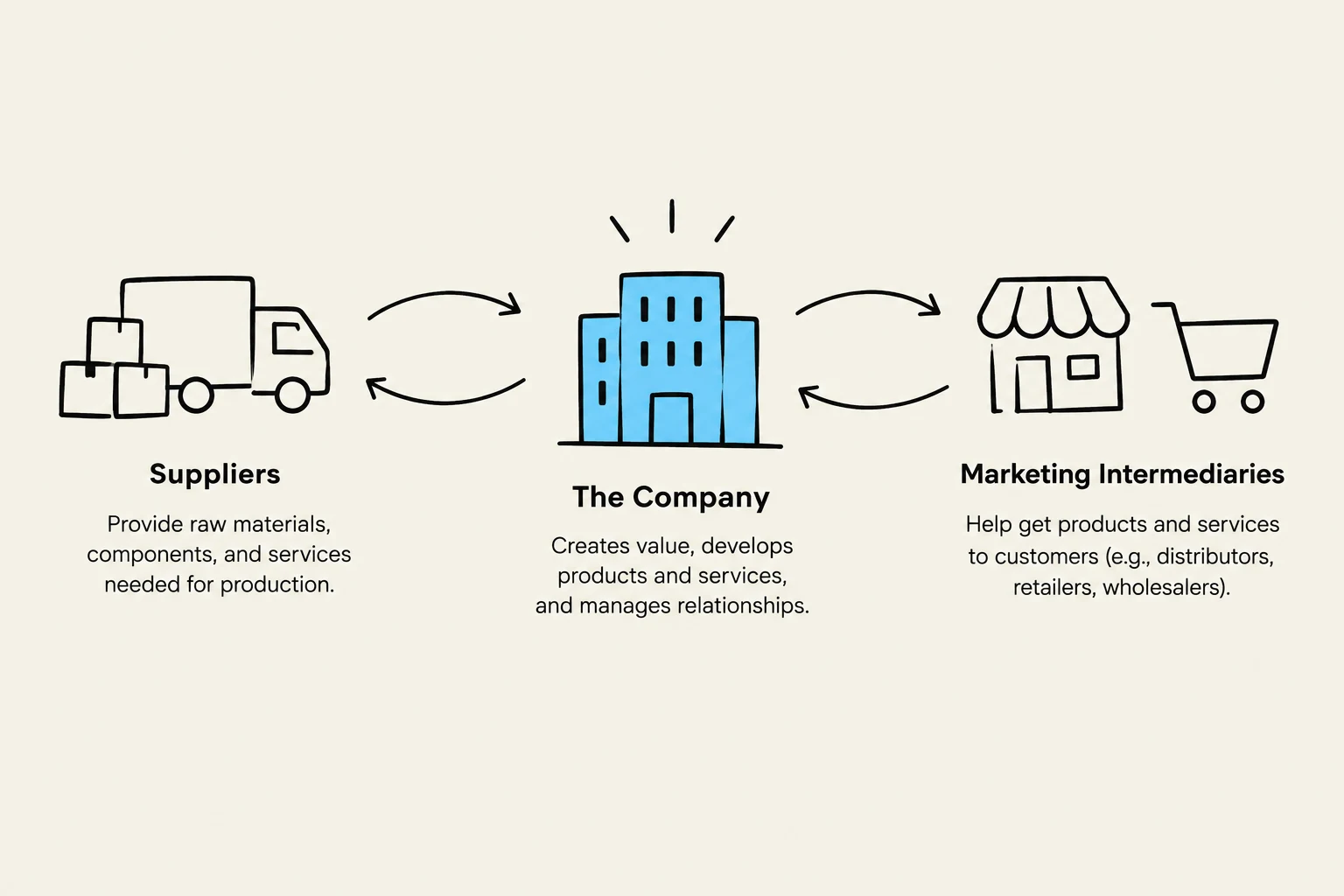
The Company: Internal departments (such as finance, R&D, and purchasing) must work together to understand customer needs and create value.
Suppliers: These provide the necessary resources to produce goods and services. Problems here—such as supply shortages or natural disasters—can severely disrupt marketing efforts.
Marketing Intermediaries: These help the company promote, sell, and distribute products to final buyers, including resellers, physical distribution firms, and marketing service agencies.
Competitors: To succeed, marketers must gain a strategic advantage by positioning their products strongly against rivals.
Publics: Any group that has an interest in or impact on the organization, such as media, government, or local communities.
Customers: The most important actors, encompassing consumer, business, reseller, government, and international markets.
This diagram illustrates the basic flow of goods and services from suppliers to a company and then to marketing intermediaries who distribute them to customers.
Exam Tip: When asked to distinguish between micro and macro environments, remember that the microenvironment involves actors close to the company that affect its immediate ability to serve customers, while the macroenvironment involves larger societal forces.
The Macroenvironment: Larger Societal Forces
While the microenvironment deals with immediate relationships, the macroenvironment consists of larger societal forces that shape the opportunities and threats facing the entire microenvironment. These forces are generally broader and harder for a single company to control.
The major forces in the macroenvironment include the demographic, economic, natural, technological, political, and cultural environments.
This diagram illustrates the macroenvironment, detailing demographic and economic factors that influence market conditions and strategic decisions.
The Demographic Environment
Demography is the study of human populations in terms of size, density, location, age, gender, race, occupation, and other statistics. Because markets are made of people, changes in population characteristics directly impact marketing decisions.
Marketers closely monitor several demographic trends:
Generational Groups: Populations are divided into distinct cohorts, such as Baby Boomers, Generation X, Millennials (Gen Y), Generation Z, and Generation Alpha. "Generational marketing" involves tailoring strategies to the specific values and behaviors of these groups.
Changing Family Structures: Shifts in how families are composed affect consumption patterns.
Geographic Shifts: The movement of populations from one region to another changes local market demands.
Diversity and Education: An increasingly educated, professional, and diverse population creates new niche markets.
The Economic Environment
The economic environment consists of factors that affect consumer purchasing power and spending patterns. Marketers must stay alert to:
Changes in consumer spending: How much money people are willing to part with during different economic cycles.
Income distribution: The way wealth is spread across a population, which dictates which types of products (luxury vs. necessity) will thrive.
The Natural and Technological Environments
The natural environment involves the physical environment and the natural resources needed as inputs by marketers. In recent decades, environmental sustainability has become a major concern due to shortages of raw materials, increased pollution, and heightened government intervention.
Simultaneously, the technological environment creates entirely new markets and opportunities. Examples include:
Digital Technology: The rise of the Internet and the "Internet of Things" (IoT) has revolutionized how consumers interact with brands.
Tracking Technologies: Tools like Radio-frequency identification (RFID) allow for sophisticated product tracking.
The Political and Cultural Environments
The political environment includes laws, government agencies, and pressure groups that limit or influence organizations. For example, legislation like the Children’s Online Privacy Protection Act (COPPA) regulates how companies collect data from children. Companies also navigate "socially responsible behavior," where they must balance profit with the interests of society and the environment.
Finally, the cultural environment consists of institutions and forces that affect a society's basic values and behaviors.
Core Beliefs: These are values that are highly persistent and difficult to change.
Secondary Beliefs: These are more open to change, such as shifting views on nature, society, or themselves.
How Companies Respond
Firms generally take one of two stances when facing these environmental forces:
Reactive Firms: These companies passively accept the environment and do not attempt to change it.
Proactive Firms: These companies develop strategies to actively change the environment, taking aggressive actions to influence the publics and forces that affect them.
By understanding these layers—from the immediate supplier to the broad technological shift—marketers can better position themselves to thrive in an ever-changing world.
Keep reading for free.
Create an account to finish this reading and make it part of your study routine.