


In physics, we often deal with quantities that possess both a magnitude and a direction, such as displacement, velocity, acceleration, and force. While you can add these quantities visually using a graphical method (like the tip-to-tail method), the analytical method is far more precise. This method relies on breaking vectors down into their fundamental parts and using mathematical tools like trigonometry and the Pythagorean theorem to find a single, accurate resultant vector.
The Foundation: Coordinate Systems and Vector Resolution
Before performing any calculations, you must establish a coordinate system. Typically, we use a standard Cartesian plane with a horizontal -axis and a vertical -axis. The orientation of your vectors relative to these axes determines whether their components will be positive or negative.
The core of the analytical method is vector resolution. This is the process of taking a single diagonal vector and "resolving" it into two perpendicular parts: a horizontal component and a vertical component.
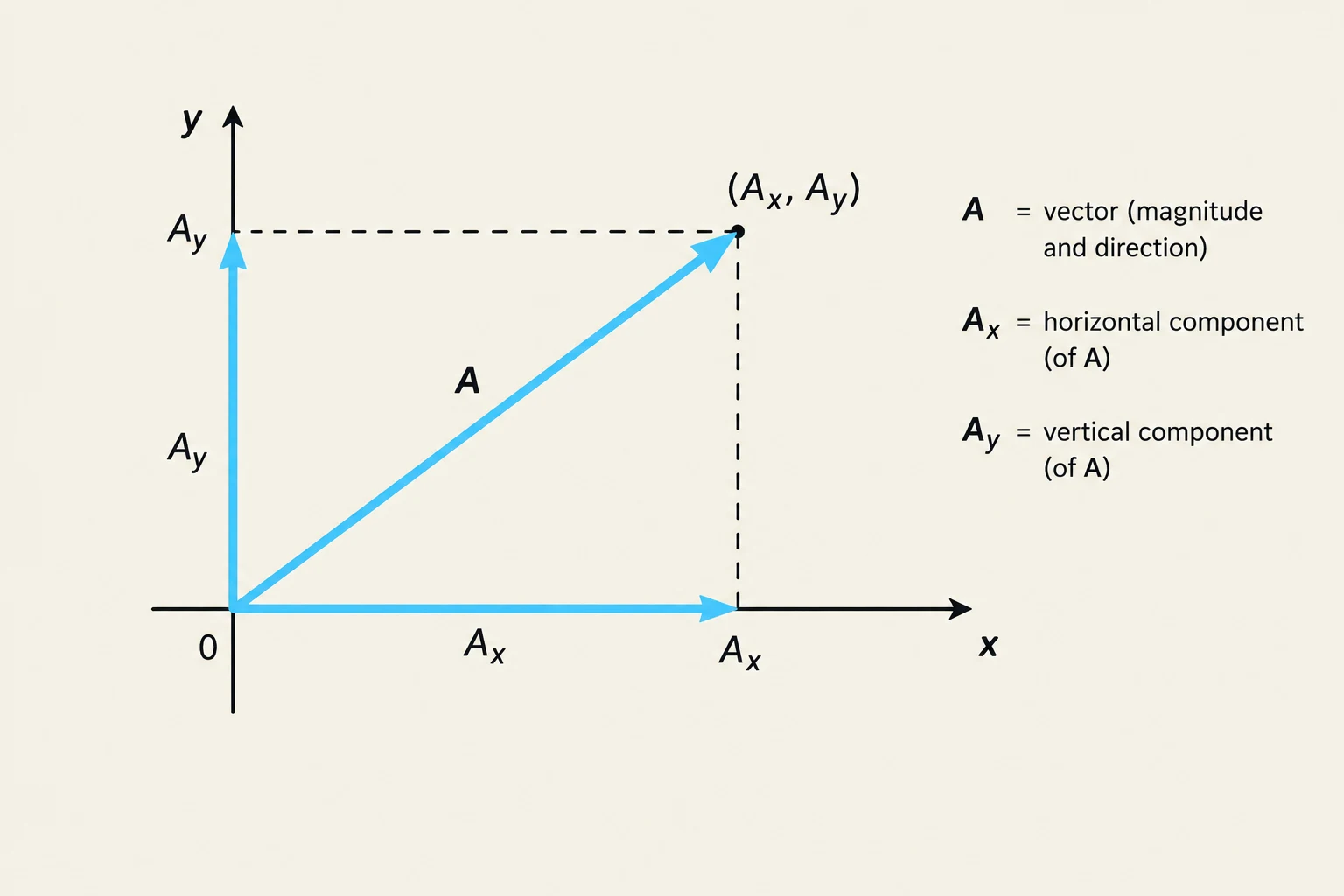
By resolving a vector, we transform a complex diagonal movement into two simple, independent movements along the axes.
Calculating Horizontal and Vertical Components
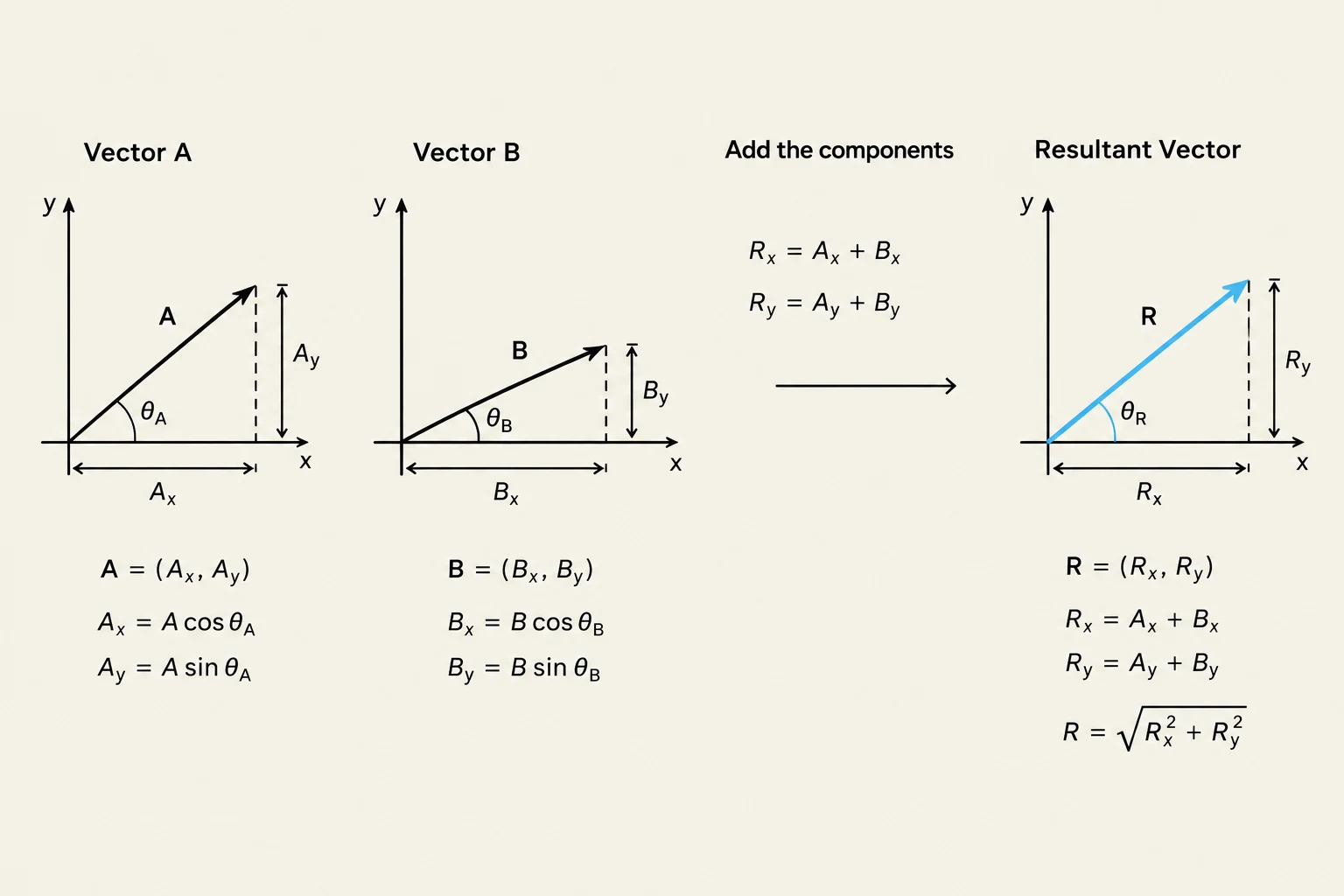
To find these components, we use trigonometric identities. If we know the magnitude of a vector () and the angle () it makes with the horizontal -axis, we can calculate the components as follows:
- Horizontal Component (): This represents the vector's influence along the x-axis.
- Vertical Component (): This represents the vector's influence along the y-axis.
Keep reading for free.
Create an account to finish this reading and make it part of your study routine.
Continue reading freeAlready have an account? Log in
Updated