Analytical Epidemiology: Study Designs, Matching, and Confounding
This article explores observational study designs in analytical epidemiology, including cohort and case-control studies, and discusses the challenges of confounding and strategies for matching to ensure study validity.
In the field of epidemiology, researchers aim to move beyond mere description to understand the "why" and "how" of disease distribution. While descriptive epidemiology identifies high-risk groups by examining rates across person, time, and place, analytical epidemiology seeks to test hypotheses regarding the associations between suspected risk factors and health outcomes. This article explores the sophisticated tools used in observational epidemiology to assess these associations, focusing on specific study designs, the nuances of matching, and the critical challenge of confounding.
Observational Study Designs
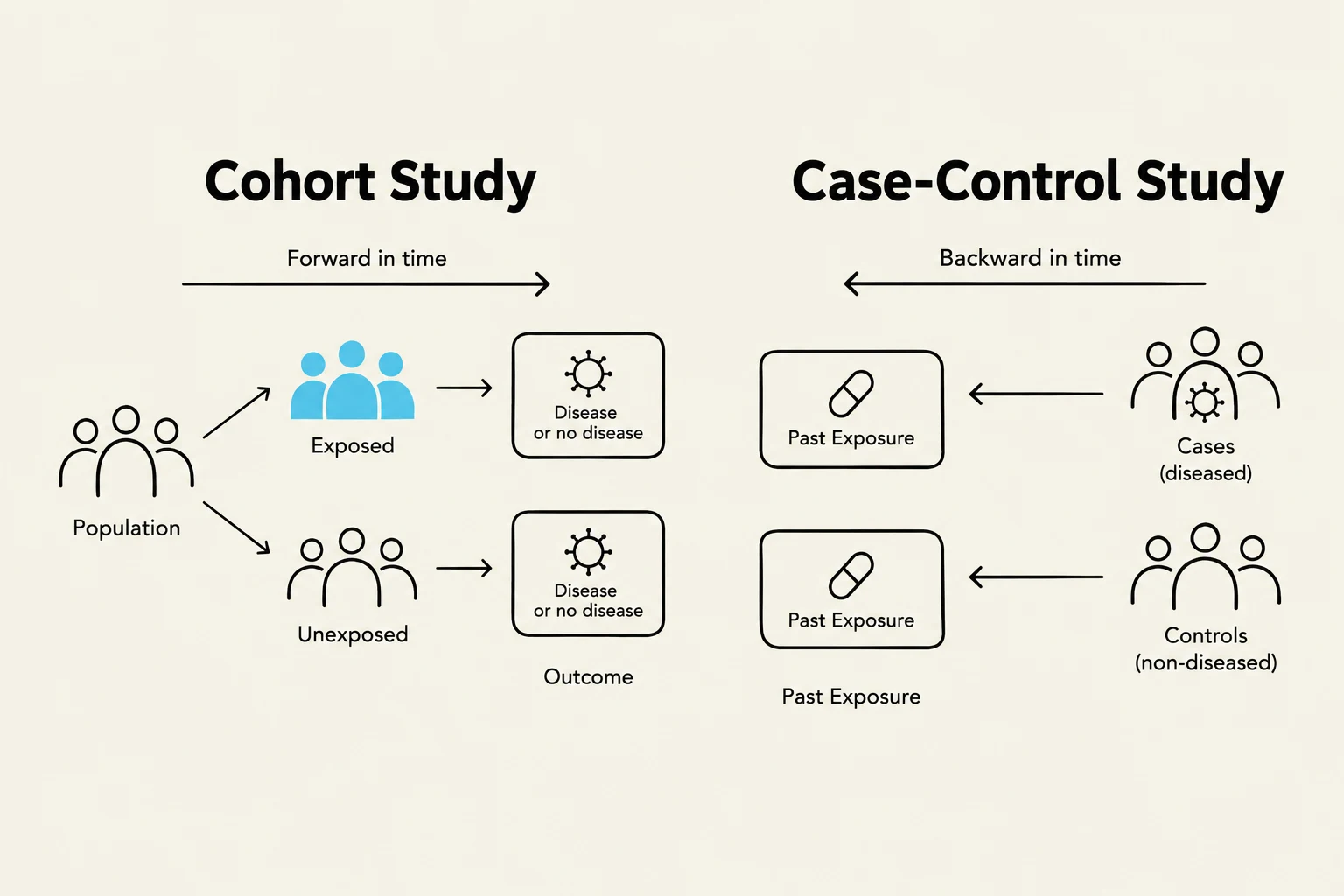
This diagram illustrates the fundamental differences between cohort studies and case-control studies in research methodology. Cohort studies follow a population forward in time, observing exposed and unexposed groups to determine outcomes like disease or no disease. Case-control studies work backward in time, identifying cases (diseased) and controls (non-diseased) and then investigating their past exposures.
Analytical epidemiology primarily utilizes observational designs where the investigator does not intervene but rather observes natural exposures and outcomes. Two of the most fundamental designs are cohort studies and case-control studies.
Cohort Studies
In a cohort study, a group of individuals is followed over time to see how exposures relate to the development of an outcome. These are often prospective, meaning they look forward in time, allowing for a clear temporal sequence between exposure and disease.
Case-Control Studies
Case-control studies work backward. Researchers identify individuals who already have the disease (cases) and compare them to individuals without the disease (controls) to look for differences in past exposures. This design is particularly efficient for studying rare diseases.
Case-Crossover Design
A specialized variation is the case-crossover design, which is used to study the transient effects of exposures on the risk of acute events. In this design, the individual serves as their own control. The exposure is measured during a "case period" (immediately before the event) and compared to a "control period" (a time when the event did not occur). This is highly effective for studying triggers like sudden environmental changes or specific behaviors that precede an acute health crisis.
The Challenge of Confounding
This diagram illustrates a confounding variable in a study. Smoking is shown as a confounder that affects both coffee consumption (exposure) and the likelihood of developing heart disease (outcome).
A central goal of analytical epidemiology is to ensure that the observed association between an exposure and an outcome is not actually caused by a third, extraneous variable. This third variable is known as a confounder.
Confounding occurs when a variable is associated with both the exposure and the outcome, potentially distorting the true relationship. For example, if a study finds an association between coffee consumption and heart disease, but fails to account for smoking (since coffee drinkers might be more likely to smoke), smoking acts as a confounder.
Even after adjusting for known variables, researchers may face residual confounding. This happens when the confounding effect is not fully eliminated, often due to measurement errors or because the researcher failed to account for all relevant variables.
Exam Tip: When evaluating a study, always ask: "Is there a third variable that explains both the exposure and the outcome?" If yes, you are looking at potential confounding.
Matching Strategies in Case-Control Studies
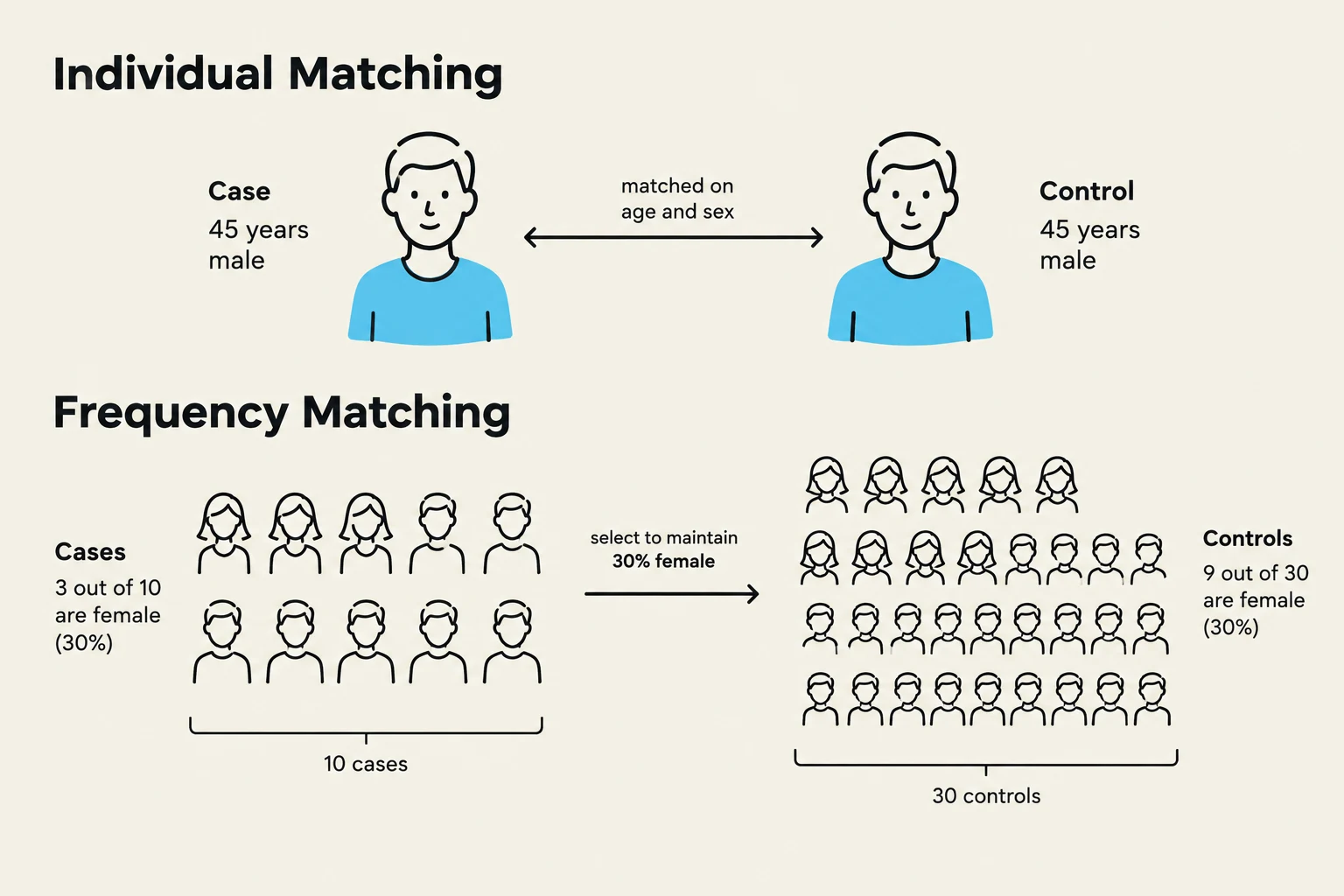
This illustration depicts two methods of matching in study design: individual matching, where a case is matched to a control based on specific criteria like age and sex, and frequency matching, where the proportion of certain characteristics (e.g., sex) is maintained between cases and controls.
To combat confounding, researchers often use matching. Matching involves selecting controls that are similar to cases regarding certain characteristics (like age or sex) to ensure those characteristics do not bias the results.
Individual Matching
In individual matching, each case is paired with one or more specific controls who share identical or very similar characteristics. For example, if a case is a 45-year-old male, the researcher selects a control who is also a 45-year-old male.
Frequency Matching
Frequency matching is a broader approach where the researcher ensures that the distribution of a characteristic in the control group is similar to that in the case group, rather than matching individuals one-to-one. For instance, if 30% of cases are female, the researcher ensures that approximately 30% of the control group is also female.
Advanced Matching: Minimum Euclidean Distance
In complex studies with multiple continuous variables, researchers may use the minimum Euclidean distance measure method to find the "closest" possible match for a case based on a mathematical distance between their various characteristics.
Warning: Overmatching
While matching is powerful, it carries a significant risk: overmatching. If you match cases and controls on a variable that is actually part of the causal pathway between the exposure and the disease, you may inadvertently "mask" the true association, making it impossible to detect the effect you are studying.
Validity in Epidemiological Research
The quality of an epidemiological study is measured by two types of validity:
Internal Validity: This refers to how accurately the study reflects the true relationship between exposure and outcome within the specific group being studied. Effective control of confounding and avoidance of overmatching are essential for high internal validity.
External Validity: Also known as generalizability, this refers to the extent to which the study's findings can be applied to other populations or settings.
Statistical Measures: The Odds Ratio
In case-control studies, the primary measure of association is the odds ratio (OR). The OR compares the odds of exposure among the cases to the odds of exposure among the controls. It provides a numerical estimate of how much more (or less) likely the cases were to have been exposed compared to the controls.
Summary Table of Concepts
Concept
Definition
Key Consideration
Confounding
A third variable distorting the exposure-outcome link
Must be controlled to ensure internal validity
Matching
Selecting controls similar to cases
Avoid overmatching to prevent bias
Case-Crossover
Individual acts as their own control
Best for transient, acute exposures
Ecologic Fallacy
Inferring individual risk from group data
Aggregate data = individual data
Keep reading for free.
Create an account to finish this reading and make it part of your study routine.