Explore metabolic pathways like anaerobic respiration and fermentation that allow cells to produce ATP in the absence of oxygen. This includes glycolysis, alcohol fermentation, and lactic acid fermentation.
In the world of cellular biology, oxygen is often viewed as the ultimate fuel for energy production. Through aerobic respiration, cells efficiently break down glucose to produce large amounts of ATP (adenosine triphosphate), the universal energy currency of life. However, life is incredibly resourceful. When oxygen is unavailable, cells must rely on alternative metabolic pathways to survive. These processes—known as anaerobic respiration and fermentation—allow cells to continue producing ATP even in the absence of oxygen.
The Foundation: Glycolysis
Before exploring how cells handle a lack of oxygen, we must understand the starting point for all these pathways: glycolysis. Glycolysis is a metabolic process that occurs in the cytosol of the cell, where a single molecule of glucose is oxidized into two molecules of pyruvate.
During this process, the cell harvests energy through substrate-level phosphorylation, resulting in a net gain of 2 ATP molecules. Crucially, glycolysis also involves the reduction of NAD+ (nicotinamide adenine dinucleotide) into NADH.
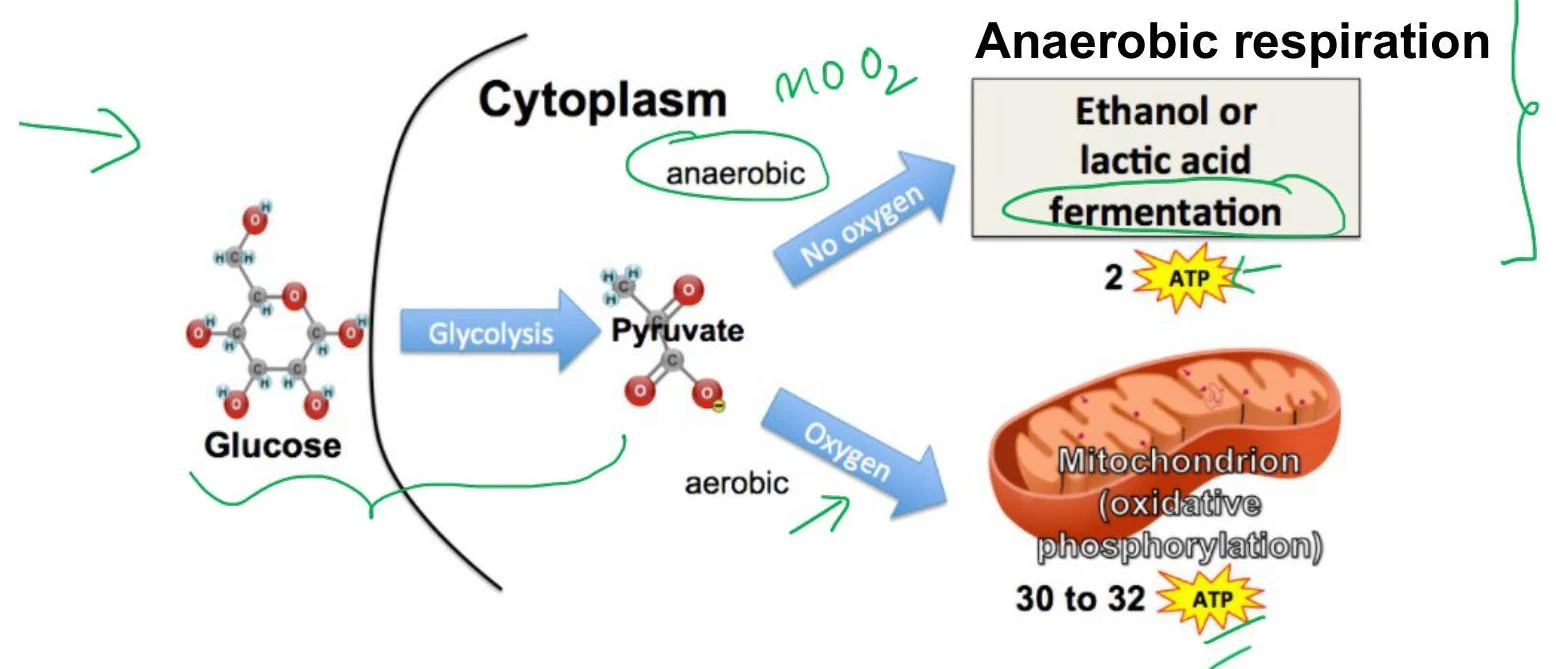
This diagram illustrates the processes of anaerobic and aerobic respiration, starting with glucose and glycolysis, leading to pyruvate. Anaerobic respiration results in fermentation, producing 2 ATP, while aerobic respiration, occurring in the mitochondrion, yields 30 to 32 ATP.
In aerobic conditions, NADH would travel to the electron transport chain to drop off electrons and be recycled back into NAD+. However, without oxygen to act as the final electron acceptor, the electron transport chain ceases to function. This creates a biological crisis: if all the available NAD+ is converted to NADH, glycolysis will grind to a halt because there will be no NAD+ left to accept electrons, and ATP production will stop entirely.
Exam Tip: Remember that the primary goal of fermentation is not actually to produce more energy, but to regenerate NAD+ so that glycolysis can continue to produce a small, steady supply of ATP.
Anaerobic Respiration
It is easy to confuse fermentation with anaerobic respiration, but they are distinct processes. Anaerobic respiration is utilized by certain prokaryotes (bacteria and archaea) that live in environments devoid of oxygen.
Unlike fermentation, anaerobic respiration does utilize an electron transport chain. The key difference lies in the final electron acceptor. While aerobic respiration uses O2, anaerobic respiration uses an inorganic substance, such as a sulfate ion (SO42−). A common byproduct of this process is hydrogen sulfide (H2S). Because these alternative electron acceptors are less efficient than oxygen, the total amount of ATP produced via anaerobic respiration is less than that produced during aerobic respiration.
Fermentation: Survival Without an Electron Transport Chain
Fermentation is a metabolic strategy used when oxygen is absent and an electron transport chain cannot be utilized. Instead of using an electron transport chain, fermentation uses pyruvate (or a derivative of pyruvate) to accept electrons from NADH. This oxidizes NADH back into NAD+, allowing glycolysis to repeat and produce a continuous, albeit small, supply of ATP.
Fermentation produces a net of only 2 ATP molecules per glucose molecule via substrate-level phosphorylation. There are two primary types of fermentation that are vital to both biology and industry:
1. Alcohol Fermentation
In alcohol fermentation, typically performed by certain bacteria and yeast, the process occurs in two steps:
The first step involves the release of carbon dioxide (CO2).
The second step produces ethanol.
This diagram illustrates the process of alcohol fermentation, starting with glucose undergoing glycolysis to produce pyruvate. Pyruvate is then converted to acetaldehyde, releasing carbon dioxide. Finally, acetaldehyde is reduced to ethanol.
This process is of immense commercial importance, particularly in the production of alcoholic beverages like beer.
2. Lactic Acid Fermentation
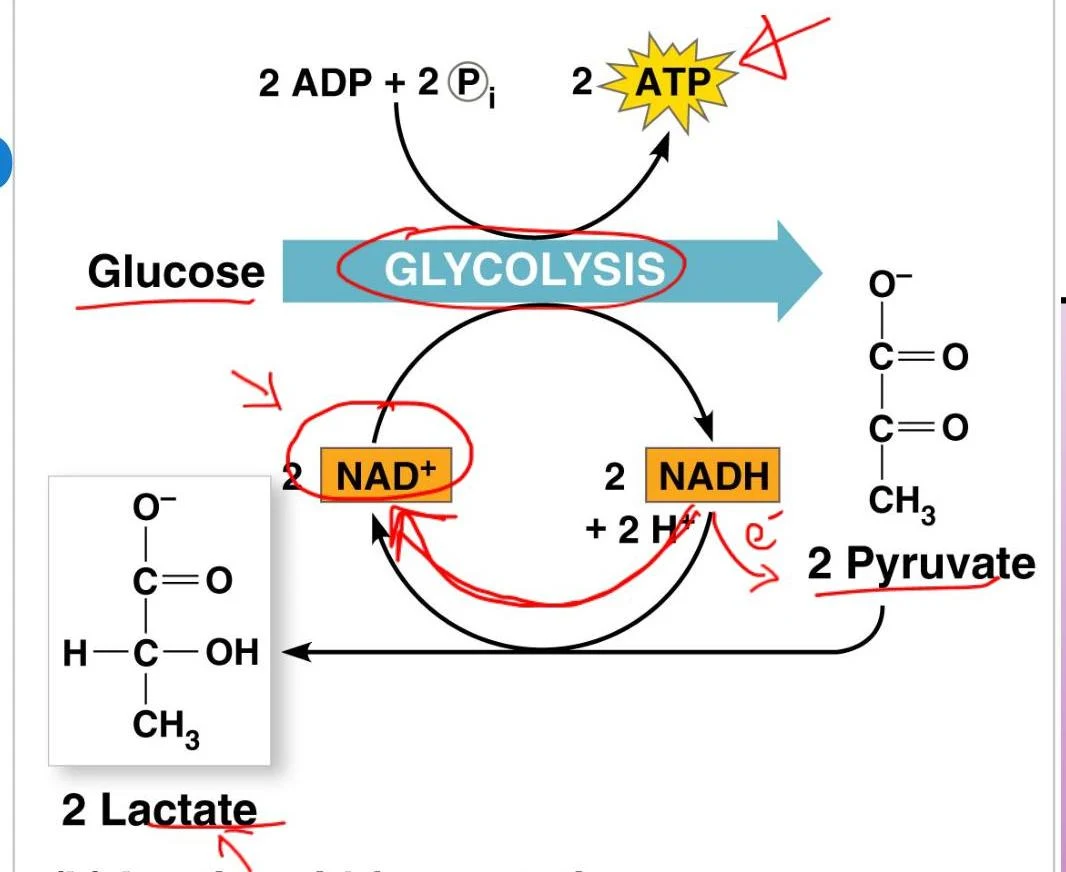
In lactic acid fermentation, pyruvate is reduced by NADH to form lactate (lactic acid). Unlike alcohol fermentation, this process does not release CO2.
Diagram illustrating the process of glycolysis, showing the conversion of glucose to pyruvate with the production of ATP and NADH.
This process is found in various bacteria and fungi, and it is also famously occurring in human muscle cells during intense exercise when oxygen demand exceeds supply.
Summary Comparison
To master this topic, it is helpful to compare the three main pathways of energy harvesting:
Feature
Aerobic Respiration
Anaerobic Respiration
Fermentation
Uses Glycolysis?
Yes
Yes
Yes
Uses Electron Transport Chain?
Yes
Yes
No
Final Electron Acceptor
Oxygen (O2)
Inorganic molecule (e.g., SO42−)
Pyruvate or derivative
ATP Production
Very High
Moderate (Less than aerobic)
Low (Net 2 ATP)
NAD+ Regeneration
Via Electron Transport Chain
Via Electron Transport Chain
Via reduction of pyruvate
Whether it is a yeast cell making bread rise, a bacterium producing yogurt, or a sprinter's muscles working through an oxygen deficit, these anaerobic processes are essential drivers of life in diverse environments.
Keep reading for free.
Create an account to finish this reading and make it part of your study routine.