Explore the fundamental concepts of metabolism, including the nature of energy, the laws of thermodynamics, free energy, and the roles of ATP and enzymes in cellular processes. Learn about metabolic pathways, redox reactions, and enzyme regulation.
At its most fundamental level, life is a constant struggle against disorder. To maintain the complex structures that define a living organism, cells must constantly perform chemical reactions to build molecules, break them down, and harvest energy. This entire collection of chemical reactions is known as metabolism. Metabolism is not a single process but a vast network of interconnected pathways that allow an organism to transform energy from its environment into a usable form to power life.
The Nature of Energy
To understand metabolism, we must first understand energy. In biological terms, energy is defined as the ability to promote change or do work. Energy exists in two primary forms:
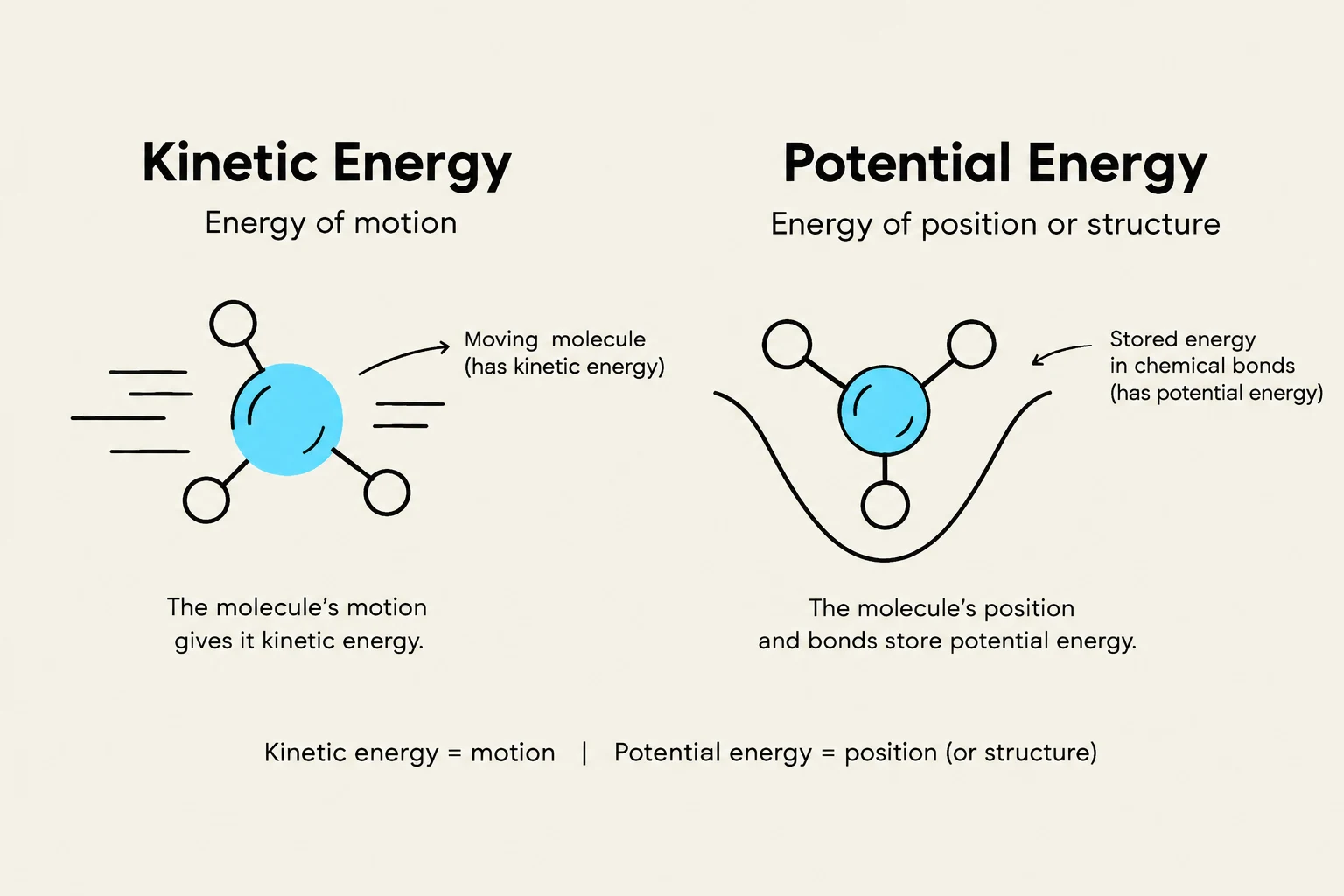
Kinetic Energy: This is the energy associated with the movement of objects or molecules.
Potential Energy: This is energy that is stored due to an object's structure or location. A crucial biological example is chemical energy, which is the potential energy stored within the molecular bonds of nutrients like glucose.
This diagram illustrates the concepts of kinetic and potential energy, showing how motion relates to kinetic energy and position or structure relates to potential energy.
The Laws of Thermodynamics
All energy transformations in living systems are governed by the laws of physics, specifically the Laws of Thermodynamics:
The First Law (Law of Conservation of Energy): Energy cannot be created or destroyed; it can only be transformed from one type to another. For example, when you eat food, the chemical potential energy in those molecules is transformed into kinetic energy (movement) and thermal energy (heat).
The Second Law: Every energy transfer increases the entropy (the degree of disorder) of a system. Because some energy is always lost as unusable heat during a transformation, the total entropy of the universe increases, and less energy becomes available for organisms to use for work.
Free Energy and Reaction Direction
Not all energy is useful for performing work. In any system, the total energy can be divided into usable energy and unusable energy (entropy). The amount of energy available to do work is called free energy (or Gibbs free energy, denoted as G).
The relationship between enthalpy (total energy), entropy, and temperature is expressed by the following equation:
HG=G+TS=H−TS
Where H is enthalpy, T is the absolute temperature in Kelvin, and S is entropy.
The change in free energy (ΔG) is the ultimate predictor of whether a chemical reaction will occur spontaneously.
Exergonic vs. Endergonic Reactions
Chemical reactions are categorized based on their free energy change:
Exergonic Reactions: These are spontaneous reactions that release energy. They have a negative free energy change (ΔG<0). An example is the breakdown of sucrose into CO2 and H2O.
Endergonic Reactions: These are non-spontaneous reactions that require an input of energy to proceed. They have a positive free energy change (ΔG>0).
Exam Tip: A "spontaneous" reaction does not necessarily mean it happens fast. It simply means the reaction is energetically favorable and can occur without a continuous input of external energy.
ATP: The Energy Intermediate
Cells solve the problem of "mismatched" reactions through energy coupling. Most cellular processes are endergonic (they need energy), but the cell obtains that energy from exergonic reactions (which release energy).
The primary molecule used for this coupling is ATP (Adenosine Triphosphate). When ATP undergoes hydrolysis (the breaking of a phosphate bond), it releases a significant amount of energy (ΔG=−7.3 kcal/mole). Cells use this released energy to drive endergonic reactions. If the sum of the ΔG for the coupled reactions is negative, the entire process becomes spontaneous.
This diagram illustrates ATP hydrolysis, an exergonic reaction where ATP breaks down into ADP and Pi, releasing energy. This released energy is then coupled to drive an endergonic reaction, where a substrate is converted into a product.
Enzymes: The Biological Catalysts
Even if a reaction is exergonic and spontaneous, it might occur too slowly to sustain life. To speed up these reactions, cells use catalysts—agents that increase the rate of a reaction without being consumed in the process.
In living cells, the most common catalysts are enzymes (proteins). Some RNA molecules also possess catalytic properties and are known as ribozymes.
Overcoming Activation Energy
Every chemical reaction requires an initial investment of energy to get started; this is known as the activation energy. This energy allows molecules to reach a "transition state" where their bonds are stretched and ready to rearrange.
Enzymes work by lowering the activation energy. They do this by:
Straining the bonds of the reactants.
Positioning reactants together in the correct orientation.
Changing the local chemical environment.
How Enzymes Work: The Active Site and Induced Fit
Enzymes are highly specific. They possess an active site, a specific location where the reaction takes place. The reactants that bind to the enzyme are called substrates.
While older models suggested a rigid "lock and key" mechanism, we now understand the induced fit model. In this model, when a substrate binds to the active site, the enzyme undergoes a conformational change (it shifts its shape) to wrap more tightly around the substrate, facilitating the reaction.
Enzyme activity can be enhanced by non-protein helpers:
Cofactors: Usually inorganic ions that bind temporarily.
Coenzymes: Organic molecules, such as NAD+, that participate in the reaction.
Prosthetic groups: Molecules that are permanently attached to the enzyme.
Regulation and Inhibition
Because metabolic pathways must be precisely controlled, cells use various methods to turn enzymes on or off. One way is through inhibition:
Competitive Inhibition: A molecule that resembles the substrate binds directly to the active site, physically blocking the substrate from entering.
Noncompetitive Inhibition: A molecule binds to a different part of the enzyme, called an allosteric site. This binding causes the enzyme to change shape, making the active site less effective.
Feedback Inhibition is a vital form of noncompetitive inhibition used for cellular regulation. In a metabolic pathway, the end product of the pathway can act as an inhibitor for an enzyme used much earlier in the chain. When the product accumulates to high levels, it binds to the early enzyme's allosteric site, shutting down the pathway to prevent waste.
Metabolic Pathways: Catabolism and Anabolism
Metabolism is organized into two complementary types of pathways:
Catabolic Pathways: These pathways break down complex cellular components into smaller ones. These are exergonic processes that release energy, which is often captured in intermediates like ATP or NADH.
Anabolic Pathways: These are biosynthetic pathways that use energy to build large macromolecules from smaller precursors. These are endergonic and must be coupled to exergonic reactions to proceed.
Redox Reactions and Electron Carriers
Many metabolic pathways rely on oxidation-reduction (redox) reactions to move energy.
Oxidation is the removal of electrons from a molecule.
Reduction is the gain of electrons by a molecule.
These processes are facilitated by electron carriers, such as NAD+ and NADP+. For example, NAD+ can accept electrons (becoming reduced to NADH) during catabolic processes. This NADH can then be used in other parts of the cell to either release energy to make ATP or donate electrons to drive anabolic synthesis reactions.
This diagram illustrates the redox reaction between NAD+ and NADH, showing the transfer of electrons and protons during oxidation and reduction processes.
Keep reading for free.
Create an account to finish this reading and make it part of your study routine.