Carbohydrates are versatile organic molecules essential for life, serving as building blocks, structural support, cell identity markers, and energy storage. This guide explores monosaccharides, polysaccharides, and their diverse biological functions.
Carbohydrates are among the most abundant and versatile organic molecules in the biological world. Chemically, they are variations of the formula (CH2O)n, characterized by the presence of a carbonyl group and multiple hydroxyl groups. While often associated simply with "sugar" and energy, carbohydrates serve a wide array of critical roles in living organisms, acting as raw materials for complex molecules, providing structural support, facilitating cell identity, and serving as a primary medium for chemical energy storage.
Monosaccharides: The Building Blocks
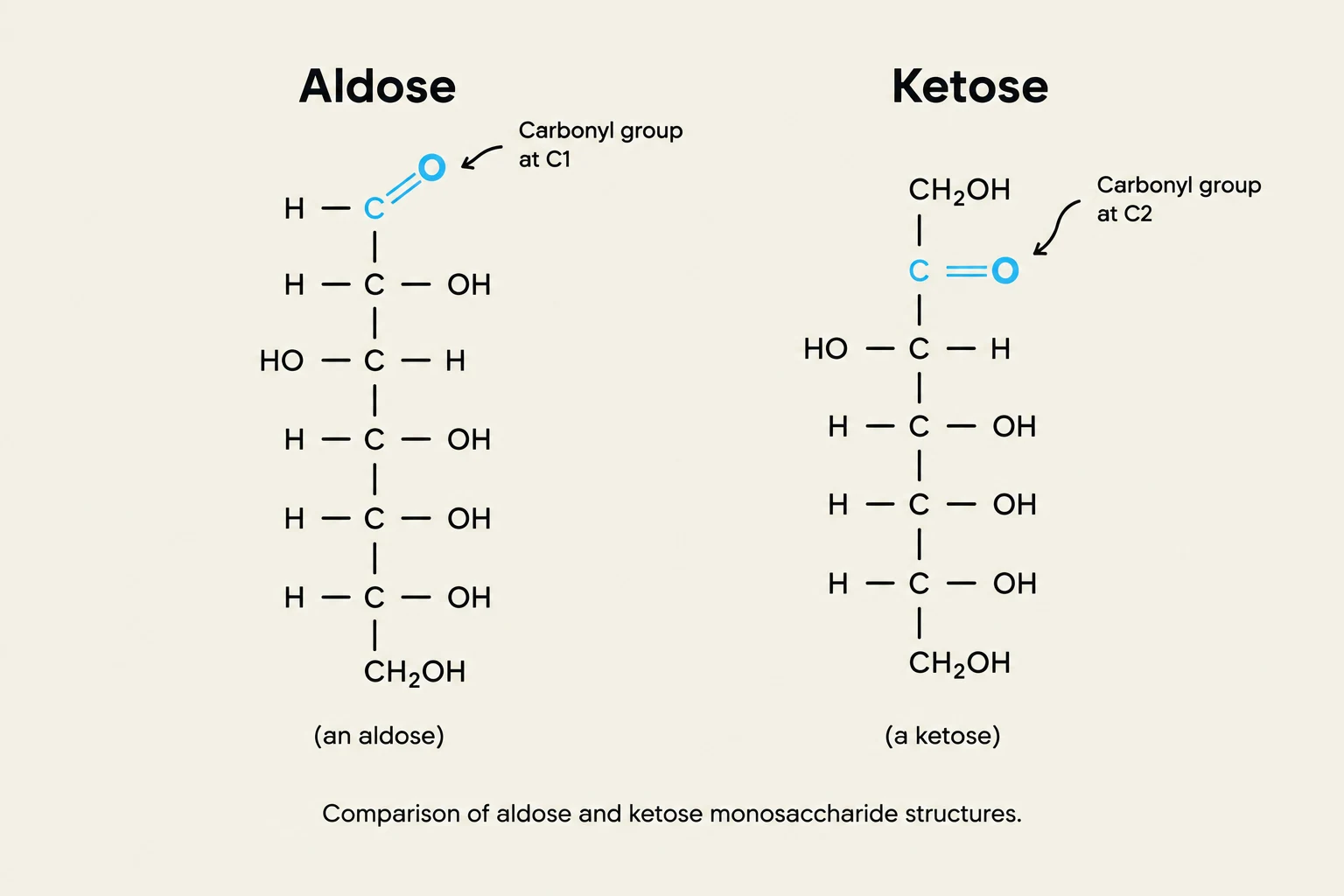
Comparison of aldose and ketose monosaccharide structures.
The simplest form of a carbohydrate is the monosaccharide, often referred to as a simple sugar. These molecules serve as the monomers that can be linked together to form more complex carbohydrates.
Monosaccharides are classified based on several structural features:
Carbonyl Group Position: The location of the carbonyl group determines whether a sugar is an aldose (where the carbonyl group is at the end of the carbon chain) or a ketose (where the carbonyl group is in the middle of the chain).
Carbon Count: They are named according to the number of carbon atoms they contain, such as trioses (3C), pentoses (5C), or hexoses (6C).
Molecular Shape: In aqueous solutions, monosaccharides can exist in a linear form or a ring shape.
Study Tip: Be prepared to sketch a six-carbon monosaccharide (a hexose) for your exam, noting the arrangement of its hydroxyl (-OH) groups.
Polysaccharides and Glycosidic Linkages
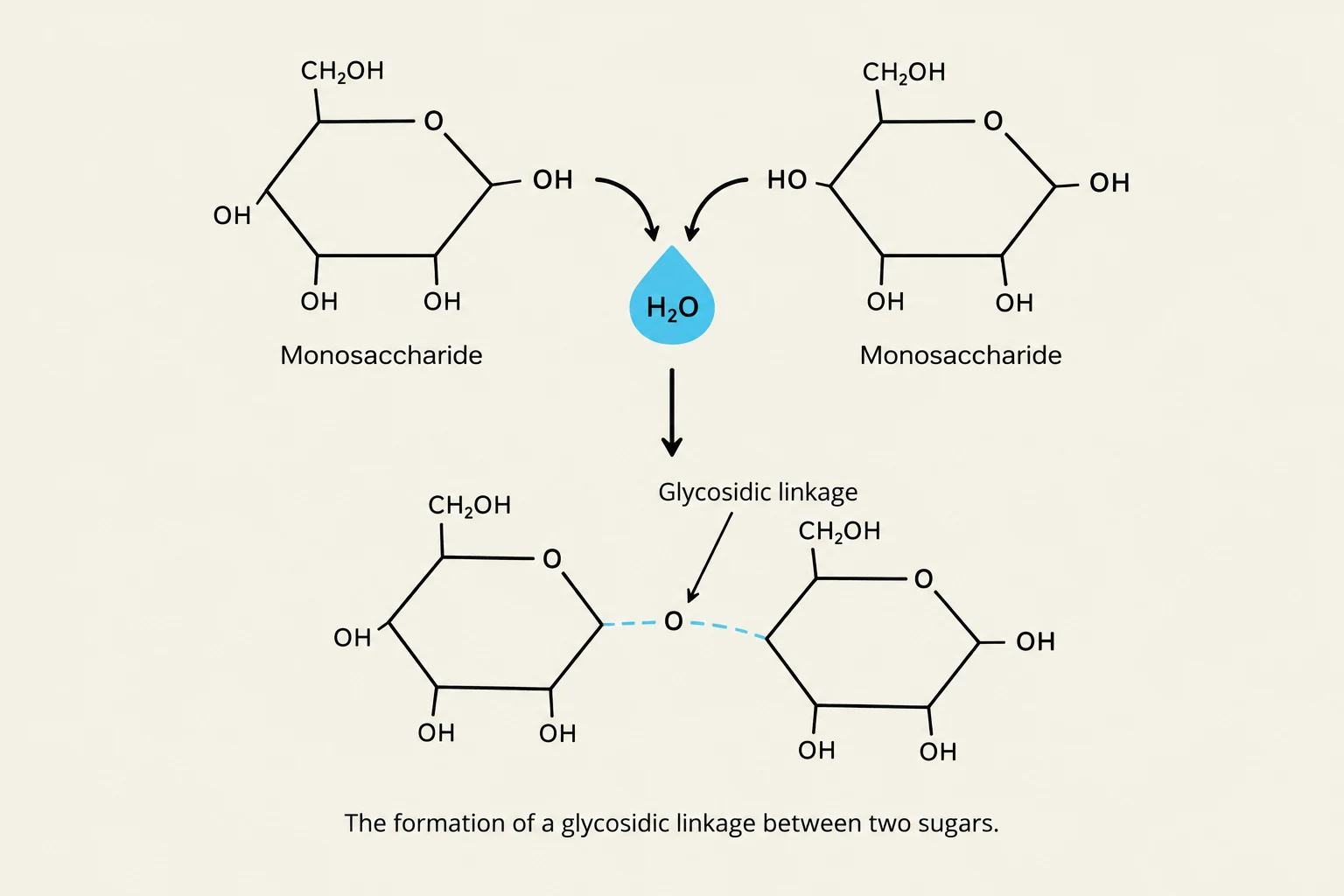
The formation of a glycosidic linkage between two sugars.
When monosaccharides are joined together, they form polymers known as polysaccharides (or complex carbohydrates). The bond that connects these monomers is called a glycosidic linkage, which forms between the hydroxyl groups of adjacent sugars.
The geometry and properties of a polysaccharide depend heavily on the type and location of these linkages. For example, the difference between α-linkages and β-linkages can determine whether a molecule is used for easy energy release or for building tough, permanent structures.
Storage Polysaccharides
Storage polysaccharides are designed to be broken down easily when an organism needs energy. They typically utilize α-glycosidic linkages, which enzymes can readily hydrolyze.
Starch: The primary storage form of glucose in plants.
Glycogen: A highly branched storage form of glucose used by animals.
Structural Polysaccharides
In contrast to storage molecules, structural polysaccharides are built for strength and durability. They typically form long, straight, parallel strands that are held together by hydrogen bonds, creating tough, strong fibers.
Cellulose: A major component of plant cell walls.
Chitin: A structural component found in the cell walls of fungi and the exoskeletons of insects and crustaceans. Chitin is composed of N-acetylglucosamine monomers joined by β-1,4-glycosidic linkages.
Peptidoglycan: A molecule that strengthens bacterial cell walls by joining two different monosaccharides via β-1,4-glycosidic linkages.
Biological Functions: Beyond Energy
While energy is a major theme, carbohydrates are essential for several other cellular processes.
Raw Materials and Cell Identity
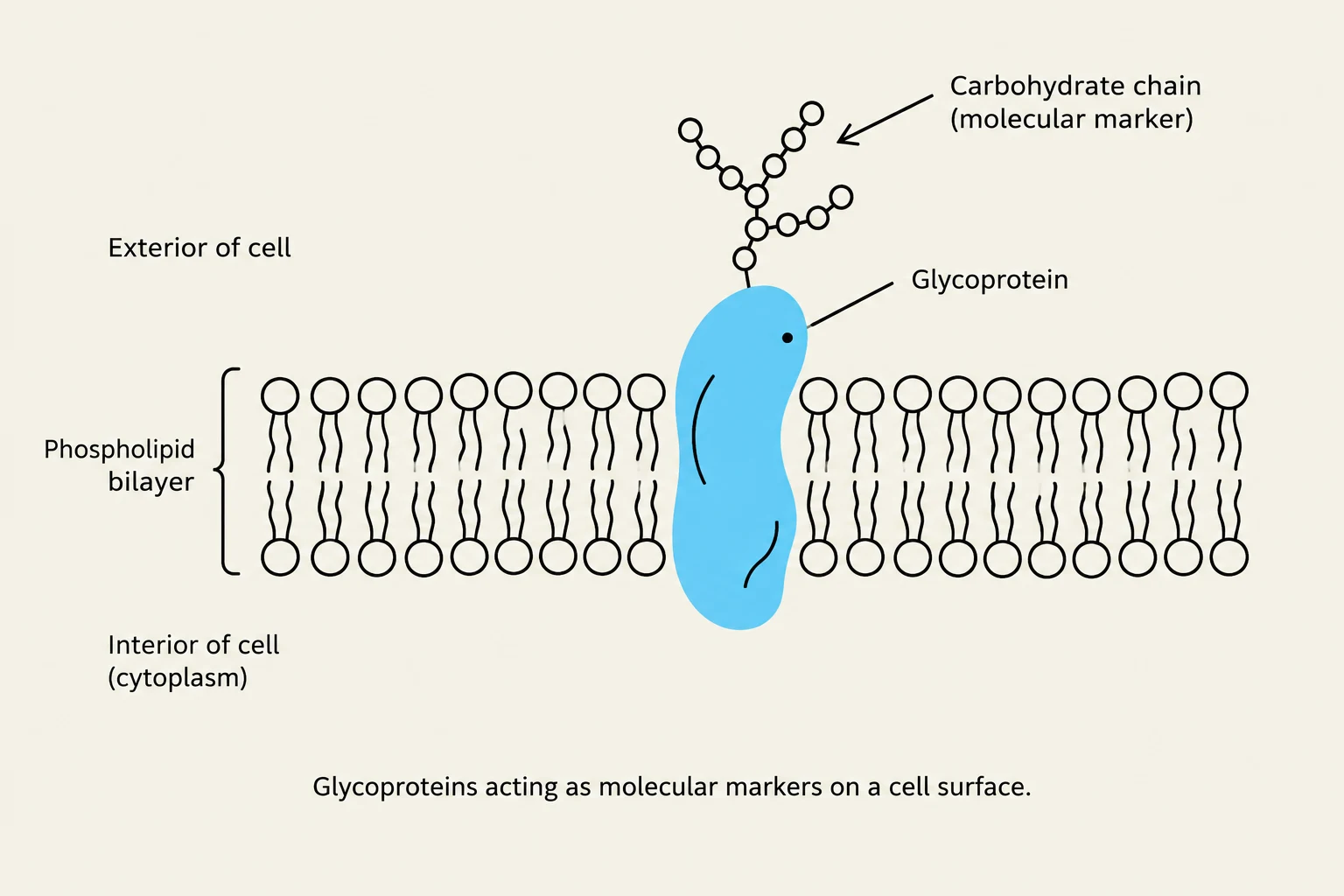
Glycoproteins acting as molecular markers on a cell surface.
Carbohydrates serve as the fundamental raw materials for synthesizing even more complex molecules; for instance, both DNA and RNA contain sugars.
Furthermore, carbohydrates are vital for cell recognition. When a carbohydrate is attached to a protein, it forms a glycoprotein. These glycoproteins act as molecular markers on the cell surface, allowing cells to recognize one another and communicate. Because of the immense diversity of monosaccharides, cells can create a vast array of unique glycoproteins that identify specific cell types (such as muscle or nerve cells) within a body.
Chemical Energy Storage and Photosynthesis
Carbohydrates are the primary way organisms capture and store solar energy. Through the process of photosynthesis, plants convert light energy into the high-potential energy found in the C−C and C−H bonds of carbohydrates.
The chemical equation for photosynthesis is:
\text{CO}_2 + \text{H}_2\text{O} + \text{sunlight} \rightarrow (\text{CH}_2\text{O})_n + \text{O}_2
\end{aligned}$$
During this process, electrons are moved from $\text{C}-\text{O}$ and $\text{C}=\text{O}$ bonds (found in $\text{CO}_2$ and $\text{H}_2\text{O}$) to $\text{C}-\text{C}$ and $\text{C}-\text{H}$ bonds in the carbohydrate. Because $\text{C}-\text{C}$ and $\text{C}-\text{H}$ bonds have higher potential energy, carbohydrates possess much higher free energy than the inorganic molecules from which they are made.
To use this energy, organisms break down these carbohydrates through cellular respiration. Enzymes hydrolyze the molecules to release glucose, and the energy stored in those glucose bonds is eventually transferred to the phosphate bonds of **ATP**, which powers cellular work:
$$\begin{aligned}
\text{CH}_2\text{O} + \text{O}_2 + \text{ADP} + \text{P}_i \rightarrow \text{CO}_2 + \text{H}_2\text{O} + \text{ATP}
\end{aligned}$$
$$$
$$$
Keep reading for free.
Create an account to finish this reading and make it part of your study routine.