


Proteins are the functional workhorses of the cell, responsible for everything from catalyzing chemical reactions to providing structural support. While they appear to be complex, three-dimensional machines, they are actually built from a simple repeating unit: the amino acid. By understanding how these small molecules link together and fold, we can grasp how a linear sequence of information (the genetic code) transforms into a dynamic, functional biological tool.
Anatomy of an Amino Acid
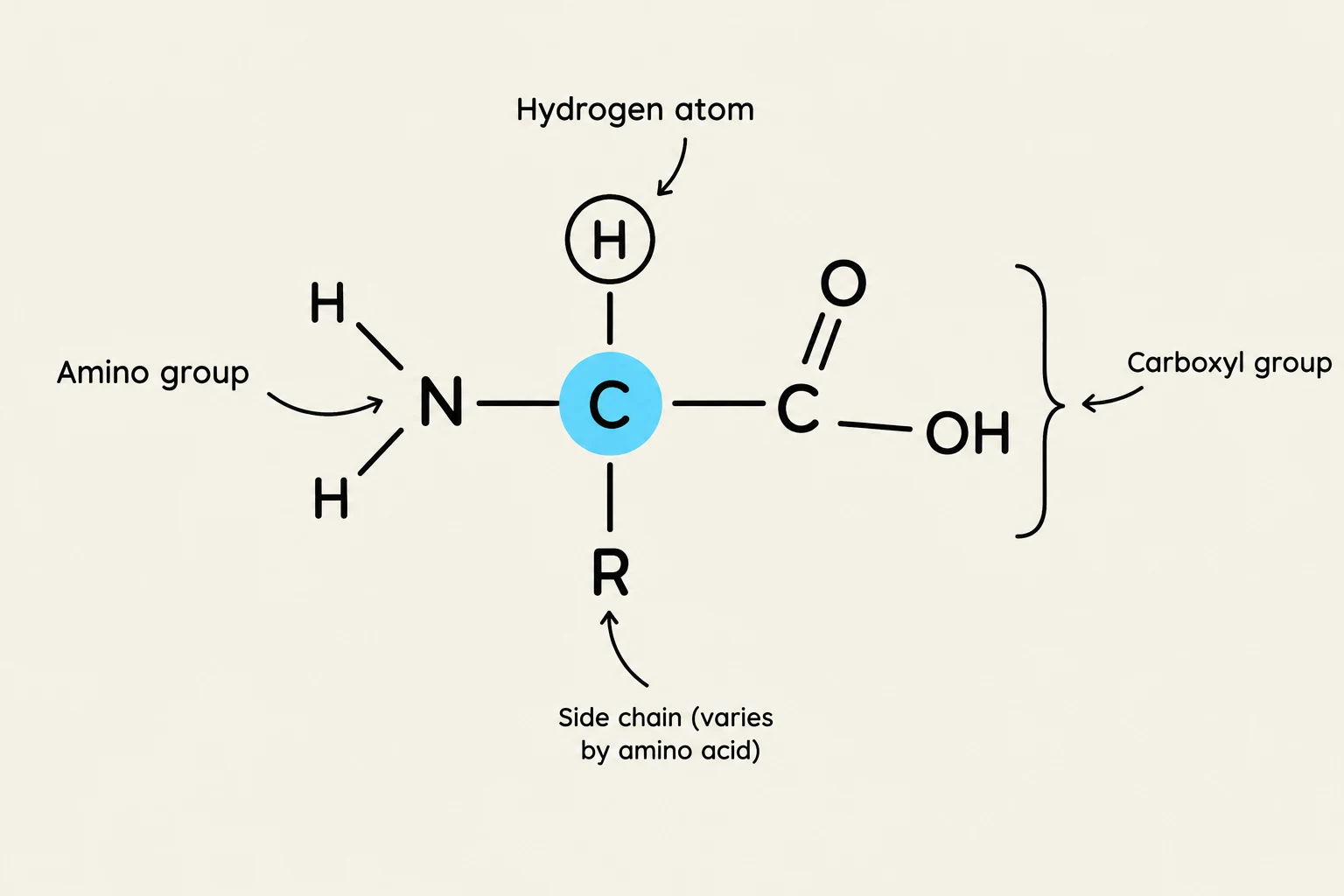
Every amino acid shares a common core structure, which allows them to be linked together in a predictable fashion. An amino acid consists of a central carbon atom bonded to four distinct components:
- An Amino Group (): The nitrogen-containing end of the molecule.
- A Carboxyl Group (): The acidic end of the molecule.
- A Hydrogen Atom: A single hydrogen bonded to the central carbon.
- An R Group (Side Chain): A variable group that distinguishes one amino acid from another.
The "R group" is the most critical component for protein function. While the backbone remains constant, the R group changes for each of the 20 standard amino acids.
R Group Properties
The chemical nature of the R group determines how an amino acid behaves in different environments. Because R groups vary in their chemical makeup, they can be categorized by their properties, such as whether they are polar, nonpolar, acidic, or basic. These properties dictate how the amino acids will interact with each other and with water once they are folded into a protein. The specific order of these R groups in a chain is what ultimately determines the final shape and function of the protein.
Keep reading for free.
Create an account to finish this reading and make it part of your study routine.
Continue reading freeAlready have an account? Log in
Updated