Amino Acid Polymerization and Polypeptide Structure
Explains the fundamental building blocks of life, amino acids, their polymerization into polypeptides via condensation reactions, and the resulting peptide backbone structure, distinguishing between polypeptides and proteins.
In the study of molecular biology, understanding how life builds complex machinery requires a look at its fundamental building blocks: amino acids. While individual amino acids are small organic molecules, they possess the unique ability to link together into long, organized chains. These chains eventually fold into functional proteins, which serve as the enzymes, structural components, and signaling molecules that drive nearly every cellular process.
The Building Blocks: Amino Acids
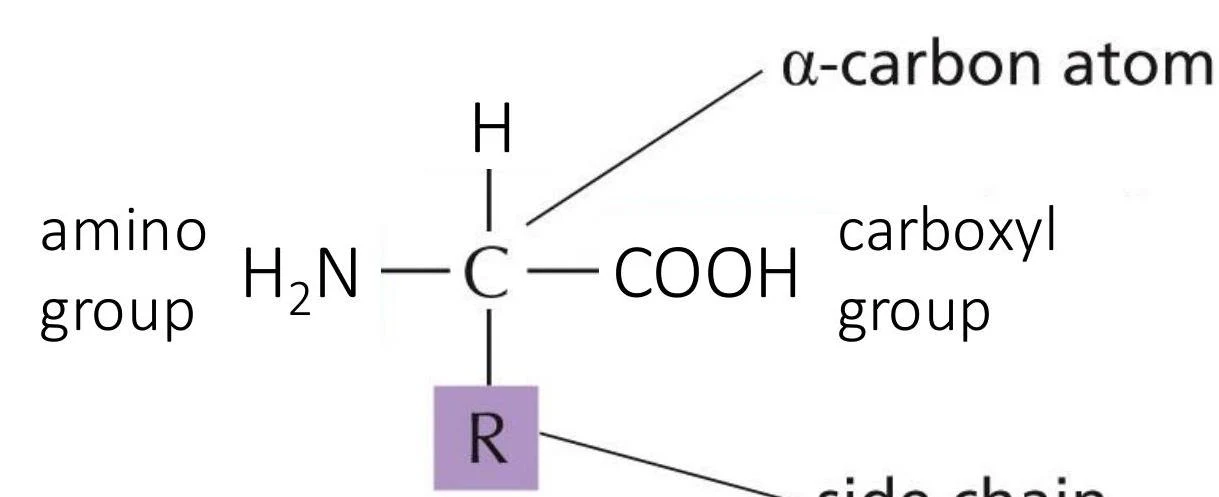
An amino acid is a small molecule characterized by a central carbon atom, known as the alpha carbon (Cα), which is bonded to four distinct groups:
An amino group (−NH2)
A carboxyl group ($-COOH$)
A hydrogen atom
A variable side-chain group (the R-group)
The general structure of an amino acid, showing the alpha-carbon atom bonded to an amino group, a carboxyl group, a hydrogen atom, and a variable side chain (R-group).
The R-group is the most critical component for biological diversity. While all 20 standard amino acids share the same basic backbone, their R-groups vary in size, shape, charge, and polarity. These variations dictate how the amino acids interact with water and, ultimately, how the final chain will fold.
Amino acids are generally categorized by the chemical properties of these side chains:
Nonpolar: These side chains (often hydrocarbons) are hydrophobic and tend to avoid contact with water.
Polar (Uncharged): These contain groups like hydroxyls or amides that can form hydrogen bonds with water.
Charged: These include acidic amino acids (which carry a negative charge at physiological pH) and basic amino acids (which carry a positive charge).
Exam Tip: When discussing protein folding, remember that the sequence of these R-groups is what determines the final 3D shape. Certain amino acids have "special" roles: Glycine provides flexibility, Proline provides rigidity, and Cysteine can form covalent disulfide bonds to stabilize structures.
Polymerization via Condensation Reaction
Amino acids do not simply float together; they must be chemically bonded to form a chain. This process is known as polymerization.
The specific mechanism used is a condensation reaction. In this reaction, the carboxyl carbon of an existing polypeptide chain reacts with the amino nitrogen of an incoming amino acid. During this process, a molecule (typically water) is released as the two subunits join.
This diagram illustrates the formation of a peptide bond between two amino acids, a process that occurs during protein synthesis. The reaction involves the removal of a water molecule and requires energy.
The resulting covalent linkage between the carbon and the nitrogen is called a peptide bond.
The Polypeptide Structure
Once many amino acids have been linked, they form a polypeptide. This chain possesses a repeating structural unit known as the peptide backbone.
The Peptide Backbone and Directionality
The backbone follows a consistent, repeating N-C-C pattern: the nitrogen from the amino group, the alpha-carbon, and the carbon from the carboxyl group.
Because the polymerization process is directional—always adding the new amino acid's amino group to the previous amino acid's carboxyl group—every polypeptide has two distinct ends:
N-terminus (amino-terminus): The "start" of the chain, characterized by a free amino group.
C-terminus (carboxyl-terminus): The "end" of the chain, characterized by a free carboxyl group.
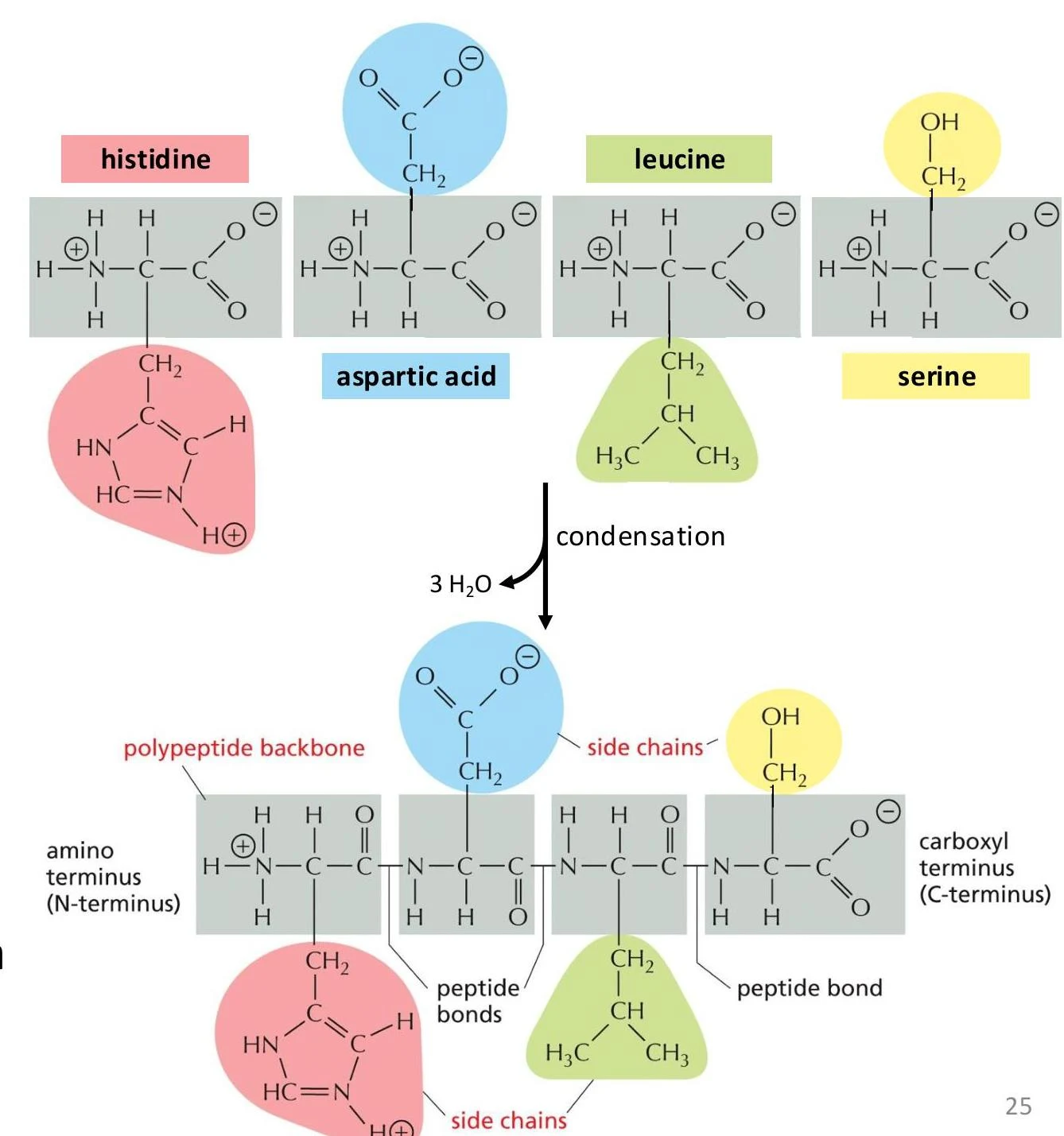
This diagram illustrates the formation of a polypeptide chain through the condensation of amino acids, showing the peptide bonds, polypeptide backbone, amino terminus, and carboxyl terminus.
Amino Acids vs. Amino Acid Residues
A common point of confusion in biochemistry is the terminology used to describe the subunits within a chain. When an amino acid undergoes a condensation reaction, it loses parts of its original structure (such as the $-OH$ from the carboxyl group or an −H from the amino group) to form the bond.
Because they are chemically modified "remainders" of the original molecules, the subunits within a polymerized chain are called amino acid residues.
Worked Example: If you are looking at a polypeptide chain made of four units, you would not say it is "made of four amino acids." Instead, you would say it is a "tetrapeptide consisting of four amino acid residues".
From Polypeptide to Protein
It is vital to distinguish between a polypeptide and a protein, as they are not always synonymous.
Polypeptide: This is any linear chain of amino acids connected by peptide bonds. A polypeptide can be very short and lacks a complex structure.
Protein: A protein is a more complex structure. It is typically a long polypeptide (often containing 100 or more residues) that has folded into a specific, stable 3D shape to perform a biological function.
This illustration shows the condensation reaction between amino acids to form a polypeptide chain, highlighting the formation of peptide bonds and the resulting polypeptide backbone with amino and carboxyl termini.
In summary: All proteins are polypeptides, but not all polypeptides are proteins. A polypeptide only becomes a protein once it achieves the functional, folded conformation required by the cell.
Keep reading for free.
Create an account to finish this reading and make it part of your study routine.