In the study of genetics and toxicology, understanding how chemical compounds interact with DNA is vital for assessing biological risk. While mutations can drive evolutionary diversity, they often result in deleterious effects, such as cancer or genetic disorders. To bridge the gap between chemical exposure and biological consequence, scientists utilize specialized assays like the Ames test to detect mutagenicity, while simultaneously studying the sophisticated DNA repair systems that organisms use to safeguard their genomic integrity.
The Ames Test: Detecting Mutagenicity
The Ames test is a fundamental biological assay used to evaluate the mutagenic potential of chemical compounds. Rather than testing directly on complex mammalian tissues, which can be expensive and ethically complex, the assay utilizes specific strains of the bacterium Salmonella typhimurium.
The Mechanism of Reversion Mutations
The test relies on the use of his− strains of S. typhimurium. These specific bacterial strains possess a mutation in a gene required for the biosynthesis of the amino acid histidine, meaning they cannot grow on a minimal medium that lacks histidine supplementation.
The assay measures the rate of reversion mutations. A reversion occurs when a second mutation restores the original function of the histidine biosynthetic pathway, converting the bacteria from a his− state back to a his+ state. Once reverted, these bacteria can synthesize their own histidine and are able to grow into visible colonies on minimal medium.
A compound is classified as a mutagen if the number of revertant colonies observed on experimental plates is significantly higher than the spontaneous reversion rate found in control plates.
Specialized Strains and Metabolic Activation
To ensure a comprehensive assessment of a chemical's danger, researchers use different strains of S. typhimurium to detect specific types of DNA damage:
Base-pair substitution strains: These strains (such as TA 100) are designed to detect compounds that induce transitions or transversions, where one nucleotide base is swapped for another.
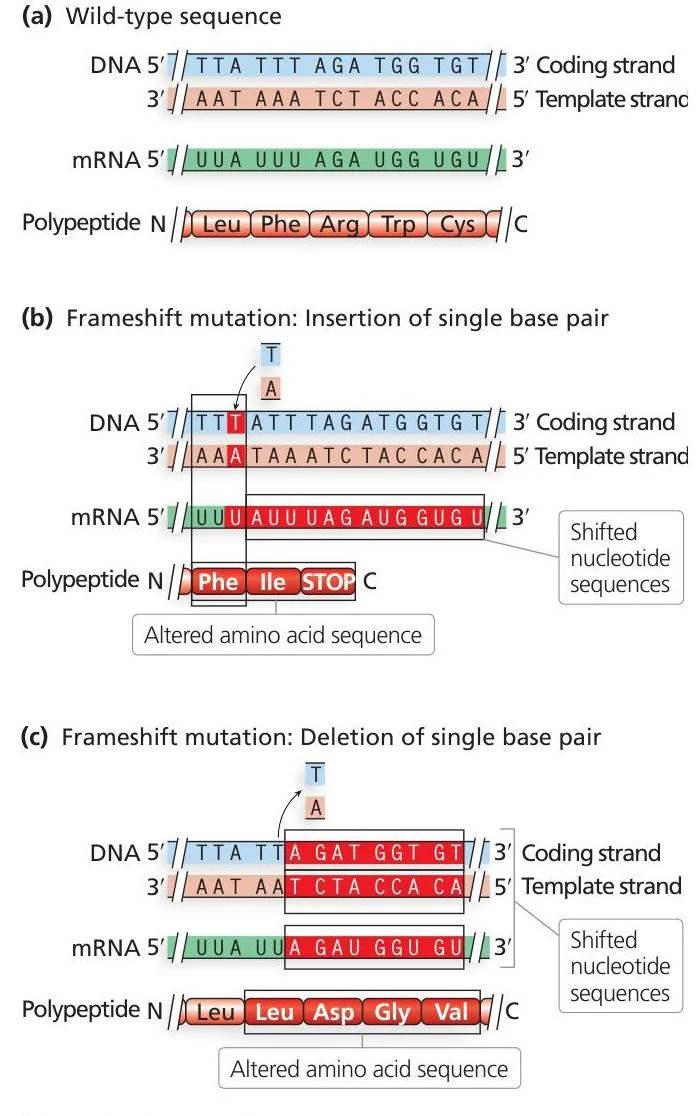
Frameshift mutation strains: These strains (such as TA 1538) detect compounds that cause insertions or deletions of nucleotides, which shift the reading frame of the genetic code.
This illustration demonstrates the effects of frameshift mutations on DNA sequences, mRNA transcription, and polypeptide chains. It shows a wild-type sequence and how the insertion or deletion of a single base pair can lead to altered amino acid sequences, including premature stop codons.
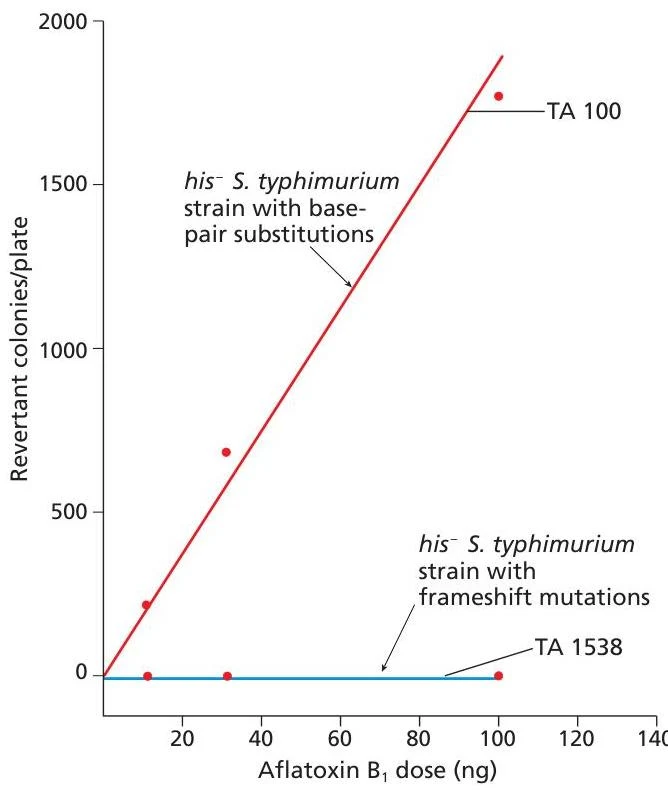
A critical refinement in the Ames test is the addition of S9 extract. This is a preparation of rat liver enzymes that simulates mammalian metabolism. This is necessary because some compounds are not mutagenic themselves but become highly mutagenic once they are metabolized by the liver. A classic example is aflatoxin B1, a powerful mutagen that induces high rates of base-pair substitution but does not typically cause frameshift mutations.
This graph illustrates the mutagenic effect of Aflatoxin B1 on two strains of Salmonella typhimurium. The strain with base-pair substitutions (TA 100) shows a dose-dependent increase in revertant colonies, indicating mutagenicity. The strain with frameshift mutations (TA 1538) shows no significant increase in revertant colonies, suggesting it is less susceptible to this particular mutagen or the mutagen acts via base-pair substitutions.
DNA Repair Systems: Maintaining Genomic Integrity
While the Ames test measures the induction of mutations, organisms possess complex DNA repair systems to counteract such damage and maintain the stability of their genome. These systems must strike a delicate balance: they must be efficient enough to prevent lethal mutations, yet allow for enough variation to facilitate evolution.
Direct Repair of DNA Damage
Direct repair refers to processes that fix DNA lesions immediately without needing to remove and replace large segments of the DNA strand. These mechanisms restore the DNA to its original wild-type state directly.
DNA Polymerase Proofreading: During DNA replication, DNA polymerase acts as the first line of defense. It possesses an inherent ability to identify and correct mismatched nucleotides as they are being incorporated into the new strand.
Photoreactive Repair: This mechanism specifically addresses damage caused by ultraviolet (UV) light. UV radiation can induce the formation of covalent bonds between adjacent thymine bases, creating "pyrimidine dimers" that stall replication.
Diagram illustrating the formation of thymine dimers in DNA when exposed to UV light, showing adjacent thymines forming covalent bonds.
Diagram illustrating the process of nucleotide excision repair in DNA, where UV-induced thymine dimers are removed and the DNA strand is restored.
Circumvention Mechanisms
Sometimes, DNA damage is too extensive or complex for immediate direct repair. In these instances, organisms utilize circumvention mechanisms. These processes allow the cell to bypass blocked DNA replication sites. By "skipping over" the lesion, the cell can complete replication and avoid cell death, even though the original DNA lesion remains in the sequence to be addressed by other repair pathways later.
Exam Tip: Distinguishing Mutation Types
When reviewing Ames test results, remember that base-pair substitutions change a single "letter" in the DNA code (e.g., A to G), whereas frameshift mutations (insertions or deletions) change the entire "reading frame" of the gene, often leading to much more drastic changes in the resulting protein.
Summary Table: Mutation and Repair Overview
Feature
Base-Pair Substitution
Frameshift Mutation
Mechanism
Single nucleotide swap (Transition/Transversion)
Insertion or Deletion of nucleotides
Ames Strain Example
TA 100
TA 1538
Primary Repair Focus
Proofreading & Mismatch Repair
Excision Repair & Circumvention
Keep reading for free.
Create an account to finish this reading and make it part of your study routine.