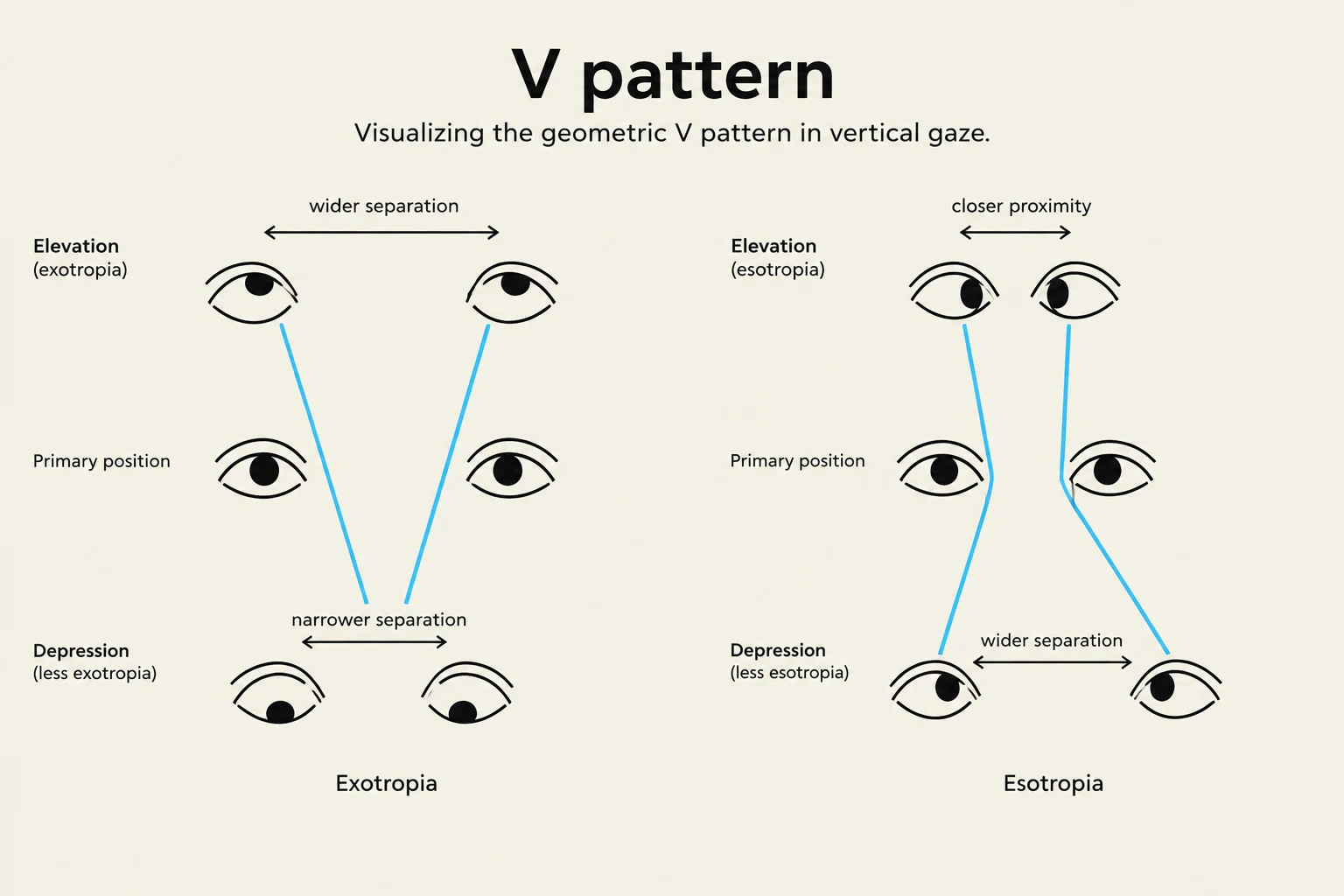
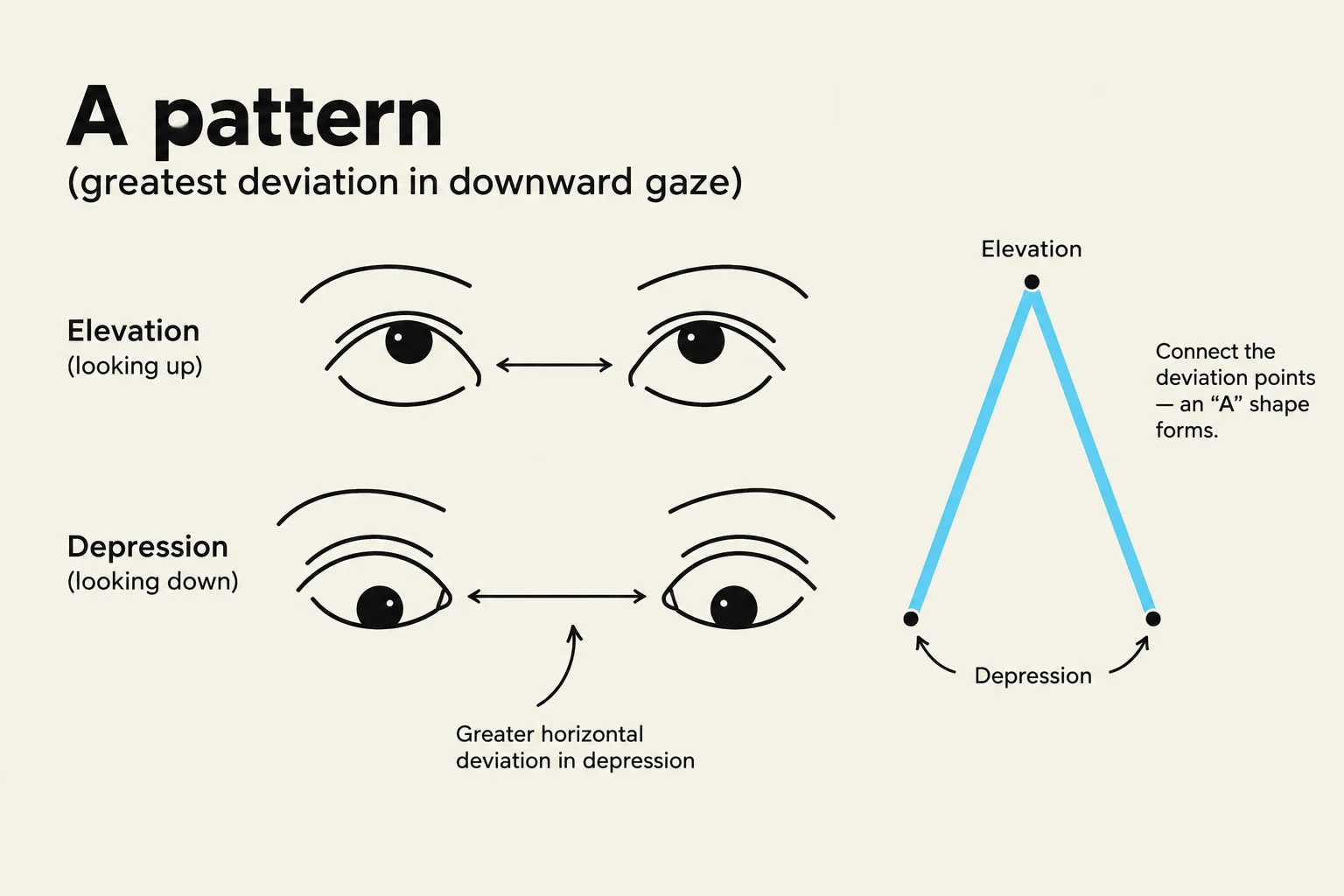
- Pathological A pattern: Defined by a difference of >10Δ between elevation and depression.
This is categorized as:
- A esotropia (A eso): Increased esotropia on depression.
- A exotropia (A exo): Increased exotropia on depression.
While V and A are the most common, other geometric patterns such as X, Y, λ, and ◊ can also occur.
Exam Tip: To distinguish between physiological and pathological patterns, remember the threshold values: V patterns require a difference >15Δ, while A patterns require a difference >10Δ.
Prevalence and Aetiology
Alphabet patterns are relatively common, appearing in $12%–50%$ of patients with horizontal strabismus. Notably, the V pattern is twice as common as the A pattern. Within these groups, A-exotropia is more common than A-esotropia.
Clinical Associations
Certain physical features and syndromes are associated with specific patterns:
- V pattern: Often associated with downward-slanting palpebral fissures.
- A pattern: Often associated with upward-slanting palpebral fissures.
- Syndromes: Craniosynostosis (e.g., Crouzon, Apert, and Pfeiffer syndromes) and plagiocephaly often display A and V patterns due to orbital anomalies. Down syndrome is also frequently associated with A-pattern esotropia.
Theories of Aetiology
There is disagreement in the literature regarding the exact cause, but several theories exist:
- Abnormal Oblique Muscle Function: This is the most popular theory. For example, inferior oblique (IO) over-action is frequently associated with both A and V patterns.
- Vertical Muscle Weakness: Weakness in the vertical recti can cause patterns. For instance, a V-eso can result from superior oblique (SO) weakness, while a V-exo can result from superior rectus (SR) weakness.
- Abnormal Muscle Insertions: If horizontal muscles are inserted too high or too low, or if oblique muscles are inserted too anteriorly or posteriorly, it alters the mechanical advantage and causes pattern deviations.
- Muscle Pulleys: Mislocation of the connective tissue pulleys can cause incomitance in vertical gaze. For example, an A-pattern may be caused by the medial rectus (MR) pulley being too low and the lateral rectus (LR) pulley being too high, leading to incyclorotation.
- Sagittalisation: Disruption of the normal parallelism of the obliques can cause torsion, which in turn alters vertical muscle contraction.
Investigation
To accurately diagnose an alphabet pattern, a systematic orthoptic assessment is required:
- Measurements: Assessment must be performed in Primary Position (PP), direct elevation, and direct depression.
- Cover Test (PCT): Using a 6m distance to eliminate accommodation, though measuring at 1/3m may be useful to assess accommodative influences.
- Other Tools: The Synoptophore, Lees screen, and assessment of the field of binocular single vision (BSV) are valuable.
When investigating, the clinician must gather information regarding:
- Symptoms: Presence of diplopia or asthenopia.
- Nature of Deviation: Whether it is constant or intermittent (e.g., decompensating during prolonged reading).
- Torsion: An objective assessment of ocular torsion is essential.
Management and Surgical Principles
The goal of management is to obtain or retain binocular single vision (BSV), create a larger field of BSV, and achieve better ocular alignment.
Surgical Decision Making
The choice of surgery depends heavily on the underlying aetiology. A key surgical principle is:
- If there is significant vertical muscle over- or under-action: Operate on the vertical (oblique) muscles.
- If vertical muscle action is normal or only mildly affected: Operate on the horizontal muscles.
Specific Surgical Options
| Pattern | Primary Goal | Surgical Options |
|---|
| V esotropia | Reduce convergence on elevation | IO recession/myectomy; MR transposition downwards; SO weakening |
| V exotropia | Reduce divergence on elevation | LR recession/transposition upwards; IO weakening; SR weakening |
| A esotropia | Reduce convergence on depression | SO posterior tenotomy/tenectomy; MR transposition upwards; IO weakening |
| A exotropia | Reduce divergence on depression | IR weakening; LR transposition downwards; SO weakening |
Advanced Techniques
- Transposition of Horizontal Muscles: If oblique muscles are not the primary issue, the insertion of horizontal muscles can be moved. For a V-eso, the MR insertion is moved downwards.
- Slanting Insertions: Introduced by Bietti, this involves recessing the upper or lower margins of a muscle more than the opposite margin to fine-tune the effect on elevation or depression. For example, to reduce V-exotropia, the upper margin of the LR is recessed more than the lower margin.
Clinical Note: When performing horizontal muscle surgery, clinicians must be cautious of postoperative risks. For instance, if an MR insertion is found to be abnormally low, it may need to be transposed upwards to prevent an A-exotropia postoperatively.