Aircraft Icing: Types, Intensity, and Meteorological Factors
An in-depth explanation of aircraft icing, covering the physics of super-cooled water droplets, different types of ice (clear, rime, mixed), icing intensity classification, and the relationship between cloud types and icing hazards. It also discusses special icing phenomena and aerodynamic factors affecting icing sever
Aircraft icing is one of the most significant meteorological hazards in aviation, capable of rapidly degrading aircraft performance and compromising flight safety. Understanding the physics of how water transitions from a liquid state to a solid on an airframe is essential for every pilot. This article explores the mechanics of super-cooled water, the various forms ice can take, how icing intensity is classified, and the relationship between different cloud types and icing risks.
The Physics of Icing: Super-cooled Water Droplets
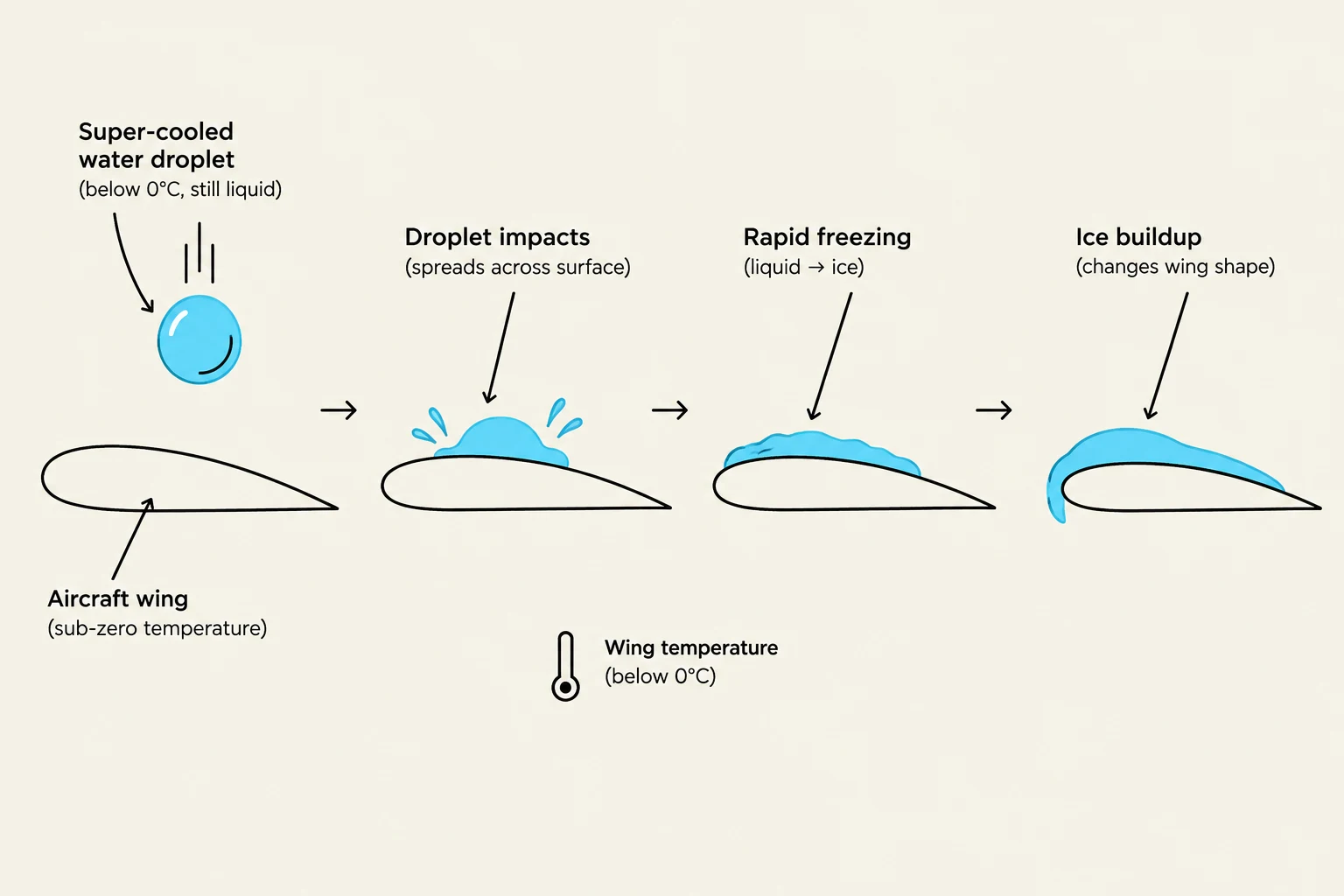
The fundamental driver of aircraft icing is the presence of super-cooled water droplets. Under specific meteorological conditions, water droplets can exist in a liquid state even when the ambient temperature is well below 0∘C. These droplets will not freeze spontaneously; however, the moment they impact an aircraft surface that is at or below freezing temperatures, the collision triggers an immediate phase change, causing the water to freeze and coat the airframe.
The rate of this freezing process is influenced by several factors. When a droplet strikes the aircraft, it releases the latent heat of fusion, which momentarily warms the remaining liquid to 0∘C. The speed at which the rest of the droplet freezes thereafter depends on the temperature of the aircraft skin and the surrounding air.
Diagram illustrating the process of ice buildup on an aircraft wing due to super-cooled water droplets impacting and freezing on its surface at sub-zero temperatures.
Exam Tip: Remember that the closer the air and skin temperatures are to 0∘C, the slower the water freezes. This allows the water to spread further across the airfoil before solidifying, which can lead to more complex ice shapes.
Types of Ice
Ice is categorized based on how the droplets freeze upon impact, which determines the ice's physical properties and its effect on the aircraft.
Clear Ice
Clear ice is transparent and glass-like with a rough surface. It possesses high adhesive and cohesive properties, meaning it sticks very well to the aircraft. This type forms when large droplets freeze slowly after impact, allowing the water to flow back along the airfoil surface before it solidifies. Clear ice is particularly dangerous because it typically forms on leading edges, windshields, propeller blades, and engine inlets.
Rime Ice
Rime ice is rough, milky, and opaque in appearance. It is formed by the almost instantaneous freezing of small super-cooled water droplets. Because the droplets freeze so quickly, they trap a large amount of air, making the ice brittle and porous. While rime ice may not be as heavy as clear ice, its danger lies in the aerodynamic alteration of the wing camber and the potential to choke carburetors or instruments.
Mixed Ice
As the name suggests, mixed ice possesses properties of both clear and rime ice. It occurs when large and small super-cooled droplets coexist. The resulting accumulation is whitish, irregular, and rough. Mixed ice can accumulate very rapidly and is notoriously difficult to remove.
Icing Intensity Classification
To communicate the severity of an icing encounter, aviation authorities use a standardized classification system based on the rate of accumulation and the necessity of corrective action:
Classification
Description
Required Pilot Action
Trace
Perceptible, but no significant accumulation.
Usually not hazardous if de-icing/anti-icing equipment is not used.
Light
Significant accumulations for shorter periods.
Occasional use of de-icing/anti-icing equipment is required.
Moderate
Significant accumulations for prolonged flight (>1 hour).
De-icing/anti-icing equipment may fail to control the hazard; immediate diversion is necessary.
Severe
Rapid, dangerous accumulations.
Immediate flight diversion is mandatory.
Cloud Types and Icing Hazards
The type of cloud an aircraft enters is a primary indicator of the potential icing threat.
Convective Clouds (Cumulus and Cumulonimbus)
Convective clouds, such as Towering Cumulus (TCU) and Cumulonimbus (CB), are associated with unstable air and strong vertical updrafts. These clouds contain large water droplets and can produce severe icing.
Temperature/Ice Relationship: Between 0∘C and −25∘C, clear ice is common. Between −25∘C and −40∘C, rime ice is more likely.
Pilot Action: If temperatures are between +2∘C and −20∘C, pilots should attempt to navigate laterally around cumulus clouds to avoid short but potentially severe encounters.
Layer Clouds (Stratus)
Layer or stratiform clouds generally have weaker updrafts and smaller droplets compared to convective clouds. Consequently, icing in layer clouds is often less severe but can cover a much greater horizontal extent.
Pilot Action: If icing is encountered in stratus clouds, pilots should immediately activate ice protection systems and consider changing altitude by approximately 3,000 feet to exit the icing environment.
Cirrus Clouds
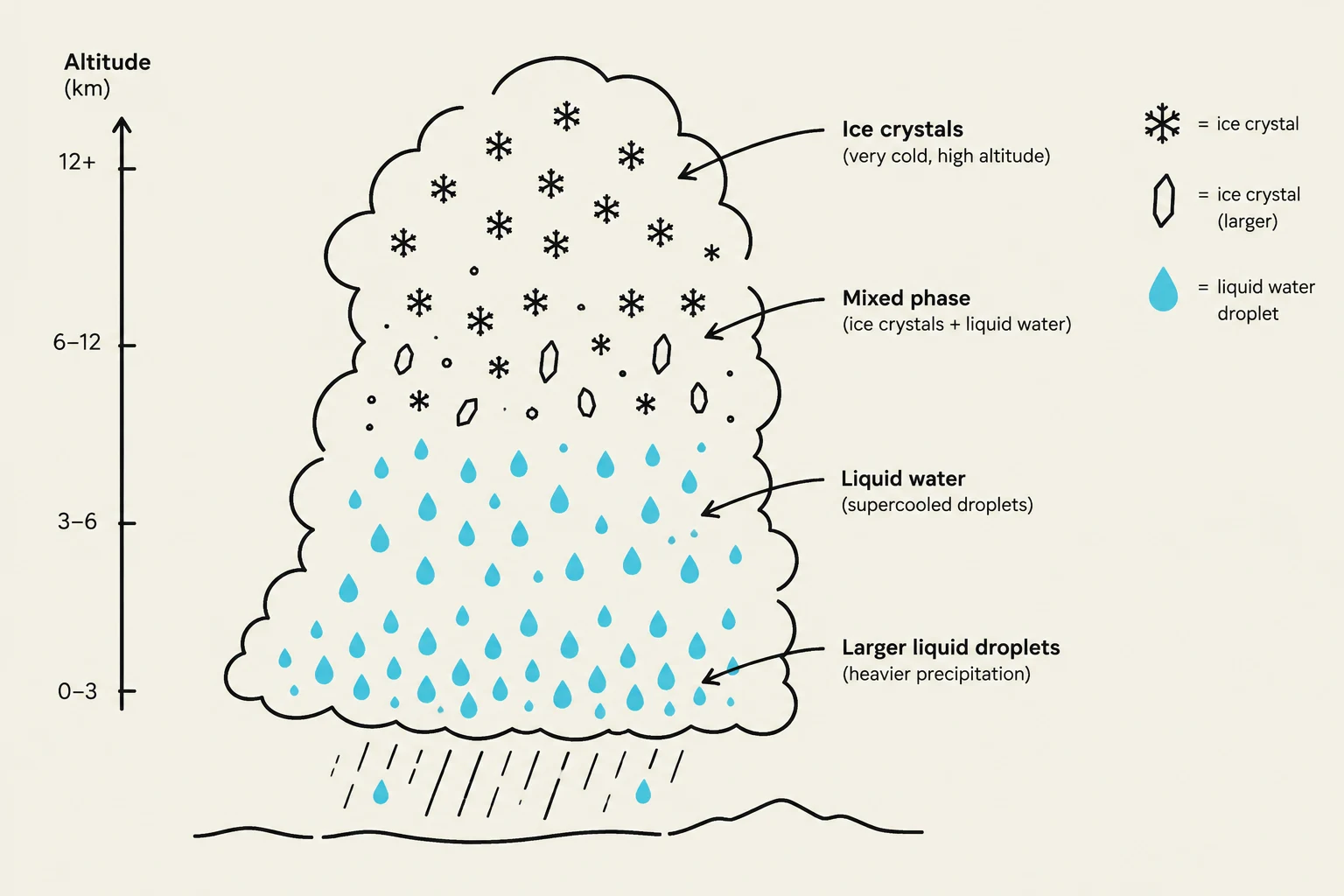
Cirrus clouds are primarily composed of ice crystals. Because they lack liquid water, they do not constitute a serious icing hazard, with the exception of the anvil tops of thunderstorms where updrafts may still carry super-cooled droplets.
This diagram illustrates the different phases of water within a cloud, from ice crystals at high altitudes to liquid water droplets at lower altitudes, and the resulting precipitation.
Special Icing Phenomena
Freezing Rain and Drizzle
Freezing rain occurs when snow falls through a warm layer and melts into rain, only to fall back into a sub-freezing layer near the surface. This results in the formation of severe clear ice upon impact. Freezing drizzle is similar but involves the coalescence of super-cooled droplets within stratus clouds; this ice is often most severe near the cloud base.
Hoar Frost
Unlike structural icing caused by droplets, hoar frost forms through sublimation—where water vapor changes directly into ice crystals without becoming liquid. This can occur on parked aircraft on clear, cold nights or when an aircraft descends from freezing temperatures into warmer, moist air. Even a light coating of frost can significantly increase stall speed, posing a major takeoff risk.
Aerodynamic and Engine Factors
The severity of icing is also dictated by collection efficiency—the fraction of liquid water an aircraft actually collects. Factors that increase collection efficiency include higher aircraft speeds, larger water droplets, and sharper leading edges.
Furthermore, icing is not limited to the airframe. It can occur in:
Piston Engines: Specifically via carburetor icing during fuel vaporization.
Jet Engines: In the induction system, inlet guide vanes, and even the fuel system if water is present in the fuel.
Keep reading for free.
Create an account to finish this reading and make it part of your study routine.