Agency Problems and Monitoring in Corporate Governance
Explores the agency problem arising from the separation of ownership and control in corporations, detailing agency costs and the mechanisms used to align manager and owner interests, such as boards of directors and institutional investors.
In a perfect world, every decision made by a company's management would maximize the wealth of its owners. However, in the real world of large, complex corporations, a fundamental gap often exists between those who own the company (the principals/shareholders) and those who run it (the agents/managers). This gap creates agency problems, where managers may prioritize their own interests—such as job security, excessive perks, or empire-building—over the long-term value of the firm.
To bridge this gap, firms must implement sophisticated monitoring and incentives to ensure that managers act in the best interest of the shareholders. This process involves a delicate economic balancing act known as managing agency costs.
Understanding Agency Costs
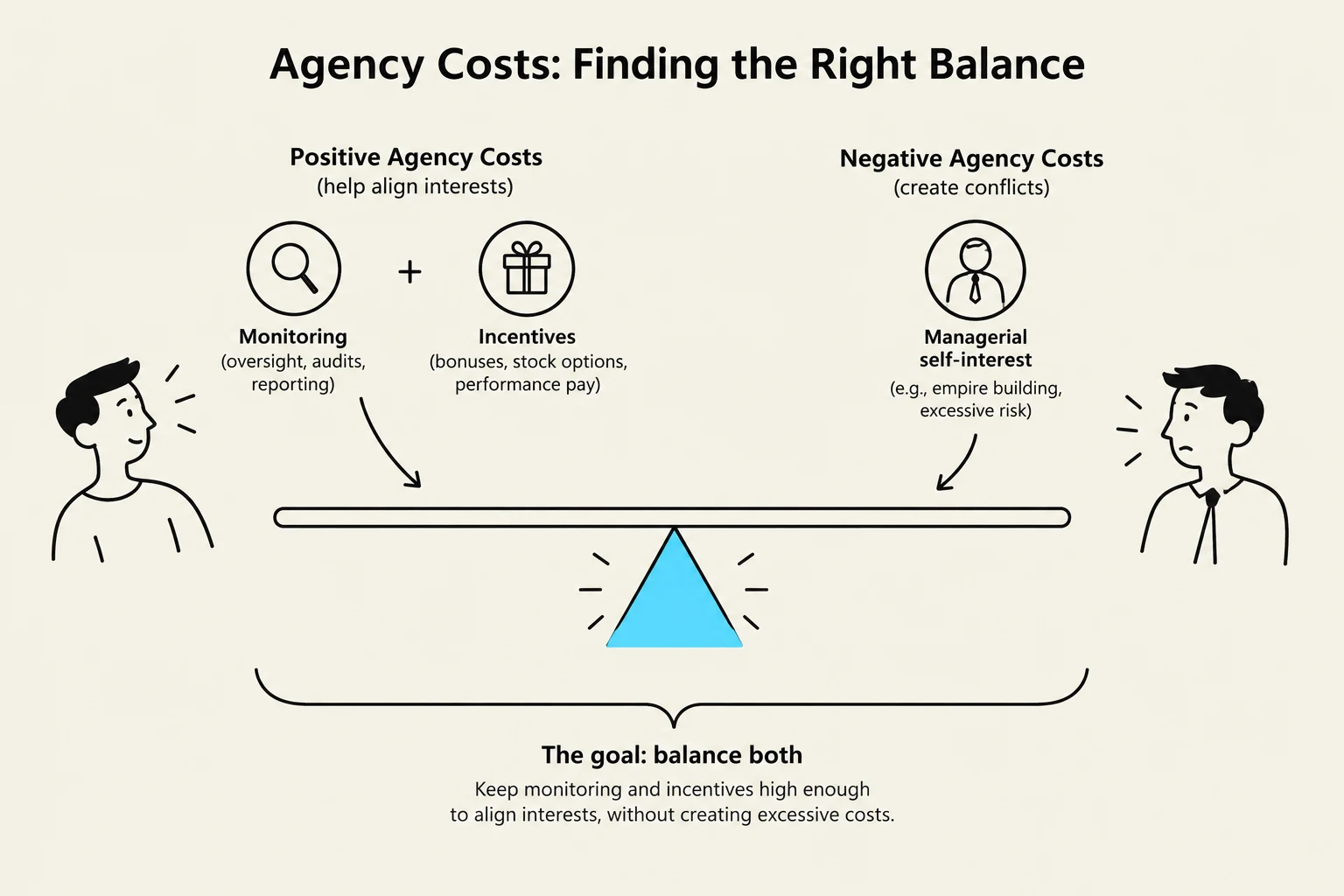
Agency costs are not a single expense but a category of costs that arise from the separation of ownership and control. They are generally divided into two types:
Positive Agency Costs: These are the necessary expenditures required to align interests. This includes the costs of setting up monitoring systems (like hiring auditors) and designing incentive packages (like stock options).
Negative Agency Costs: These are the actual losses incurred when alignment fails. This includes "managerial perks" (unnecessary luxury expenses) or "under-investment," where managers avoid risky but profitable projects because they fear for their personal job security.
An efficient firm does not aim for zero agency costs—which would be impossible—but rather seeks to minimize the total cost by balancing the two.
Total Agency Cost=Positive Agency Costs+Negative Agency Costs
This diagram illustrates the concept of agency costs in economics, explaining how monitoring and incentives can help align interests, while managerial self-interest can create conflicts. The goal is to find a balance between these factors to manage costs effectively.
The Board of Directors: The Primary Monitor
The most formal mechanism for oversight is the board of directors. Elected by shareholders, the board's primary responsibility is to oversee management and ensure that the company's strategic implementation aligns with owner objectives.
Composition: Insiders vs. Outsiders
An effective board requires a strategic mix of two types of members:
Inside Members: These are individuals who are also employees of the firm, such as the CEO or CFO. They provide essential context regarding the company's day-to-day operations and management rationale.
Outside Members: These are external professionals or community leaders who do not work for the company. While insiders provide knowledge, a majority of outside members is crucial for rigorous oversight. Without enough outsiders, the board risks becoming a "rubber stamp" for the CEO's decisions.
Specialized Subcommittees
To prevent conflicts of interest, boards often delegate specific tasks to specialized subcommittees. Ideally, these should be composed exclusively of outside members to ensure objectivity:
Audit Committee: Responsible for ensuring the accuracy of financial statements and the integrity of the firm's reporting.
Personnel and Compensation Committee: Responsible for evaluating managerial performance and setting pay scales.
Nominating Committee: Tasked with identifying and recommending new candidates for the board.
Finance Committee: Focuses on the firm's capital structure and major financial decisions.
Potential Weaknesses in Board Governance
Even with a formal structure, certain dynamics can undermine a board's effectiveness:
Board Interlocks: This occurs when executives from different companies sit on each other's boards. While this can facilitate information sharing, it can also create "mutual dependencies" where directors are hesitant to challenge one another, weakening the monitoring function.
The Chairperson Role: When the CEO also serves as the chairperson of the board, it can be a double-edged sword. While it may act as a signaling mechanism to the market that the board trusts the CEO's leadership, it also grants the CEO significant power to control the board's agenda and limit the scope of oversight.
This diagram illustrates the corporate governance structure, showing the relationship between shareholders, the board of directors, and management, and how they contribute to company performance.
Institutional Investors and Shareholder Influence
While the board provides formal oversight, institutional investors provide a powerful layer of both formal and informal monitoring. These are large-scale organizations, such as pension funds (e.g., CalPERS) or mutual funds, that manage massive amounts of capital on behalf of many individuals.
The Power of Large Stakes
Because institutional investors hold significant portions of a company's stock, they possess immense shareholder influence. They can use their voting power to:
Influence the composition of the board of directors.
Demand changes in corporate governance practices.
Engage in activism, where they use their resources to actively monitor performance and pressure management for improvements.
The Threat of Divestment
One of the most effective monitoring tools held by institutional investors is the "threat to sell." If management fails to act in the interest of shareholders, these large players can sell massive blocks of stock. This sudden drop in demand can lead to a significant decline in stock price, providing a massive incentive for managers to remain compliant and performance-oriented.
Exam Tip: When discussing institutional investors, remember the trade-off. While they promote accountability and reduce agency costs, there is a risk that they may prioritize short-term growth (to satisfy quarterly reports) over the long-term value creation necessary for a firm's sustained success.
Summary Table: Monitoring Mechanisms
Mechanism
Type
Primary Goal
Potential Risk
Board of Directors
Formal
Oversight of management and strategic alignment
Board interlocks or CEO dominance
Subcommittees
Formal
Specialized oversight (Audit, Compensation)
Conflicts of interest if insiders are included
Institutional Investors
Informal/Formal
Pressure for performance and governance
Short-termism/Focus on quarterly results
Incentives (Stock)
Alignment
Mirroring shareholder interests
Encouraging excessive risk-taking
Keep reading for free.
Create an account to finish this reading and make it part of your study routine.