Aerobic Respiration: Glycolysis, Pyruvate Oxidation, and the Citric Acid Cycle
Explore the intricate process of aerobic respiration, detailing glycolysis, pyruvate oxidation, and the citric acid cycle. Understand how cells generate ATP through these interconnected metabolic pathways, utilizing oxygen as the final electron acceptor for maximum energy yield.
Aerobic respiration is the sophisticated multi-step process by which eukaryotic cells extract energy from organic molecules, primarily glucose, to produce adenosine triphosphate (ATP). This process is not a single reaction but a series of interconnected metabolic pathways that involve the breakdown of large molecules (catabolism) and the provision of precursors for biosynthesis (anabolism). By utilizing oxygen as a final electron acceptor, cells can maximize the energy yield from a single molecule of glucose, producing significantly more ATP than anaerobic processes.
The First Stage: Glycolysis
The journey of glucose metabolism begins in the cytosol of the cell with glycolysis. During this stage, a single six-carbon glucose molecule is broken down through a series of enzymatic steps into two three-carbon molecules of pyruvate.
Glycolysis involves two main phases: an energy-investment phase where ATP is consumed to phosphorylate the sugar, and an energy-payoff phase where ATP and reduced coenzymes are produced. The net reaction for glycolysis can be summarized as follows:
. While glycolysis produces a small amount of ATP via substrate-level phosphorylation, its most critical contribution to aerobic respiration is the production of pyruvate and the reduced coenzyme NADH.
Mitochondrial Entry and Pyruvate Oxidation
To continue the oxidation process, the pyruvate produced in the cytosol must enter the mitochondrion. The outer mitochondrial membrane is relatively permeable due to pore-forming proteins called porins, but the inner membrane is highly impermeable to polar and ionic substances. Therefore, pyruvate requires a specific transporter located in the inner mitochondrial membrane to reach the matrix.
Once inside the mitochondrial matrix, pyruvate undergoes oxidative decarboxylation to become acetyl CoA. This reaction is catalyzed by a massive enzyme assembly known as the pyruvate dehydrogenase complex. This step is crucial because it links glycolysis to the citric acid cycle by converting a three-carbon pyruvate into a two-carbon acetyl group attached to Coenzyme A.
The stoichiometry for the conversion of two pyruvates (from one glucose) is:
The citric acid cycle, also known as the TCA cycle or the Krebs cycle, takes place within the mitochondrial matrix. This cycle serves as the central metabolic hub of the cell.
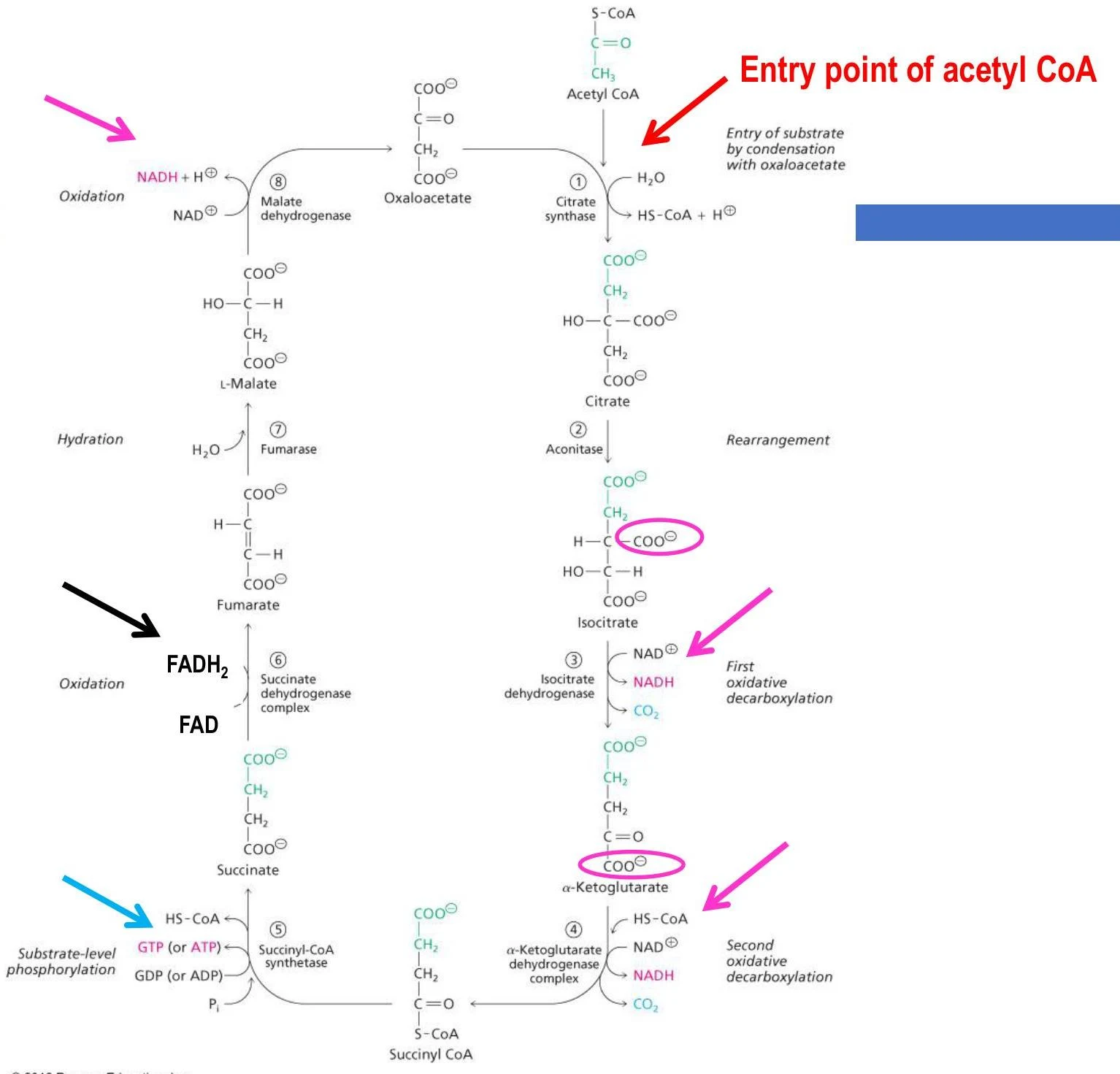
The cycle begins when the two-carbon acetyl group from acetyl CoA is condensed with a four-carbon molecule, oxaloacetate, to form a six-carbon molecule called citrate. Through a series of seven enzymatic steps, the citrate is oxidized, releasing two molecules of CO2 and regenerating the original oxaloacetate to allow the cycle to continue.
This diagram illustrates the Krebs cycle, a series of chemical reactions used to release stored energy from molecules.
The primary purpose of the cycle is not the direct production of ATP, but rather the coenzyme reduction of NAD+ and FAD. For every turn of the cycle (one acetyl CoA), the following are produced:
3 NADH
1 FADH2
1 GTP (which is readily converted to ATP)
2 CO2
Because one glucose molecule produces two pyruvates, the cycle turns twice per glucose molecule.
Exam Tip: Amphibolic Nature
The citric acid cycle is described as amphibolic because it functions in both catabolic (degradative) and anabolic (synthetic) pathways. While it oxidizes acetyl groups for energy, its intermediates (like α-ketoglutarate or oxaloacetate) can be drawn off to serve as precursors for synthesizing amino acids or other molecules. To prevent the cycle from running out of intermediates, the cell uses anaplerotic reactions to replenish them.
Oxidative Phosphorylation
The final and most productive stage of aerobic respiration is oxidative phosphorylation, which occurs in the inner mitochondrial membrane. This stage consists of two closely linked processes: the electron transport chain (ETC) and chemiosmosis.
The Electron Transport Chain (ETC)
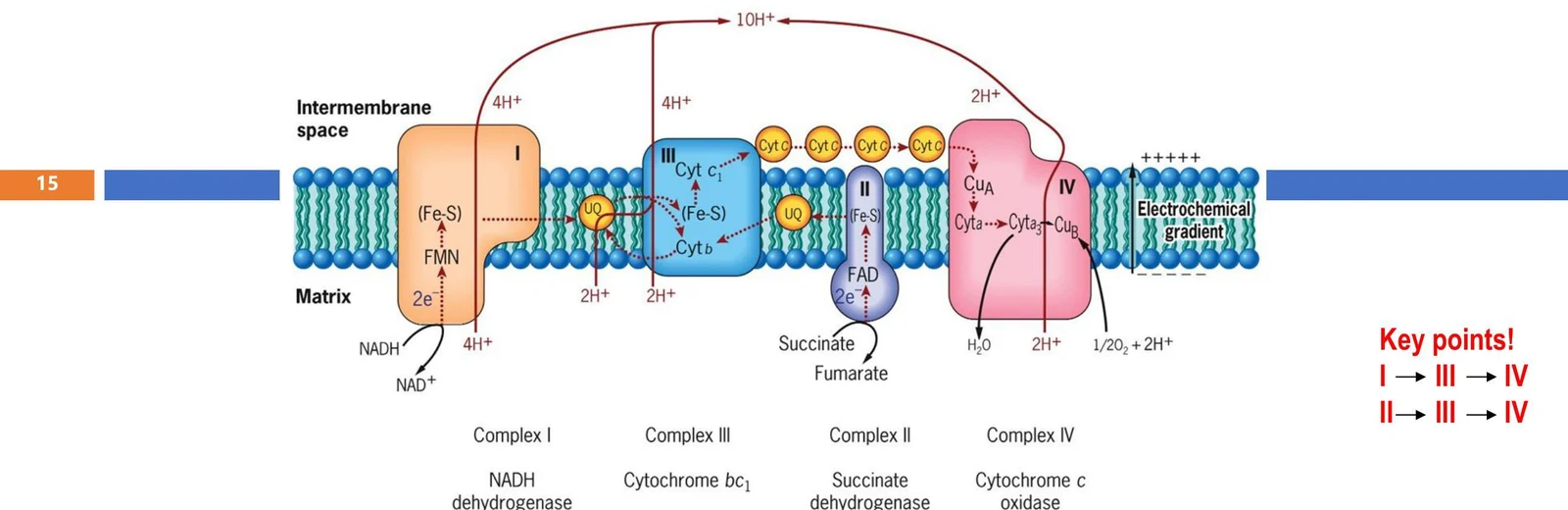
The ETC is composed of four major mitochondrial electron-transport complexes (I, II, III, and IV) and two mobile carriers: ubiquinone (Coenzyme Q) and cytochrome c.
The process begins when reduced coenzymes, NADH and FADH2, donate their high-energy electrons to the chain. NADH enters at Complex I, while FADH2 enters at Complex II. As electrons move through the complexes toward the final electron acceptor, oxygen (O2), they move from carriers with more negative redox potentials to those with more positive potentials.
Diagram illustrating the electron transport chain in cellular respiration, showing the four complexes (I-IV) embedded in the inner mitochondrial membrane and their roles in proton pumping and ATP synthesis.
As electrons pass through Complexes I, III, and IV, the energy released is used to pump protons (H+) from the mitochondrial matrix into the intermembrane space. This creates an electrochemical gradient, also known as the proton-motive force.
ATP Synthesis via ATP Synthase
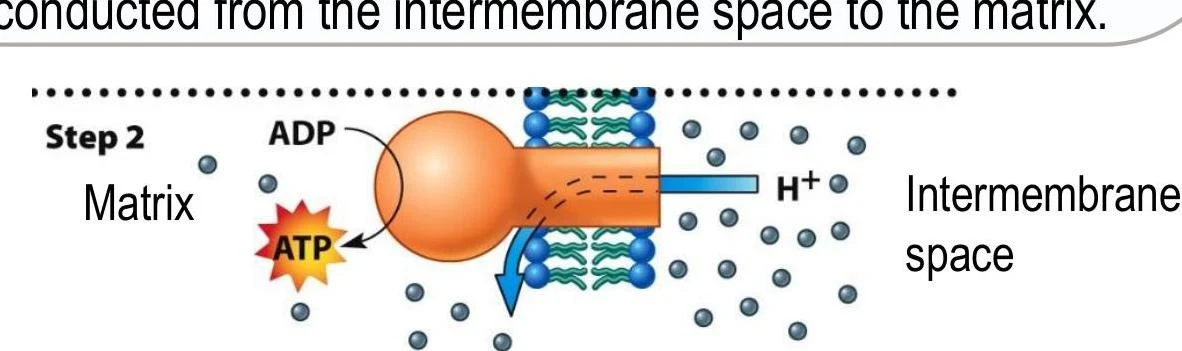
The potential energy stored in the proton gradient is harvested by ATP synthase (Complex V). This enzyme acts like a molecular turbine. Protons flow back into the matrix through a channel in the F0 portion of the enzyme, causing the F0 ring to rotate. This mechanical rotation is transmitted to the F1 catalytic subunit, which drives the phosphorylation of ADP to produce ATP.
Diagram illustrating the process of ATP synthesis from ADP and phosphate, involving the movement of protons (H+) across a membrane.
Summary of ATP Yield
The total amount of ATP generated from the complete aerobic oxidation of one glucose molecule is approximately 30 to 32 ATP. This yield is a combination of ATP produced directly via substrate-level phosphorylation in glycolysis and the citric acid cycle, and the much larger amount produced via oxidative phosphorylation.
Process
Direct ATP/GTP
Reduced Coenzymes
Estimated ATP from Coenzymes
Glycolysis
2 ATP
2 NADH
3 or 5 ATP
Pyruvate Oxidation
0
2 NADH
5 ATP
Citric Acid Cycle
2 GTP
6 NADH, 2 FADH2
15 NADH + 3 FADH2
Total
30–32 ATP
Note on NADH Transport:
NADH produced during glycolysis in the cytosol cannot cross the inner mitochondrial membrane directly. It must use specific shuttle mechanisms to transfer its electrons into the mitochondria, which is why the ATP yield from cytosolic NADH can vary (yielding either 3 or 5 ATP).
Keep reading for free.
Create an account to finish this reading and make it part of your study routine.