This guide explains the physiological challenges of exercising in hot environments and details the adaptations and protocols for heat acclimatization training to optimize performance and prevent heat-related illness.
For aerobic endurance athletes, competing in hot environments presents a significant physiological challenge. Without proper preparation, the body struggles to manage the thermal load, leading to increased perceived exertion, elevated core and skin temperatures, and a higher risk of fatigue or heat-related illness. To mitigate these risks and optimize performance, athletes must undergo heat acclimatization training—a process of intentional heat exposure designed to trigger specific physiological adaptations that improve thermoregulation and cardiovascular stability.
This illustration compares the physiological responses of an unacclimatized person and an acclimatized person to heat-induced dehydration during exercise, highlighting differences in sweat production, blood volume, and heart rate.
The Physiological Challenge of Heat
When exercising in heat, the body's primary goal is to maintain a stable internal temperature through thermoregulation. However, high ambient temperatures interfere with the body's ability to dissipate heat, leading to several critical issues:
Elevated Temperatures: Both core and skin temperatures rise more rapidly during exercise.
Sweating Loss and Dehydration: To cool down, the body increases its sweat rate. While necessary, excessive sweating loss can lead to a significant decrease in blood volume.
Cardiovascular Strain: As blood volume decreases due to sweating, the heart must work harder to maintain cardiac output and deliver oxygen to working muscles, leading to an increased exercise heart rate (HR) at a given intensity.
Electrolyte Imbalance: Increased sweating also increases the risk of losing essential electrolytes, which are vital for neuromuscular function.
Physiological Adaptations to Heat
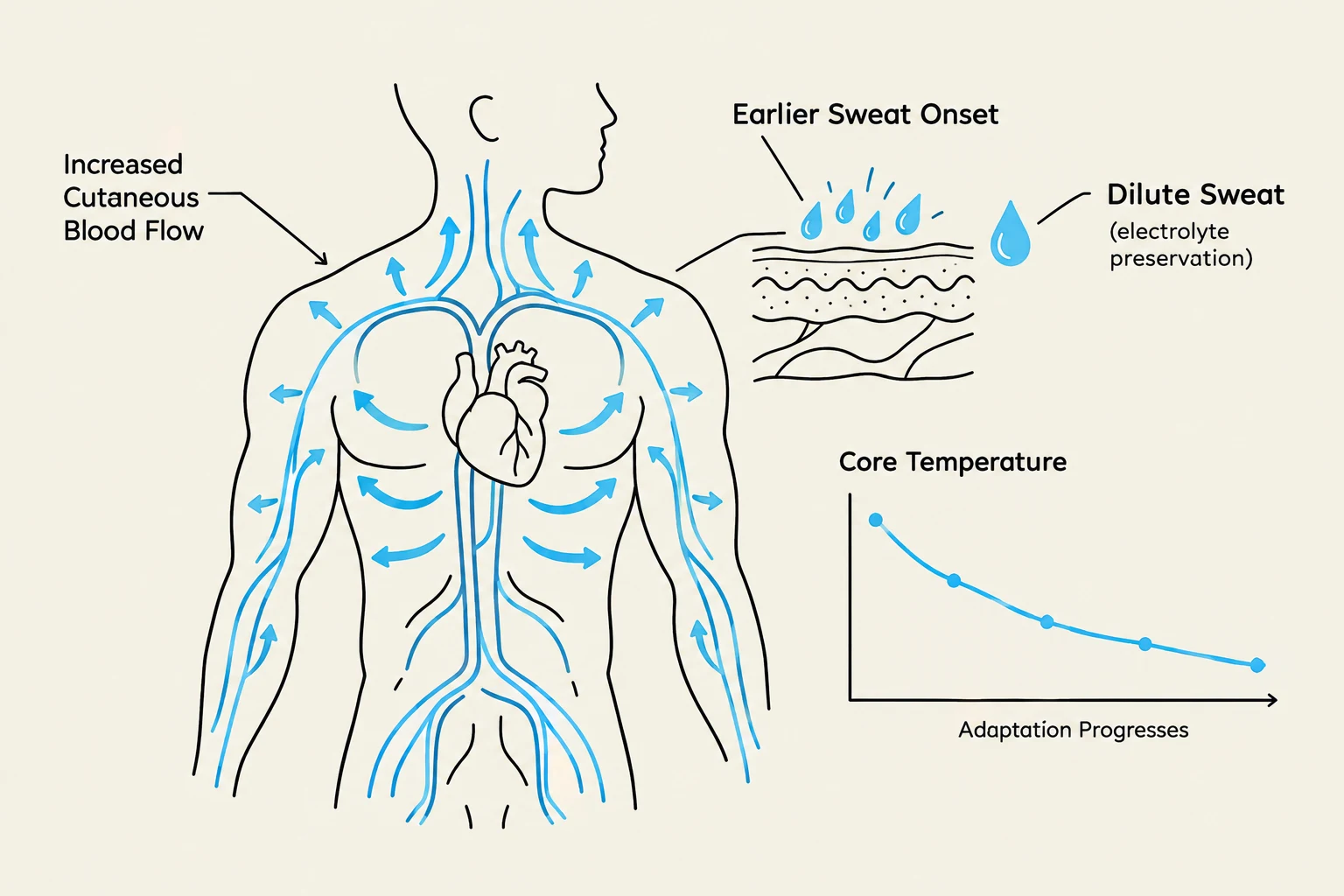
This illustration depicts the physiological responses to heat adaptation, including increased cutaneous blood flow, earlier sweat onset, and dilute sweat for electrolyte preservation, alongside a graph showing core temperature decreasing as adaptation progresses.
Successful heat acclimatization results in a suite of adaptations that allow the athlete to perform more efficiently under thermal stress. These adaptations focus on improving heat dissipation and protecting the cardiovascular system:
Increased Blood and Plasma Volume: One of the most critical adaptations is the expansion of plasma volume. This supports cardiovascular stability by providing more fluid to maintain blood pressure and support both muscle perfusion and skin blood flow.
Enhanced Thermoregulation: The body becomes more efficient at moving heat from the core to the surface. This is achieved through improved cutaneous (skin) blood flow and increased skin sensitivity.
Optimized Sweating Mechanisms: Acclimatized athletes experience an earlier onset of sweating (occurring at a lower body temperature) and an increased sweat rate. Crucially, the sweat produced becomes more dilute, which helps preserve electrolytes, and the increased volume provides more efficient evaporative cooling.
Reduced Physiological Strain: The cumulative effect of these changes is a lower core and skin temperature and a reduced exercise heart rate for any given workload.
Exam Tip: When discussing heat acclimatization, remember that the primary goal is to reduce "physiological strain." This is characterized by lower core/skin temperatures and a lower heart rate at a submaximal workload.
Acclimatization Protocols and Duration
The depth and effectiveness of heat adaptation are heavily dependent on the duration of heat exposure. Protocols are generally categorized into three timeframes:
Short-term: Less than 7 days.
Medium-term: 8–14 days. It is important to note that most significant adaptations occur within the first 4–6 days of this period. For those following a 10–14 day protocol, missing 2–3 days does not significantly impair the overall adaptation.
Long-term: 15 days or more.
To ensure safety and efficacy, training sessions should typically last between 60–90 minutes. Athletes should build intensity slowly, remain strictly hydrated, and have access to cooling equipment to prevent heat illness.
Training Strategies for Competition Readiness
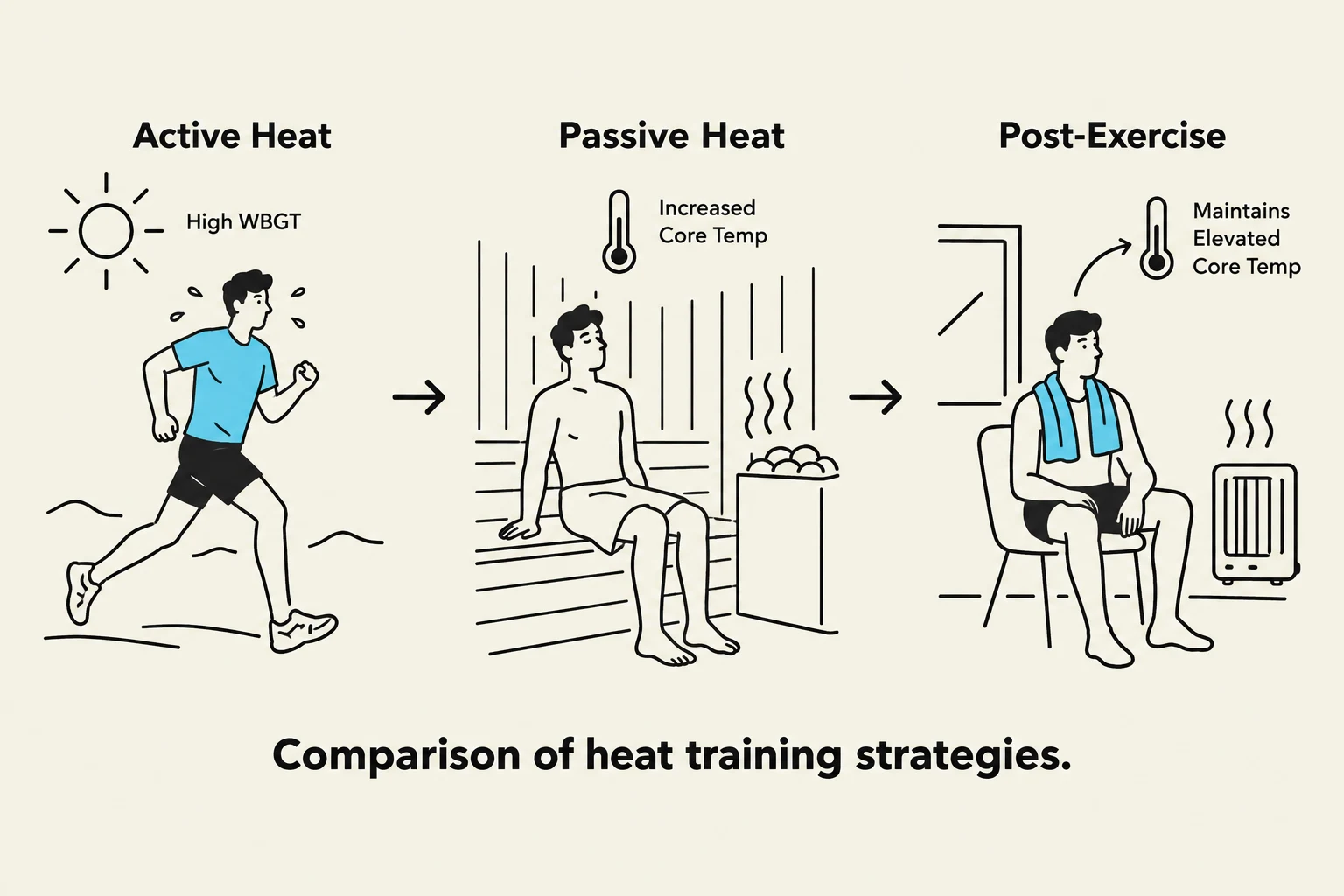
Comparison of heat training strategies: active heat (running in high WBGT), passive heat (sauna with increased core temperature), and post-exercise (maintaining elevated core temperature).
To prepare for a specific competition, athletes should ideally begin practicing in the heat months in advance. There are several evidence-based methods to implement this:
1. Heat Events
The most direct method is performing practice sessions in the heat. A common guideline for safe training is to ensure the wet-bulb globe temperature (WBGT) is ≤30∘C (or ≤86∘F).
2. Gradual Progression and Passive Exposure
Athletes do not have to jump immediately into high-intensity heat sessions. A gradual progression can involve:
Starting with reduced duration or intensity.
Combining active exercise with passive heat exposure, such as using a sauna or hot-water immersion.
3. Post-Exercise Passive Heat
Another effective strategy is utilizing 30 minutes of passive heat exposure immediately following an exercise session. This helps to maintain or elevate the core temperature and can further stimulate the sweat rate, aiding the acclimatization process.
Strategy
Method
Primary Benefit
Active Heat
Training in high WBGT environments
Mimics competition conditions
Passive Heat
Sauna or hot-water immersion
Increases core temp with less metabolic cost
Post-Exercise
30 min passive heat after training
Maintains elevated core temp and sweat rate
Monitoring Progress
How does an athlete know if the training is working? While VO2 max monitoring is the most accurate, it is often unavailable in field settings. Instead, athletes should monitor "signs of adaptation," such as:
Improved perceived fitness levels.
A lower exercise heart rate when performing the same workload as previous sessions.
An increased sweat rate and a more rapid cooling period post-exercise.
Safety Warning: Always monitor for signs of heat illness during acclimatization. If an athlete experiences extreme fatigue, dizziness, or nausea, they should cease training immediately and seek cooling.
Keep reading for free.
Create an account to finish this reading and make it part of your study routine.