Acute Coronary Syndrome and Coronary Revascularization Procedures
This content explains Acute Coronary Syndrome (ACS), its management including pharmacological interventions and thrombolytic therapy, and coronary revascularization procedures like Percutaneous Coronary Intervention (PCI) and Coronary Artery Bypass Graft (CABG) surgery.
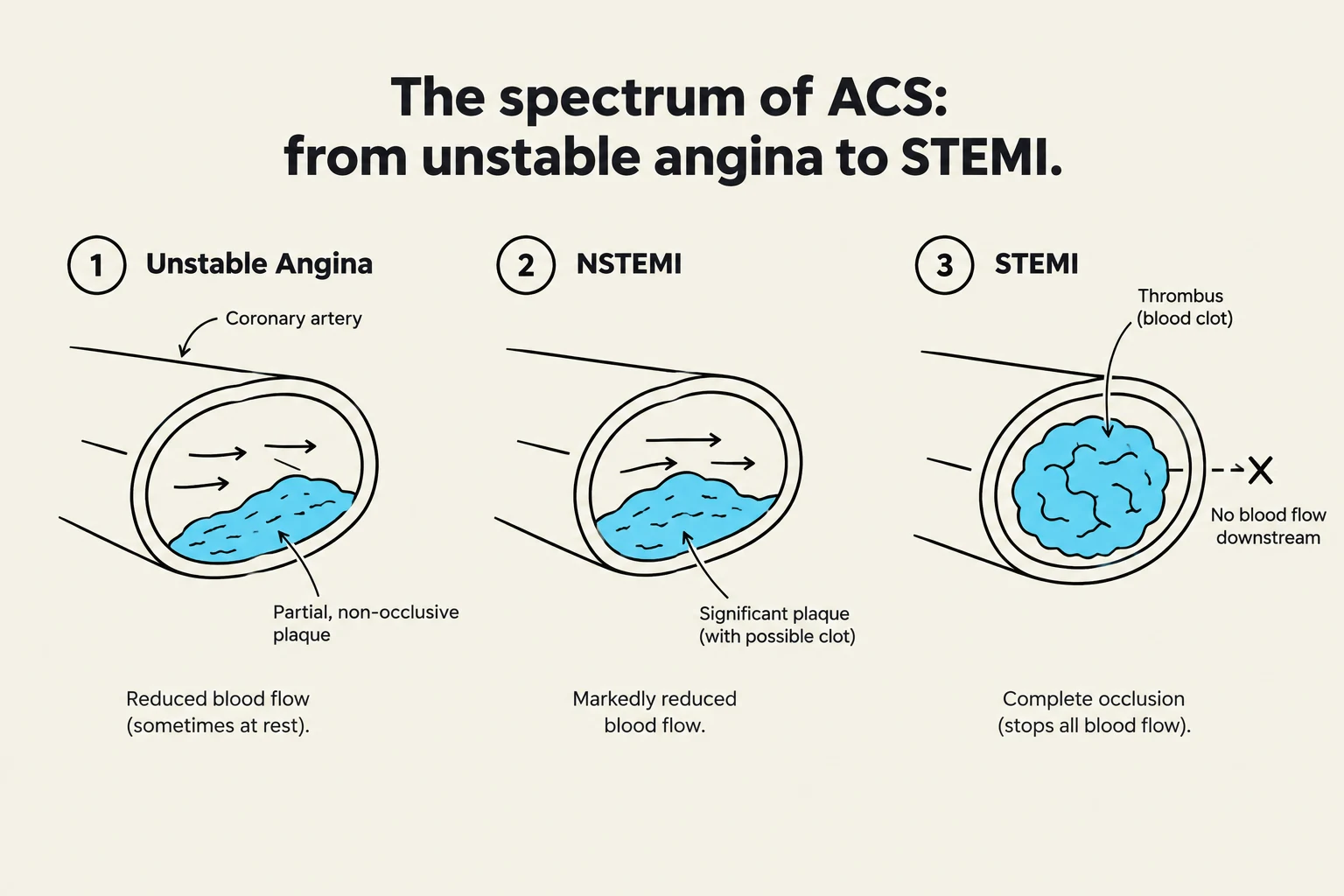
Acute Coronary Syndrome (ACS) represents a spectrum of clinical conditions—including unstable angina (UA), NSTEMI, and STEMI—that all involve myocardial ischemia. Because the underlying pathophysiology involves the abrupt stoppage of blood flow, often due to an occlusive thrombus, management is a race against time. In the clinical setting, the guiding principle is "time is muscle"; the faster blood flow is restored, the more myocardial tissue can be salvaged.
This diagram illustrates the spectrum of acute coronary syndrome (ACS), showing the progression from unstable angina with partial plaque to NSTEMI with significant plaque and possible clot, and finally to STEMI with a complete blockage of blood flow due to a thrombus.
Acute Coronary Syndrome (ACS) Implementations
When a patient presents with symptoms of ACS—such as substernal chest pain, shortness of breath, diaphoresis, or a "feeling of doom"—immediate stabilization is required. Initial nursing and medical implementations focus on decreasing myocardial oxygen demand and maintaining perfusion.
Key immediate actions include:
Obtaining a 12-lead EKG: This is critical to determine the location and size of the infarction and to differentiate between STEMI and NSTEMI.
Establishing IV Access: Necessary for the rapid administration of emergency medications.
Pharmacological Interventions
Medications are categorized by their mechanism of action to prevent further clotting and reduce the workload on the heart:
Anti-platelets: Drugs such as ASA (Aspirin) and Plavix are used to prevent further platelet aggregation.
Nitroglycerin (NTG): Administered sublingually or via IV to promote vasodilation. If the patient responds to sublingual doses, long-acting versions (such as an IV continuous infusion or paste) are often required.
Beta Blockers: These are typically administered within 24 hours to reduce heart rate and oxygen demand.
Anti-coagulants: Medications like Heparin or LMW Heparin (Lovenox) are used to prevent clot propagation, especially if the patient is not immediately heading to the catheterization lab.
Thrombolytic Therapy
Thrombolytic (fibrinolytic) therapy, using agents such as Retavase or TNKase, is a specific intervention reserved for STEMI patients. This is primarily utilized in facilities that do not have immediate access to cardiac catheterization resources.
Thrombolytics must be administered IV, ideally within 30 minutes of arrival at the Emergency Department. The primary indicator of success for this therapy is the return of the ST segment to baseline on the EKG.
Exam Tip: If a question asks which patient is a candidate for thrombolytic therapy, look for the patient with an ST-elevation myocardial infarction (STEMI) who is in a facility without immediate PCI capabilities.
Coronary Revascularization Procedures
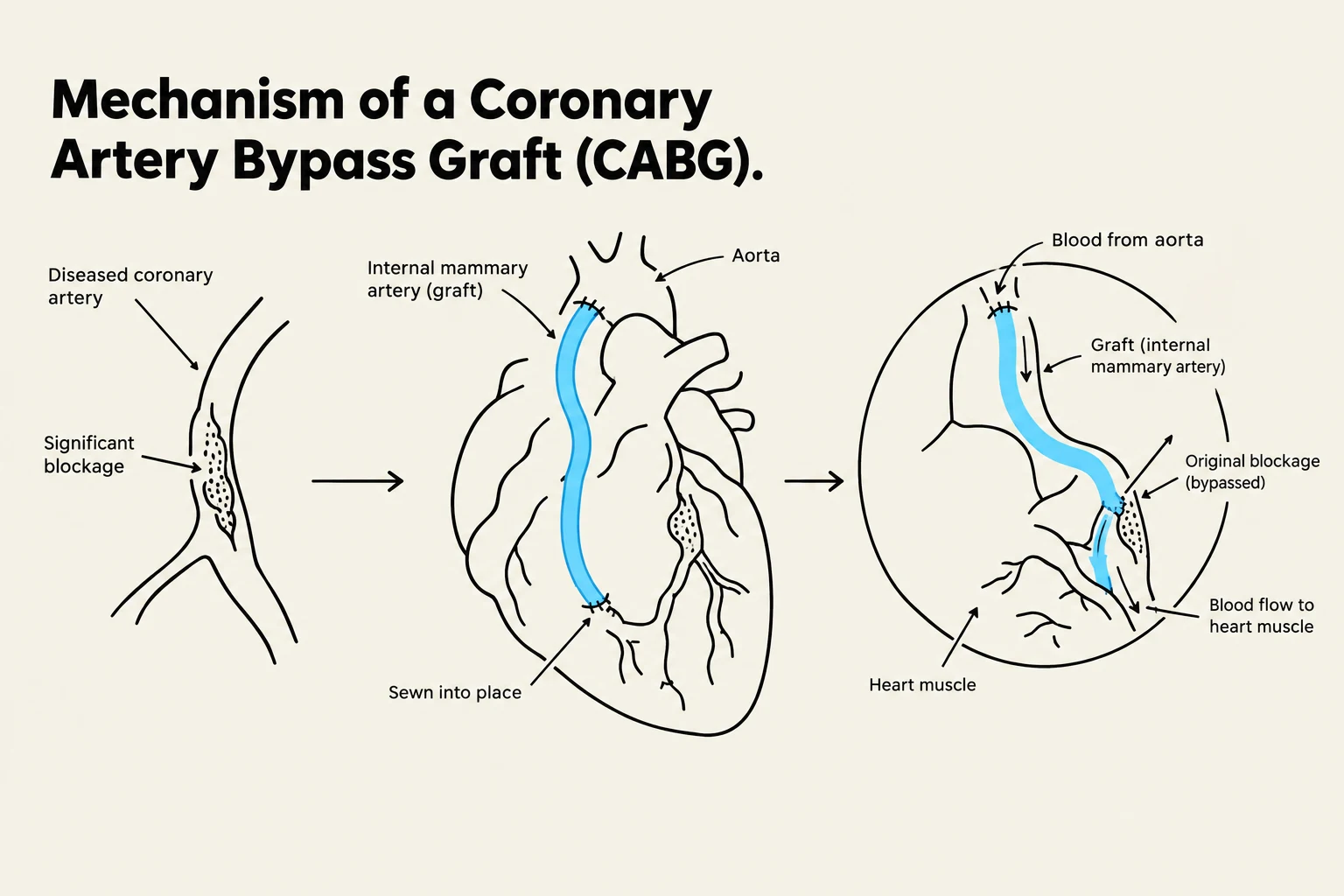
Diagram illustrating the mechanism of a Coronary Artery Bypass Graft (CABG) procedure, showing a diseased coronary artery with a blockage, the placement of an internal mammary artery graft, and the resulting bypass of the blockage to restore blood flow to the heart muscle.
When medications and thrombolytics are insufficient, or when a patient has significant multi-vessel disease, invasive revascularization is required to restore blood flow.
Cardiac Catheterization and Angiography
Cardiac catheterization serves a dual purpose: diagnostic (visualizing the location and severity of blockages) and interventional (opening the blockages). During the procedure, a catheter is inserted (often via the femoral artery) and guided through the aorta into the coronary arteries.
img-0.jpegFigure 1: Path of catheter into the coronary artery via the femoral artery.
Percutaneous Coronary Intervention (PCI)
PCI is the primary interventional method used to increase myocardial blood flow and salvage muscle. It is often preferred over surgical options like CABG because it uses local rather than general anesthesia, results in shorter hospital stays (1–3 days), and allows for a much faster return to work.
PCI typically involves two main steps:
Percutaneous Transluminal Coronary Angioplasty (PTCA): A balloon is inflated at the site of the atheroma (plaque) to compress the blockage and stretch the artery open.
Coronary Artery Stent Placement: An intracoronary device (stent) is inserted after the angioplasty to act as a scaffold, maintaining vessel patency and preventing the artery from collapsing.
img-1.jpegFigure 2: The process of balloon inflation to crack the atheroma.
Complications of PCI
While highly effective, PCI carries risks, including:
Arterial Dissection: A tear in the artery wall that can lead to rupture, cardiac tamponade, or sudden occlusion.
Restenosis: The re-narrowing of the artery at the site of the intervention.
Bleeding: Specifically at the catheter insertion site.
Nursing Interventions for PCI
Post-procedure nursing care is focused on preventing complications and monitoring for the return of ischemia. Key interventions include:
Monitoring for recurrent angina: Pain may indicate that the vessel has re-occluded.
Neurovascular assessments: Checking pulses and sensation distal to the insertion site.
Site Inspection: Frequent monitoring of the puncture site for bleeding or hematoma formation.
Vital Signs and Rhythm: Continuous monitoring of blood pressure and cardiac rhythm.
Activity: Maintaining bed rest per institutional policy.
Surgical Revascularization (CABG)
In cases where PCI is not feasible—such as long, tortuous blockages, left main coronary artery disease, or three-vessel disease—Coronary Artery Bypass Graft (CABG) surgery is indicated.
CABG involves using a healthy vessel (a graft) to bypass the diseased segment of the artery. Common graft sources include the internal mammary artery (IMA), the saphenous vein, or the radial artery.
Types of CABG
Traditional CABG: Requires a sternotomy and the use of a Cardiopulmonary Bypass (CPB) machine (heart-lung machine) to keep the patient alive while the heart is stopped.
Off-Pump CABG (OPCAB): Performed while the heart continues to beat, avoiding the use of the CPB machine.
Minimally Invasive Direct CABG (MIDCAB): A less invasive approach that does not require a full sternotomy.
Note on Grafts: The internal mammary artery is the most common artery used for bypass grafts due to its efficacy.
Summary Table: PCI vs. CABG
Feature
PCI
CABG
Anesthesia
Local
General
Hospital Stay
1–3 days
4–6 days (standard)
Recovery Time
5–7 days
6–8 weeks
Invasiveness
Low (Percutaneous)
High (Surgical)
Keep reading for free.
Create an account to finish this reading and make it part of your study routine.