


In the study of microbiology and cell biology, understanding how molecules cross the cell membrane is fundamental. While passive diffusion allows molecules to move down their concentration gradient without energy expenditure, cells often need to move substances against their concentration gradient—from an area of low concentration to an area of high concentration. This process is known as active transport. To achieve this, cells must couple the movement of the solute to an energy source, ensuring that the "uphill" climb of the molecule is powered by a "downhill" flow of energy or ions.
Primary Active Transport: ABC Transporters
The most direct form of active transport is primary active transport, where the energy is derived directly from a chemical reaction, most commonly the hydrolysis of Adenosine Triphosphate (ATP). One of the most significant families of primary transporters is the ATP-Binding Cassette (ABC) transporters.
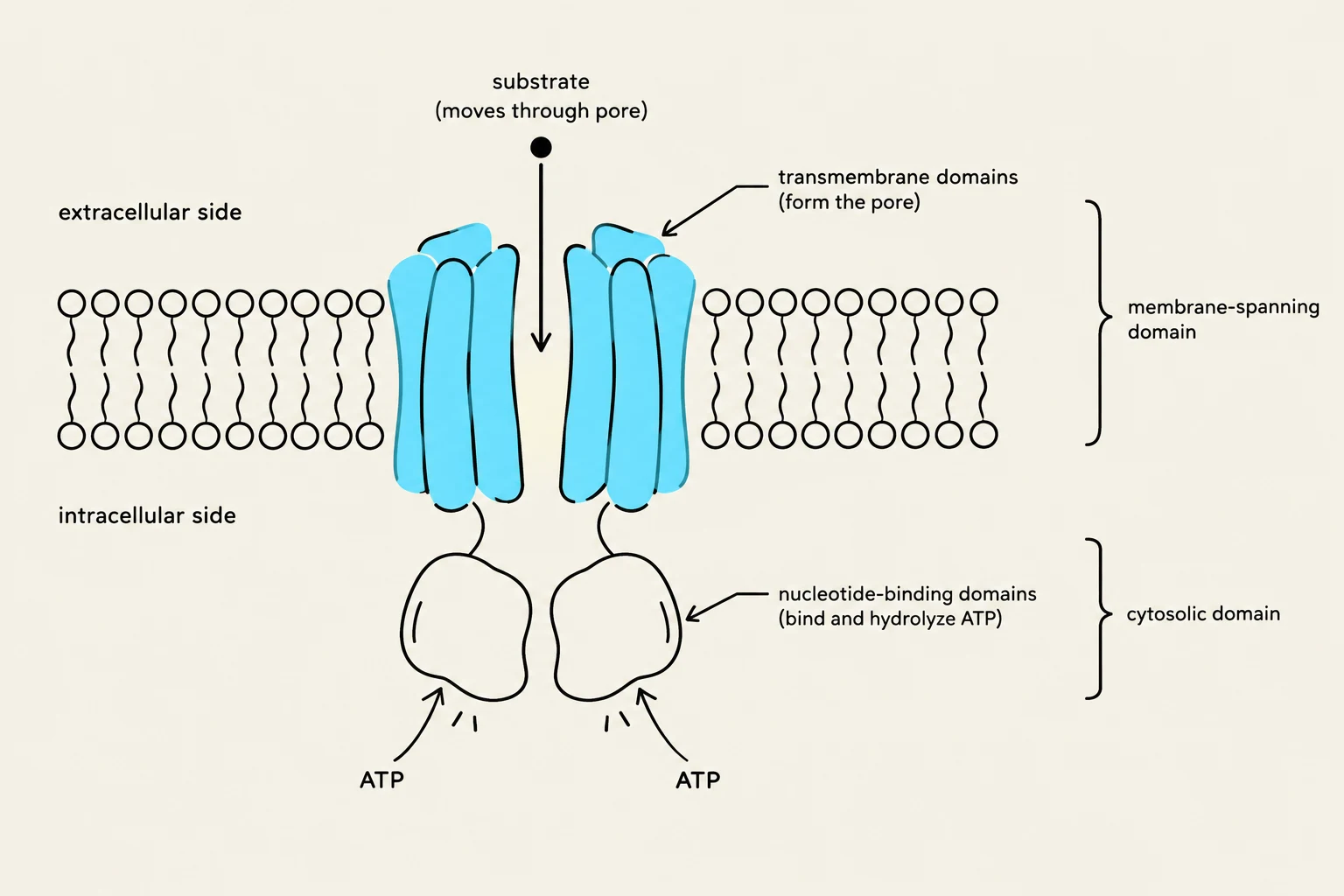
ABC transporters are characterized by their highly conserved structural domains. They typically consist of two transmembrane domains (TMDs) that form the pathway through the membrane and two nucleotide-binding domains (NBDs) located in the cytoplasm. The NBDs are responsible for binding and hydrolyzing ATP.
The mechanism generally follows a cycle:
- The substrate binds to the transporter.
- ATP binds to the NBDs, causing a conformational change in the protein.
- This change "flips" the transporter from an inward-facing to an outward-facing orientation (or vice versa), pushing the substrate across the membrane.
- ATP is hydrolyzed to ADP and inorganic phosphate, triggering the transporter to return to its original state.

Keep reading for free.
Create an account to finish this reading and make it part of your study routine.
Continue reading freeAlready have an account? Log in
Updated