


In the study of neurophysiology, understanding how cells communicate is fundamental. While graded potentials allow for local, variable signaling, the action potential is the primary mechanism for transmitting information rapidly over long distances. These electrical signals are essential for the function of excitable membranes, such as those found in neurons and muscle cells.
The Nature of Action Potentials
Unlike graded potentials, which vary in size based on the strength of the stimulus, action potentials operate on an all-or-none principle. This means that once a stimulus is strong enough to reach a specific threshold voltage, an action potential is triggered with a constant magnitude, regardless of how much extra stimulus is applied.
Because they do not lose strength as they travel along the axon, they are ideal for long-distance communication. However, the "strength" of a stimulus is not lost; instead, it is encoded by the frequency of the action potentials—a stronger stimulus results in a higher frequency of firing.
Exam Tip: Remember the distinction between graded and action potentials. Graded potentials can be summed and lose strength over distance, whereas action potentials are all-or-none, cannot be summed, and maintain their strength during propagation.
The Mechanics of Voltage-Gated Channels
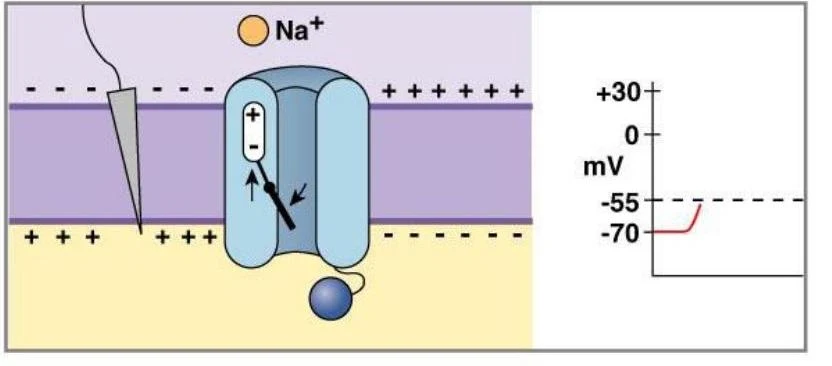
The rapid "spike" of an action potential is driven by the behavior of voltage-gated channels. These channels are unique because they possess two distinct gates that control the flow of sodium ions:
- The Activation Gate: At the resting membrane potential, this gate is closed. When a depolarizing stimulus reaches the threshold, the activation gate opens rapidly, allowing to rush into the cell.
- The Inactivation Gate: This gate acts as a secondary mechanism to stop the flow of ions. Shortly after the activation gate opens, the inactivation gate closes, halting the influx of .

Keep reading for free.
Create an account to finish this reading and make it part of your study routine.
Continue reading freeAlready have an account? Log in
Updated