Have you ever wondered how scientists can tell if a liquid is an acid or a base without tasting it? (And please, never taste a mystery chemical in a lab!) The answer lies in a fascinating group of substances known as acid-base indicators. These are specialized chemical compounds that act as visual messengers, changing their color in response to the concentration of hydrogen ions in a solution. By observing these color shifts, we can determine the pH level of a substance, ranging from highly acidic to highly alkaline.
What is an Indicator?
At its core, an acid-base indicator is typically a weak organic acid or base itself. These molecules possess a unique structural property: they can exist in two different forms—one that is stable in acidic environments and another that is stable in basic environments. Because these two forms have different arrangements of electrons, they absorb and reflect light differently, which our eyes perceive as a change in color.
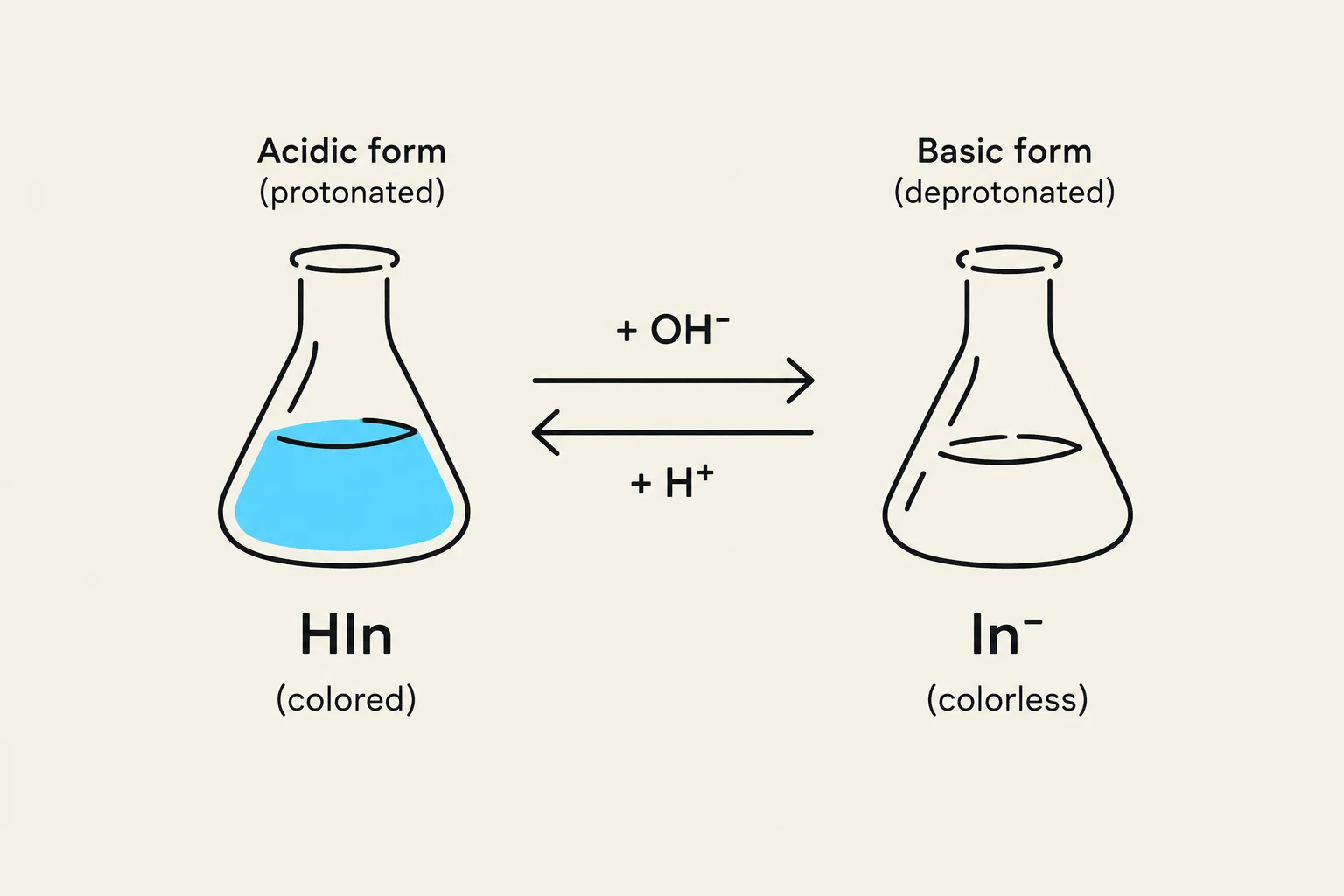
The process is driven by the concentration of hydronium ions (H_3O+) in the solution. When you add an indicator to a liquid, the indicator reacts with the available ions to shift its chemical equilibrium.
This diagram illustrates the equilibrium between the acidic (protonated) and basic (deprotonated) forms of a chemical indicator, showing how it changes color with the addition of hydroxide ions (OH-) or hydrogen ions (H+).
Exam Tip: Remember that an indicator is not just a "test"; it is a chemical species that participates in an equilibrium reaction. If you add a strong acid to the solution, you are increasing the concentration of $H^+$, which pushes the equilibrium toward the acidic form of the indicator.
Common Indicators and Their Color Profiles
In the laboratory, different indicators are used depending on the specific pH range being studied. No single indicator works perfectly for every possible pH value, so chemists often use a "palette" of substances to find the most accurate reading.
1. Litmus Paper
Litmus is one of the oldest and most widely used indicators. It is a natural way to perform a quick, qualitative test to see if a substance is acidic or basic.
In Acidic Solutions: Litmus turns red.
In Basic Solutions: Litmus turns blue.
In Neutral Solutions: It remains purple.
2. Phenolphthalein
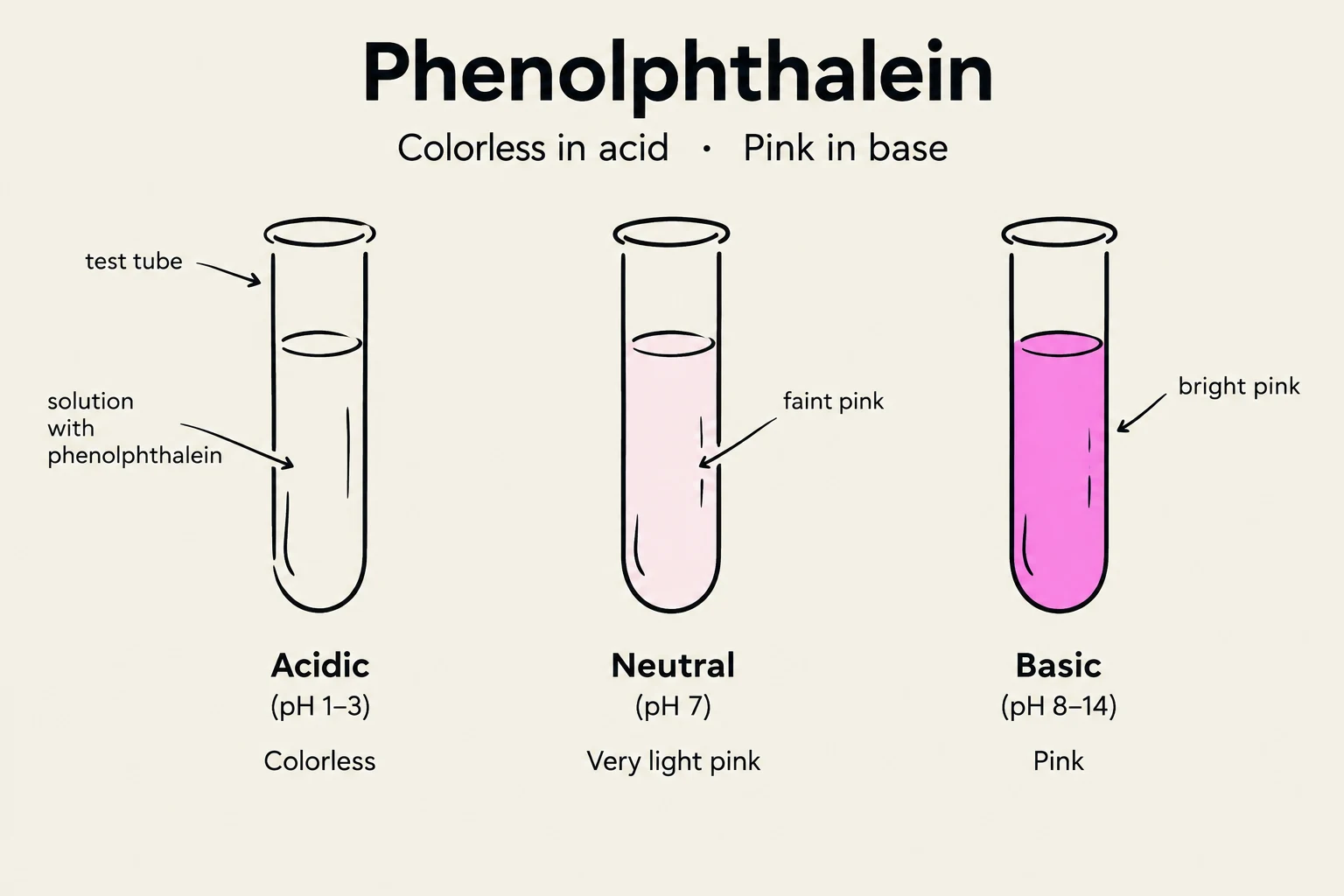
Phenolphthalein is a very common synthetic indicator used in titrations. It is particularly useful because its color change is very dramatic, making it easy to see the exact moment a reaction reaches its endpoint.
In Acidic or Neutral Solutions: It remains colorless.
In Basic Solutions (pH > 8.2): It turns a vibrant pink or magenta.
Phenolphthalein is an indicator that is colorless in acidic solutions and pink in basic solutions. The image shows test tubes with phenolphthalein in acidic, neutral, and basic conditions, illustrating the color changes.
3. Bromothymol Blue (BTB)
Bromothymol Blue is an excellent indicator for observing changes near the neutral point (pH 7). It is frequently used in biological experiments, such as monitoring the respiration of aquatic organisms.
In Acidic Solutions: It turns yellow.
In Neutral Solutions: It appears green.
In Basic Solutions: It turns blue.
The Mathematical Side: The Henderson-Hasselbalch Equation
To understand exactly when an indicator changes color, we look at the relationship between the pH and the $pK_a$ of the indicator. An indicator changes color significantly when the pH of the solution is close to its $pK_a$ value.
The equilibrium can be represented by the following equation:
HIn (color A)⇌H++In− (color B)
The relationship between the pH and the ratio of the two forms is described by the Henderson-Hasselbalch equation:
pH=pKa+log([HIn][In−])
When the concentration of the acidic form [HIn] equals the concentration of the basic form [In−], the log(1) becomes zero, and the pH=pKa. This is the "transition range" where the human eye can most easily detect the color shift.
This graph illustrates how the absorbance of light by an acid-base indicator changes with pH. The two curves represent the indicator in its acid and base forms at different wavelengths. As pH changes, the indicator shifts between these forms, altering the observed color.
Summary Table for Quick Reference
For students preparing for practical exams, memorizing the following table is highly recommended:
Indicator
Color in Acid
Color in Base
pH Range (approx.)
Litmus
Red
Blue
4.5 – 8.3
Phenolphthalein
Colorless
Pink/Magenta
8.2 – 10.0
Bromothymol Blue
Yellow
Blue
6.0 – 7.6
Methyl Orange
Red
Yellow
3.1 – 4.4
By selecting the correct indicator, you can transform a colorless liquid into a vivid display of chemical information, allowing for precise control in everything from industrial manufacturing to medical testing.
Keep reading for free.
Create an account to finish this reading and make it part of your study routine.