This reading explains acid-base reactions, neutralization, and the distinction between acid strength and concentration. It covers defining acids and bases using the Brønsted-Lowry definition, strong and weak electrolytes, writing ionic equations (molecular, complete ionic, and net ionic), and stoichiometry of neutraliz
In the study of chemistry, few interactions are as fundamental as the reaction between an acid and a base. These interactions, known as acid-base reactions, are defined by the movement of protons between substances. When these reactions occur in an aqueous solution, they often result in a specific process called neutralization, which transforms reactive ions into stable molecules like water. Understanding these reactions requires a careful distinction between how much of a substance is present and how effectively that substance behaves in a solution.
Defining Acids and Bases
According to the Brønsted-Lowry definition, the classification of a substance depends on its ability to transfer a proton ($H^+$). An acid is defined as a substance that donates a proton, while a base is a substance that accepts a proton.
The behavior of these substances in water is determined by their ability to undergo ionization (for acids) or dissociation (for bases).
Key Distinction: Strength vs. Concentration
It is a common mistake to confuse acid strength with acid concentration.
Strength refers to the extent of ionization: how much of the acid actually breaks apart into ions in water.
Concentration refers to the amount of solute present per unit volume (molarity).
A "dilute" acid can still be "strong" if it ionizes completely.
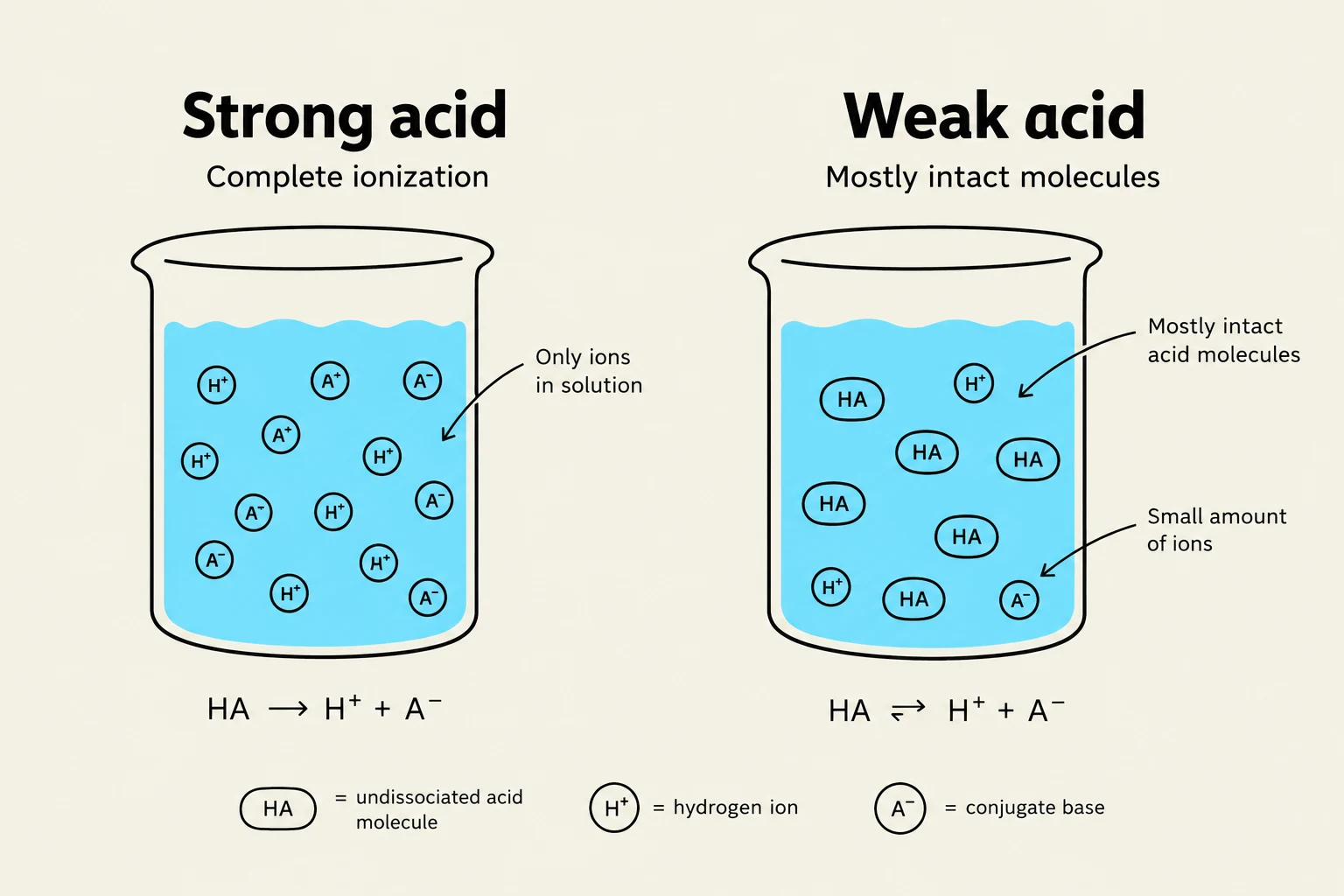
This illustration compares a strong acid, which completely ionizes in solution, with a weak acid, which mostly remains as intact molecules with a small amount of ionization.
Strong and Weak Electrolytes
To predict how a reaction will look on paper, you must first identify whether the reactants are strong or weak.
Strong Acids and Bases
A strong acid ionizes completely in water, meaning every molecule of the acid breaks apart into ions. Similarly, a strong base dissociates completely in water. When writing chemical equations, strong electrolytes must be represented as their constituent ions.
Weak Acids and Bases
A weak acid does not ionize completely; most of the acid remains in its original molecular form in the solution. For example, hydrofluoric acid (HF) is a weak acid. When writing a complete ionic equation for a weak acid, you must keep the molecule intact (e.g., HF(aq)) to represent the particles that are actually predominant in the solution. The same principle applies to weak bases, such as ammonia (NH3), which is kept as a molecule rather than being split into ions.
Writing Ionic Equations
The goal of writing ionic equations is to strip away the "noise" and reveal the actual chemical change occurring. This is done in three distinct steps.
The Balanced Molecular Equation: Write the full formulas for all reactants and products.
The Complete Ionic Equation: Split all strong electrolytes (strong acids, strong bases, and soluble salts) into their respective ions. Keep weak electrolytes and solids intact.
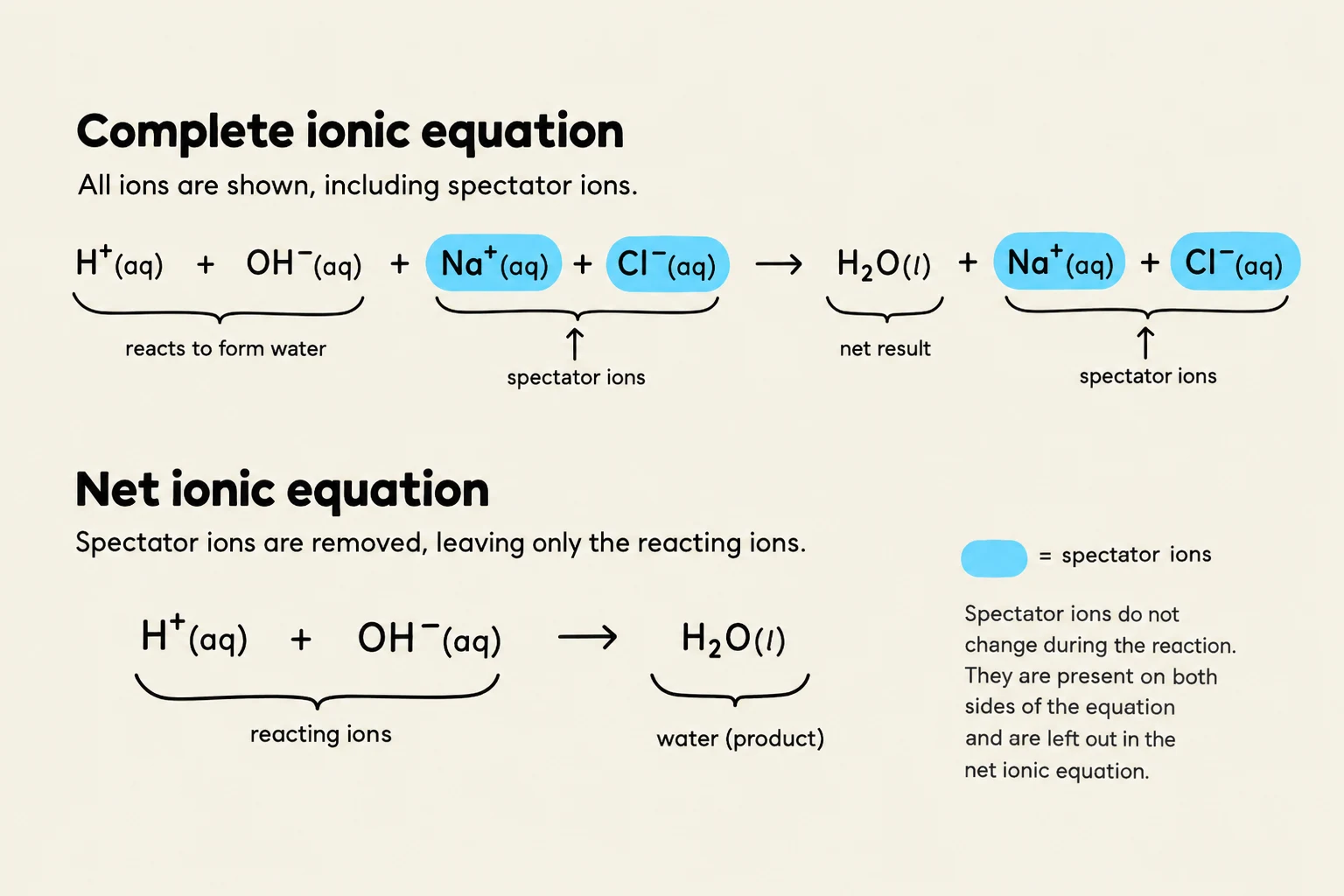
The Net Ionic Equation: Identify and remove the spectator ions. Spectator ions are ions that appear unchanged on both the reactant and product sides of the equation; they do not participate in the actual chemical change.
Example 1: Strong Acid + Strong Base
Consider the reaction between hydrochloric acid (HCl) and sodium hydroxide (NaOH):
Complete Ionic Equation:
Since HCl, NaOH, and NaCl are all strong electrolytes, we split them:
H(aq)++Cl(aq)−+Na(aq)++OH(aq)−→H2O(l)+Na(aq)++Cl(aq)−
Net Ionic Equation:
We remove the spectator ions (Na+ and $Cl^-$) to find the driving force of the reaction:
H(aq)++OH(aq)−→H2O(l)
In a standard neutralization between strong species, the net ionic equation always highlights the formation of liquid water.
This illustration explains the difference between a complete ionic equation and a net ionic equation, highlighting the role of spectator ions in chemical reactions.
Example 2: Weak Acid + Strong Base
If we replace the strong acid with a weak acid like HF, the result changes:
Complete Ionic Equation:
Because HF is weak, we keep it intact. NaOH and NaF are strong, so they split:
HF(aq)+Na(aq)++OH(aq)−→H2O(l)+Na(aq)++F(aq)−
Net Ionic Equation:
Removing the spectator ion (Na+) leaves us with:
HF(aq)+OH(aq)−→H2O(l)+F(aq)−
Note that unlike the strong acid reaction, the weak acid is still present in the net ionic equation.
Complex Reactions: Neutralization and Precipitation
Sometimes, a reaction can have more than one "driving force." A reaction might undergo neutralization (forming water) and precipitation (forming an insoluble solid) simultaneously.
For example, reacting sulfuric acid (H2SO4) with barium hydroxide ($Ba(OH)_2$) produces both water and a solid precipitate:
H2SO4(aq)+Ba(OH)2(aq)→2H2O(l)+BaSO4(s)
In this case, the $H^+$ from the acid and $OH^-$ from the base form water, while the Ba2+ and SO42− ions combine to form the insoluble solid barium sulfate.
Stoichiometry of Neutralization
Once a balanced molecular equation is established, you can use stoichiometry to calculate the quantities of reactants needed or products formed. Stoichiometry relies on the molar ratios provided by the coefficients in the balanced equation.
Worked Example:
If you are given 0.250 moles of magnesium oxide (MgO) and asked to find the mass of water produced when reacting with HCl, you would follow these steps:
Write the balanced equation:MgO(s)+2HCl(aq)→MgCl2(aq)+H2O(l)
Identify the molar ratio: From the equation, 1 mole of MgO produces 1 mole of H2O.
Convert moles to mass:moles of H2O=0.250 mol MgO×(1 mol MgO1 mol H2O)=0.250 mol H2Omass of H2O=0.250 mol×18.02 g/mol=4.505 g
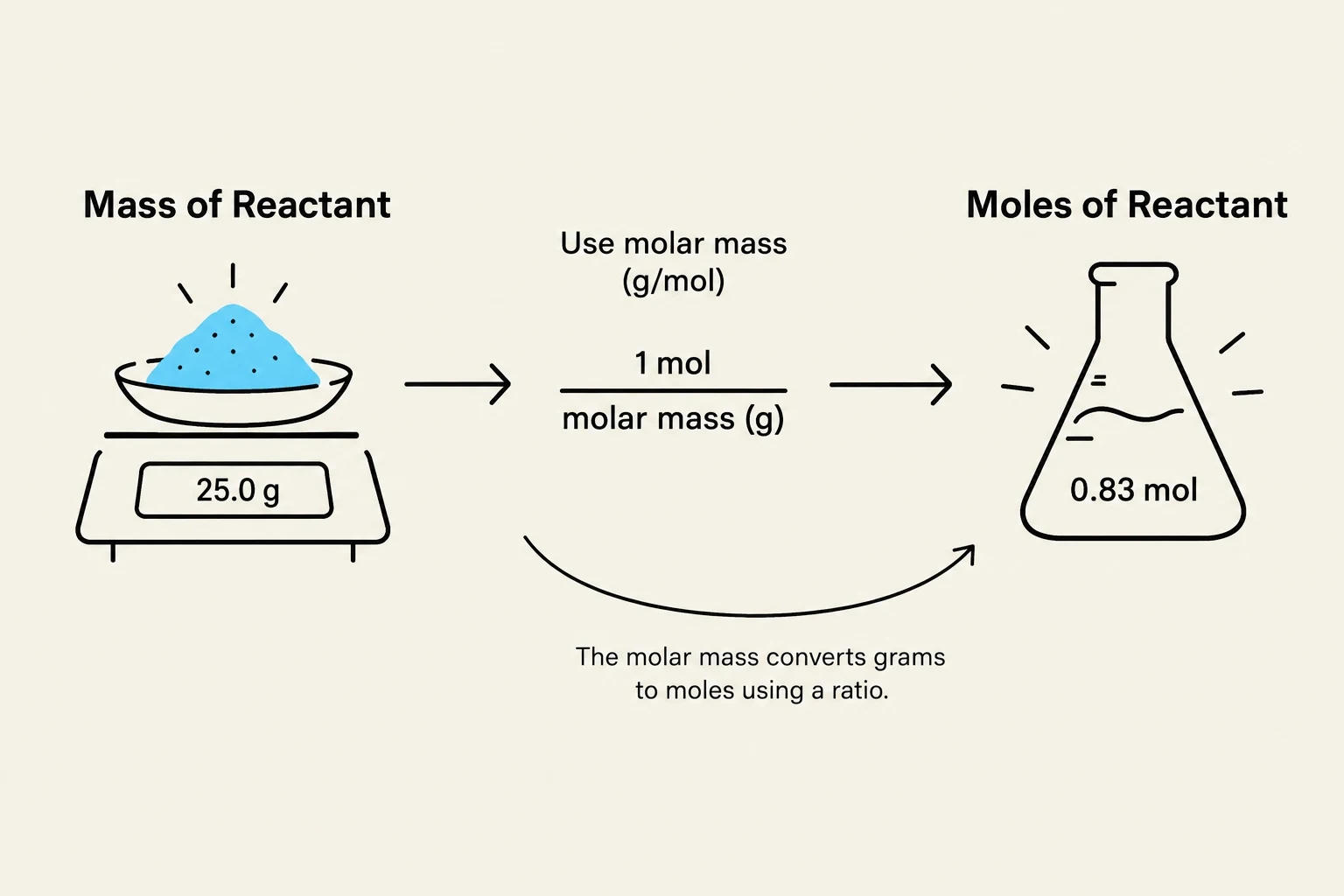
This diagram illustrates the conversion of mass of a reactant to moles of a reactant using molar mass as a conversion factor.
Study Tip: Always ensure your equation is balanced before starting any stoichiometric calculation. A single incorrect coefficient will lead to an incorrect molar ratio and a wrong final answer.
Keep reading for free.
Create an account to finish this reading and make it part of your study routine.